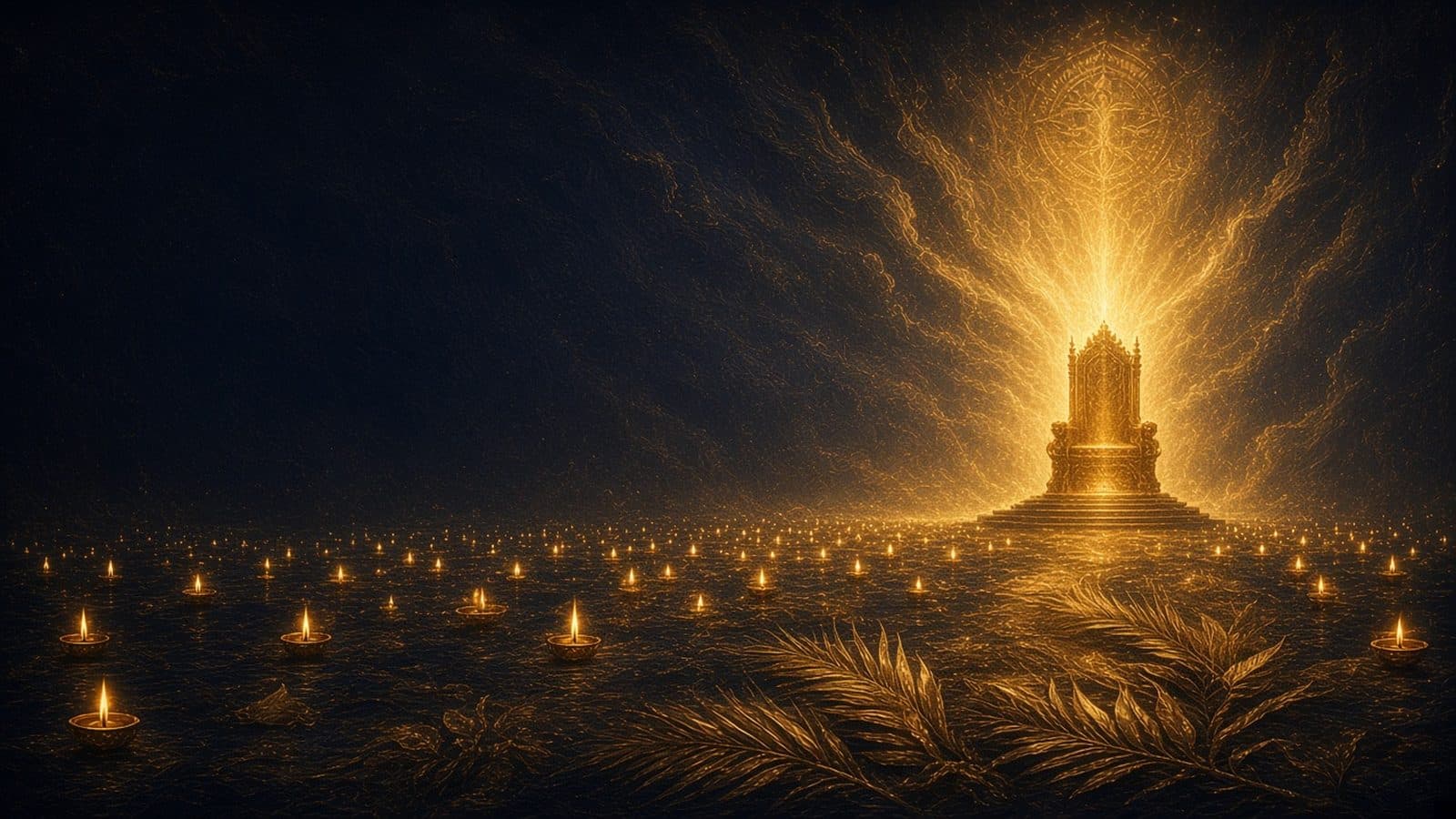
Day 14
The Counted and the Countless
Revelation 7:1-17 14 min read WEB
What is Revelation 7:1-17 about?
In short: In the pause before the seventh seal, John answers the question that ended chapter 6: those who stand on the last day are the ones God has sealed, the ones the Lamb has washed, a multitude no one can number from every nation.
Passage at a glance
- Passage
- Revelation 7:1-17 (WEB)
- Series
- Revelation, day 14 of 37
- Section
- The Seven Seals
- Reading time
- 14 minutes
- Key words
- Sealed (sphragizo), Great tribulation (thlipsis), Spread his tabernacle (skenoo), Salvation (soteria)
- Previous passage
- Revelation 6:9-17
- Next passage
- Revelation 8:1-13
Part A Context
Chapter 6 closed with a question nobody could answer: "who is able to stand?" (6:17, WEB). We expect the seventh seal to open next. Instead John pauses. Chapter 7 is an interlude, a breath held between the sixth and seventh seals, and it answers the question before the story goes on. Revelation does this more than once: when pressure is highest, it stops to show the church what is true.
That mattered to John's first readers. Believers in Asia lived among neighbours, trade guilds, and imperial ceremonies that pressed them to blend in, and many were afraid that faithfulness might mean being lost. John gives them two pictures of the same safety. In the first, God's people are counted, marked, and protected. In the second, they are a crowd too large to count, standing in white before the Lamb. What does God do with his people in the storm? He marks them, he keeps them, and he brings them home.
Part A Explanation
7:1-3The winds held back
John sees four angels at "the four corners of the earth," holding "the four winds of the earth, so that no wind would blow on the earth, or on the sea, or on any tree." Corners and winds describe the whole world, and in Zechariah 6:5 the four winds are sent from the Lord of all the earth. Here they are forces of judgment, and for now they are held.
Another angel rises "from the sunrise," carrying "the seal of the living God," and cries out, "Don't harm the earth, neither the sea, nor the trees, until we have sealed the bondservants of our God on their foreheads!" Notice the order: God's servants are marked before the harm is released.
The picture is borrowed from Ezekiel 9:4, where a mark is set on the foreheads of the people who grieve over the sin around them, and from the first Passover, when blood on a doorframe marked a household for rescue. A seal was a signet pressed into wax or clay. It said: this belongs to me. The title "living God" is spoken in a world of lifeless idols.
Does the seal mean believers will escape suffering? No, because the martyrs we met yesterday were God's people. The seal protects something deeper than the body: our belonging to him. Later, the locusts of chapter 9 harm only "those people who don't have God's seal on their foreheads."
7:4-8The twelve tribes, counted
"I heard the number of those who were sealed," says John, "one hundred forty-four thousand, sealed out of every tribe of the children of Israel." Then he lists the tribes, twelve thousand from each.
Who are they? Christians have given three main answers. Some think they are ethnic Israelites, a believing Jewish remnant sealed in a future time of trial, showing that God keeps his promises to Israel. Others think they are the whole church, the true Israel, since the New Testament gives Israel's titles to all who belong to Christ (Galatians 3:29). A third view notices the language of an army: in Numbers 1, God has Israel counted by tribes, "all who are able to go out to war." Many scholars also find the number symbolic, twelve times twelve times a thousand, a picture of completeness with no one missing.
The list itself is full of small surprises. Judah comes first, which suits the Lion of Judah who opened the scroll (5:5). Dan is absent, and Joseph stands in for Ephraim, with Manasseh listed beside him. Many scholars think Dan's absence is connected to the idolatry linked with that tribe in the Old Testament (Judges 18; 1 Kings 12:29), but nobody can be certain. Each tribe receives the same twelve thousand, so there are no first-class members.
Whatever view you hold, the point is plain. God knows his own, counts them, and does not lose a single one.
7:9-12A crowd no one could count
Then the scene changes. "After these things I looked, and behold, a great multitude, which no man could count." John heard a number, and now he sees a crowd. We have seen this move before: in chapter 5 John heard of a Lion and turned to see a Lamb (5:5-6). Some think the 144,000 and the multitude are one people seen from two angles. Others think they are two groups, perhaps Jewish and Gentile believers. Either way, the crowd astonishes.
They come "out of every nation and of all tribes, peoples, and languages." God told Abraham to count the stars, because his offspring would be as many (Genesis 15:5), and promised that all the families of the earth would be blessed through him (Genesis 12:3). Here the promise stands in the open air.
They are "standing before the throne and before the Lamb, dressed in white robes, with palm branches in their hands." Palms were used at the Feast of Tabernacles (Leviticus 23:40) and by the crowd who welcomed Jesus into Jerusalem (John 12:13). This is a victory party. And notice the verb: they are standing, the answer to the question of 6:17.
Their shout is: "Salvation be to our God, who sits on the throne, and to the Lamb!" They do not say, 'We made it.' They credit God. Then angels, elders, and living creatures fall on their faces with a sevenfold song: "Blessing, glory, wisdom, thanksgiving, honor, power, and might."
7:13-14Robes made white in blood
One of the elders asks John a question he already knows the answer to: "These who are arrayed in the white robes, who are they, and from where did they come?" John wisely replies, "My lord, you know." The elder explains: "These are those who came out of the great tribulation. They washed their robes, and made them white in the Lamb's blood."
Hold the paradox. Blood stains, and here it cleans. Only one blood can do that, and the picture takes us back to the opening of the book, where Jesus "washed us from our sins by his blood" (1:5). The multitude does not owe its white robes to its own endurance. Sinners are made clean by the Lamb. Their faithfulness is real, but it is the fruit of that washing, not its source.
The phrase "the great tribulation" is read in different ways. Some believe it is a specific period of unequalled distress shortly before Christ returns (compare Daniel 12:1). Others believe it is the whole span of Christian suffering from the first century onward, and point out that the Greek wording suggests an ongoing stream, people 'coming out' one after another. Many combine the two: tribulation marks the church in every age and peaks at the end. In every reading the multitude suffered, and the Lamb kept them.
7:15-17The tent, the Shepherd, and the tears
The chapter ends with some of the Old Testament's gentlest promises. The multitude is "before the throne of God," serving him "day and night in his temple." And "He who sits on the throne will spread his tabernacle over them." The verb here, skenoo, means to pitch a tent. It is the word John uses in his Gospel when the Word "lived among us" (John 1:14), and it echoes God's promise, "My tent also will be with them" (Ezekiel 37:27). The God who camped among us in Jesus will shelter his people for good.
Then four negatives: "They will never be hungry, neither thirsty any more; neither will the sun beat on them, nor any heat." That echoes Isaiah 49:10. Remember the black horse and its scarce bread in chapter 6? Here the hunger is reversed.
The next verse holds the strangest and loveliest picture in the book: "the Lamb who is in the middle of the throne shepherds them." A Lamb who is also a Shepherd. Jesus said, "The good shepherd lays down his life for the sheep" (John 10:11), and this Shepherd still bears the marks. He leads them "to springs of life-giving waters."
Finally, "God will wipe away every tear from their eyes." That is Isaiah 25:8 again, and we will hear it once more in the closing chapters of the Bible. John lets us glimpse the last scene in the middle of the story.
Key words in Revelation 7:1-17
- Sealed (sphragizo)
- To mark with a signet as a sign of ownership and protection. God's seal does not remove believers from trouble, but it declares that they belong to him and that nothing can separate them from that belonging.
- Great tribulation (thlipsis)
- Thlipsis means pressure or squeezing, the word for the distress believers face for their faith. Whether the phrase points mainly to one final period or to the whole age is debated, but the sufferers all end up in the same place.
- Spread his tabernacle (skenoo)
- To pitch a tent and live there. It is the word behind 'lived among us' in John 1:14, and says that God himself will camp over his people as their shelter and home.
- Salvation (soteria)
- Rescue and wholeness. The multitude cries that it belongs to God and to the Lamb, not to the people who receive it.
Cross references
- Ezekiel 9:4A mark on the foreheads of those who grieve over sin, the pattern behind the seal of God.
- Genesis 15:5Abraham is told to count the stars, because his offspring will be too many to number, which is what John sees.
- Leviticus 23:40Palm branches at the Feast of Tabernacles, a festival of joy that John applies to the multitude.
- Isaiah 49:10No hunger, thirst, or scorching sun for those whom the Lord leads by springs of water.
- John 1:14The Word became flesh and lived among us, the same tent-verb John uses for God sheltering his people.
- Revelation 21:3-4God dwells with his people and wipes away every tear, the final form of the promise glimpsed here.
Part B Three lenses on the text
The Pattern
How the whole Bible speaks here
Look at what happens to John's ears and eyes. In chapter 5 he is told to look at the Lion of Judah, and he turns and sees a Lamb. In chapter 7 he hears a number, 144,000 sealed from the tribes of Israel, and he turns and sees a crowd from every nation. In both places what John hears uses the Old Testament category, a conquering Lion, an enrolled army. What he sees is how that category is fulfilled in Jesus: the Lion wins as a slain Lamb, and the army is a multitude washed in blood.
There is a second pattern in the shape of the book. Chapter 7 pauses between the sixth and seventh seals, and chapters 10 and 11 will pause between the sixth and seventh trumpets. Just before the last of each series, the book says: remember who is being kept.
And there is a deliberate contrast of foreheads. The servants of God are sealed on their foreheads in 7:3. Later, those who follow the beast receive a mark on theirs (13:16).
The Glory
What this shows us of God
The very first thing to see in this chapter is who does the work. An angel carries the seal, but the seal belongs to "the living God." The crowd is not praising themselves for finishing. Their song is "Salvation be to our God." From the first sealing to the last tear, salvation is God's act, and that is exactly what makes it sure.
The winds of judgment are real, and John does not hide them. But look why they wait: the angels are told to hold back until God's servants are sealed. Delay in judgment is patience, and patience is mercy. The cross shows what it costs: robes washed white in blood mean the Lamb's own death in our place, the justice of God satisfied by the love of God.
Notice also where the story ends. The saved do not retire from God into some quiet corner of heaven. They "serve him day and night." Their deepest joy and his greatest honour are one thing: they stand under the shelter of his tent and see him, and nothing else is missing.
The Challenge
What it asks of us
Picture that crowd for a moment, and then picture your church on Sunday. Every nation, tribe, people, and language in one place, and not one of them concerned about who sat next to whom. Do we look anything like that? Often what we call fellowship is mostly the company of people like ourselves.
If this is where history is heading, then it matters what we do with the rest of the week. How many people from different cultures have I had to my table? How many languages have I ever tried to share Jesus in? How much of my giving reaches people who have not yet heard? I ask these as someone who is far too comfortable.
This is not about guilt. The gospel is the thing we have been given to carry, and God has promised that it will arrive in every language. We get to be part of that. And one more question: if the Lamb is shepherding people through tribulation to springs of living water, am I thirsty enough to go to them myself? Some of us have forgotten what thirst feels like.
Part C Daily devotional
Reflection
Think of a small child lost in a crowded place. The panic comes before the tears. Everything is a forest of strange legs, and the one thing the child wants is to be found by someone who knows their name.
That is a little like how it feels to be one person among billions. We worry that we have been missed, or that our faith is too small, or that one day we will drift and be lost. Revelation 7 speaks straight into that fear. God's people are sealed, counted, and kept. Not a single one is overlooked, and not one is lost, because the thing that holds them is not their grip on God but his hand on them.
Then the picture widens, and the crowd is so large that no one can count it. We are known one by one, and we belong to a family larger than we can imagine. The Lamb at the centre of the throne is the Shepherd who leads, and he knows each name.
Today you might feel tired, or small, or far from home. Let those verses carry you. You are sealed, you are part of a countless company, and a hand is going to wipe the tears from your face. Tomorrow the seventh seal opens, and heaven falls silent.
Questions for journaling
- Why do you think God pauses the seals to show John this scene before the next one begins? What do you most need to hear in a pause like that?
- What does it mean for you today that you are sealed, that you belong to God and he is keeping you? Where do you most struggle to believe it?
- The robes are white because they were washed in the Lamb's blood. Where are you still trying to make yourself clean in your own strength?
- Which people from a different background could you welcome, serve, or pray for this week so that the picture of verse 9 becomes a little more visible now?
Prayer
Father, thank you that I am not lost in the crowd. You know your own, and you have sealed us with your name. Thank you, Lord Jesus, that you are both the Lamb and the Shepherd, and that your blood has washed me clean. Forgive me when I try to keep myself, or when I forget the millions you love. Stretch my heart to the nations, give me courage in my tribulation, and keep me until the day you wipe away every tear. To our God who sits on the throne, and to the Lamb, be salvation and praise forever. Amen.
Look up one people group or language community with very little access to the gospel, pray for them by name today, and thank God for the person who first carried the gospel to you.
for the Lamb who is in the middle of the throne shepherds them, and leads them to springs of life-giving waters. And God will wipe away every tear from their eyes.Revelation 7:17 (WEB)
Common questions about Revelation 7:1-17
What is Revelation 7:1-17 about?
In the pause before the seventh seal, John answers the question that ended chapter 6: those who stand on the last day are the ones God has sealed, the ones the Lamb has washed, a multitude no one can number from every nation.
Where does Revelation 7:1-17 fit in the book of Revelation?
Chapter 6 closed with a question nobody could answer: "who is able to stand?" (6:17, WEB). We expect the seventh seal to open next. Instead John pauses. Chapter 7 is an interlude, a breath held between the sixth and seventh seals, and it answers the question before the story goes on. Revelation does this more than once: when pressure is highest, it stops to show the church what is true.
What does “Sealed (sphragizo)” mean in Revelation 7:1-17?
To mark with a signet as a sign of ownership and protection. God's seal does not remove believers from trouble, but it declares that they belong to him and that nothing can separate them from that belonging.
What does “Great tribulation (thlipsis)” mean in Revelation 7:1-17?
Thlipsis means pressure or squeezing, the word for the distress believers face for their faith. Whether the phrase points mainly to one final period or to the whole age is debated, but the sufferers all end up in the same place.
What does “Spread his tabernacle (skenoo)” mean in Revelation 7:1-17?
To pitch a tent and live there. It is the word behind 'lived among us' in John 1:14, and says that God himself will camp over his people as their shelter and home.
How can I apply Revelation 7:1-17 today?
Look up one people group or language community with very little access to the gospel, pray for them by name today, and thank God for the person who first carried the gospel to you.
What is a good memory verse for Revelation 7:1-17?
Revelation 7:17: “for the Lamb who is in the middle of the throne shepherds them, and leads them to springs of life-giving waters. And God will wipe away every tear from their eyes.” (WEB)
Free daily email
The daily study, in your inbox
One passage a day: a careful explanation, three lenses and a short devotional, sent to you by email. Free, and you can stop whenever you like.