Day 15
Silence, Incense, and Fire
Revelation 8:1-13 12 min read WEB
Passage at a glance
- Passage
- Revelation 8:1-13 (WEB)
- Series
- Revelation, day 15 of 37
- Section
- The Seven Trumpets
- Reading time
- 12 minutes
- Previous passage
- Revelation 7:1-17
- Next passage
- Revelation 9:1-21
Part A Context
Yesterday we left the great multitude standing before the throne, with every tear promised to be wiped away. Now the story returns to the seals, and the seventh and last one is opened. After six seals full of horses, martyrs, and shaking mountains, we are ready for the biggest crash of all. Instead there is no sound at all.
Then a new set of seven begins: trumpets. In Israel, trumpets were made from rams' horns or beaten silver. They called the people to assemble, sounded the alarm, led armies into battle, and announced festivals and the coming day of the Lord. The Roman world had trumpets of its own for soldiers and ceremonies, so John's readers knew that a trumpet means something is about to be declared. These seven trumpets are warnings, and they unfold in front of a God who has just been listening to his people pray.
Part A Explanation
8:1-2The hush in heaven
"When he opened the seventh seal, there was silence in heaven for about half an hour" (WEB). After the roar of worship in chapters 4, 5, and 7, this is almost shocking. The singing stops. The creatures are still. Heaven holds its breath.
What does the silence mean? The Old Testament often uses it before God acts. "Let all the earth be silent before him!" says Habakkuk (2:20), and Zephaniah adds, "Be silent at the presence of the Lord Yahweh, for the day of Yahweh is at hand" (1:7). Zechariah says, "Be silent, all flesh, before Yahweh" (2:13). So many readers hear awe before coming judgment. Others suggest the quiet is for prayer, because the next verses are all about prayers, and in Jewish worship the people prayed outside while the incense was offered (Luke 1:10). Still others see a pause of dread, a calm before a storm. These need not compete. The silence may carry all of them.
"About half an hour" should not be treated as a stopwatch. It is long enough to feel. Silence is one of the most honest things a throne room can hold.
Then John sees "the seven angels who stand before God," and "seven trumpets were given to them." Once again the verb is given. The trumpets are issued, not seized. Even the warnings that are about to sound come from the hand of God.
8:3-5Prayers go up, fire comes down
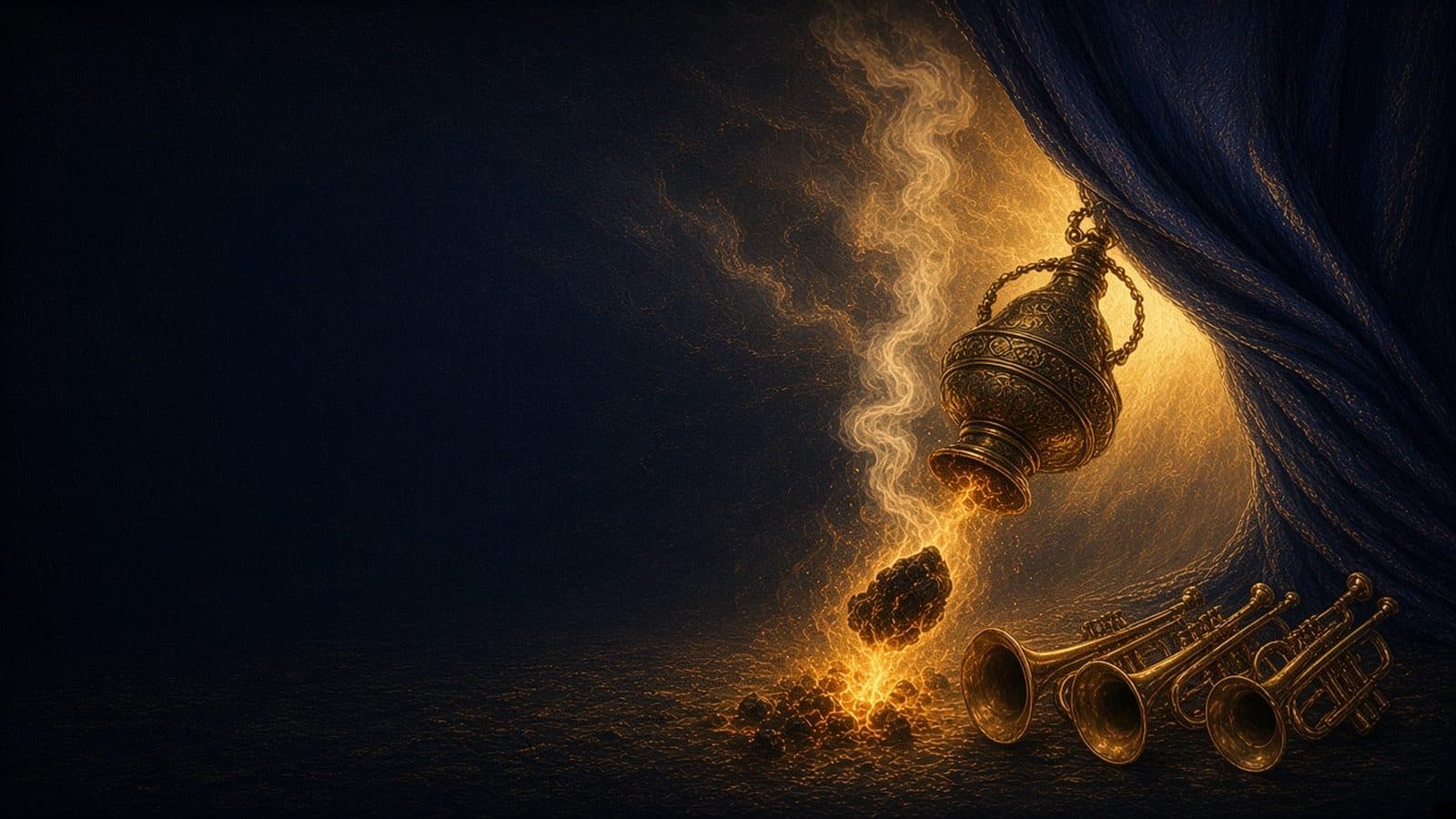
Another angel comes to the golden altar with a censer, a small bowl for burning incense. "Much incense was given to him, that he should add it to the prayers of all the saints." Then "the smoke of the incense, with the prayers of the saints, went up before God out of the angel's hand."
This is one of the most tender pictures in the book. In 5:8, incense was said to be the prayers of the saints. Here, the prayers of weak, ordinary, sometimes stumbling people rise to God mixed with sweetness. The Psalmist had asked, "Let my prayer be set before you like incense" (Psalm 141:2). Some Christians see in this angel a picture of the intercession of Christ, who "lives forever to make intercession" for his people (Hebrews 7:25), though the text itself does not say so. What the text certainly shows is that no prayer is ignored.
Which prayers? Surely the cry from under the altar in 6:10, "How long?" Here is the answer. "The angel took the censer, and he filled it with the fire of the altar, and threw it on the earth. Thunders, sounds, lightnings, and an earthquake followed." The same censer that carried prayers up carries fire down. In Ezekiel 10:2, coals of fire from between the cherubim are scattered over a city under judgment. The thunder and lightning also recall Sinai (Exodus 19:16).
The link is stunning: what God does on earth is connected to what his people ask in prayer.
8:6-9The first two trumpets
The seven angels "prepared themselves to sound," and the trumpets begin. The first brings "hail and fire, mixed with blood" thrown to the earth, so that "one third of the earth was burned up, and one third of the trees were burned up, and all green grass was burned up." At the second trumpet, "something like a great burning mountain was thrown into the sea." One third of the sea turns to blood, one third of sea life dies, and one third of the ships are destroyed.
The Old Testament is everywhere. Hail and fire came upon Egypt in the seventh plague (Exodus 9:23), and the Nile turned to blood (Exodus 7:20). A burning mountain thrown down echoes Jeremiah 51:25, where God says he will make Babylon "a burned mountain." Even the number seven is a hint: at Jericho, seven priests carried seven trumpets, and on the seventh day the walls fell (Joshua 6:4). John seems to be saying that the proud walls of the world's systems come down at the sound of God's trumpet.
Notice the fractions. One third, not all. These are not final destruction, but warnings meant to wake people. Readers have taken them in different ways: some as literal events in a future time, some as symbols of repeated judgments across history, and some as pictures of the same final period seen from a different angle than the seals. Whichever you choose, the fractions tell us that mercy is still open.
8:10-13Wormwood, darkness, and the eagle
The third angel sounds, and "a great star fell from the sky, burning like a torch." It lands on "one third of the rivers, and on the springs of the waters." The name of the star is "Wormwood," a plant with an intensely bitter taste, and "many people died from the waters, because they were made bitter." In the Old Testament, wormwood is a symbol of bitterness and a punishment on idolatry (Jeremiah 9:15; 23:15). Water, the most basic of life's gifts, turns poisonous.
The fourth trumpet strikes the lights of heaven: one third of the sun, moon, and stars is darkened. That recalls the ninth plague of Egypt, a darkness "which may be felt" (Exodus 10:21).
Then John sees an eagle, flying "in mid heaven," crying with a loud voice, "Woe! Woe! Woe for those who dwell on the earth." (Some ancient copies read 'angel' instead of 'eagle.') Three woes are announced for the three trumpets still to come, which will be worse. The phrase "those who dwell on the earth" appeared in the martyrs' prayer in 6:10, and in Revelation it often describes people who are settled in this world's order and have nowhere else to call home.
Notice one more thing: the eagle gives a warning before the worst. God does not ambush. He announces it. That is mercy, even in judgment.
Key words in Revelation 8:1-13
- Trumpet (salpinx)
- A horn that sounded an alarm, summoned Israel, or announced God's presence and judgment. In Revelation the seven trumpets are loud warnings, declared in heaven before they strike the earth.
- Censer (libanotos)
- A small vessel for burning incense. In this passage it carries two things: the prayers of the saints going up and the fire of the altar coming down.
- Wormwood (apsinthos)
- A bitter plant. In the Old Testament it stands for sorrow and for God's judgment on idolatry, and here it poisons the water of life.
- Woe (ouai)
- An exclamation of grief and warning. The eagle's triple cry prepares the reader for the last three trumpets, which are the most severe.
Cross references
- Habakkuk 2:20Let all the earth be silent before the Lord in his holy temple, the reverent hush John hears in heaven.
- Psalm 141:2Prayer rising like incense, the picture behind the censer and the prayers of the saints.
- Ezekiel 10:2Coals of fire from the altar scattered over a city, a model for the angel's fire thrown on the earth.
- Exodus 9:23-25The plague of hail and fire on Egypt, echoed in the first trumpet.
- Joshua 6:4Seven priests with seven trumpets before the walls of Jericho fell.
- Jeremiah 9:15God feeds an unrepentant people with wormwood, the background of the bitter waters.
Part B Three lenses on the text
The Pattern
How the whole Bible speaks here
The trumpets seem to reverse creation. In Genesis 1 God makes the sky, the waters and land, and the lights. The first four trumpets strike the land, the sea, the rivers and springs, and the sun, moon, and stars. Creation is not being abolished here, only shaken, but the order is clear: the world that was made to bless is being struck, section by section, because it has been turned to idols.
Then watch how Egypt is remixed. In Exodus the plagues came in one order: blood, then hail, then locusts, then darkness. John takes the same plagues and shuffles them. Hail and fire, blood in the water, darkness, soon locusts. The Exodus is the pattern for how God rescues his people by judging an empire that enslaves, and John tells his readers that the story is not finished.
Finally look at how the sevens fit. The seventh seal opens, and out of it come the seven trumpets. Many readers think the seventh trumpet will in turn open into the seven bowls (11:15 leads toward chapters 15 and 16). That is like a set of Russian dolls: the last of each series contains the next. The book keeps unfolding from the inside, and Christians differ over whether the three series run one after another or retell the same story with growing intensity.
The Glory
What this shows us of God
There is a surprising order of events in this chapter: first silence, then prayer, then fire. God's judgments are not the outbursts of a distant, bad-tempered ruler. They come after he has listened. The prayers of all the saints, including the ones prayed in confusion and tears, are gathered, mixed with incense given by heaven, and lifted up in an angel's hand. Nothing a believer has ever prayed in faith is lost.
Then God acts, and he does so with restraint. One third, not everything. The warning of the eagle comes before the three worst trumpets. A God who warns, who limits, and who waits is a God whose patience is meant to lead to repentance. His holiness is not negotiable, and his mercy is not exhausted.
Here is where the gospel steadies us. The only reason prayers can rise to a holy God is that someone has made the way. The Son who "lives forever to make intercession" for those who draw near is the reason incense, and not wrath, rises from the altar for the saints. The fire thrown to earth shows what justice looks like. The prayers going up show what grace sounds like. And both are for his glory, and for the joy of those who trust him.
The Challenge
What it asks of us
Put your phone in another room and try to sit still for thirty minutes. Not scrolling, not listening, just sitting. How did that feel? Most of us hear a half hour of silence as a threat, and heaven treats it as an act of worship.
I want to ask, gently, what my prayer life says about what I believe. If prayers are collected, mixed with incense, and carried up in an angel's hand, and if what happens on earth is connected to what is asked, then why do I treat prayer as a quick sentence tacked on before a meal? Why is prayer the first thing I drop when life is busy and the last thing I try when I am worried?
This is not about guilt. It is about wonder. You have an audience with the One on the throne, and he does not lose your words. The people who prayed from under the altar were heard. So are you. Maybe we feel powerless because we do not pray, and we do not pray because we have forgotten that prayers are heard. Today, do something small and real: stop, be quiet, and start.
Part C Daily devotional
Reflection
Do you know the hush in a concert hall just before the conductor lifts his hands? Hundreds of people, all quiet, and no one needs to be told. The silence means that something worth hearing is about to begin.
That is what the half hour in heaven feels like to me. Not empty, but full. The whole court of heaven waits, and then an angel takes up a censer, and John sees something that makes my own prayers feel suddenly important. They are collected. They are mixed with incense. They rise.
So many of my prayers are not beautiful. They are mumbled in the car or whispered at three in the morning, half sentences and half sobs. But in Revelation 8 they do not get thrown away. They are held in an angel's hand and carried to the throne, and the throne responds. I find that unbelievably comforting.
If you are carrying a prayer today that you have said so many times you feel embarrassed to say it again, say it again. It is going up like incense, and it is not forgotten. God hears all of it, and he knows what to do.
Tomorrow, the fifth trumpet blows, and a fallen star is given a key.
Questions for journaling
- What do you think the silence in heaven means, and what would it look like to bring a little of that silence into your own day?
- The prayers of the saints are mixed with incense and carried up. How does that change how you feel about prayers that seem weak or repetitive?
- The judgments are partial, one third, and are announced in advance. What does that reveal about God's heart toward people who have not yet turned to him?
- What is one prayer you have almost stopped praying, and what would it mean to begin again this week?
Prayer
Father, you are in your holy temple, and the earth is quiet before you. Thank you that you hear. Thank you that every prayer your people have prayed is gathered up and brought before you by the hand of the One who ever lives to intercede for us. Forgive me for the times I have prayed too little and doubted that you were listening. Teach me to be still, and to pray with expectation. Keep me from hardening my heart when you warn me, and bring many people to repentance by your kindness. In the name of Jesus, Amen.
Set a timer for ten minutes today, put your phone away, sit quietly before God, and then speak aloud one prayer you have been afraid to pray.
The smoke of the incense, with the prayers of the saints, went up before God out of the angel's hand.Revelation 8:4 (WEB)
Common questions about Revelation 8:1-13
What is Revelation 8:1-13 about?
When the seventh seal opens, heaven goes quiet so that the prayers of God's people can be heard, and the fire that answers them lands on earth as seven trumpets begin to warn a world that has not yet turned back.
Where does Revelation 8:1-13 fit in the book of Revelation?
Yesterday we left the great multitude standing before the throne, with every tear promised to be wiped away. Now the story returns to the seals, and the seventh and last one is opened. After six seals full of horses, martyrs, and shaking mountains, we are ready for the biggest crash of all. Instead there is no sound at all.
What does “Trumpet (salpinx)” mean in Revelation 8:1-13?
A horn that sounded an alarm, summoned Israel, or announced God's presence and judgment. In Revelation the seven trumpets are loud warnings, declared in heaven before they strike the earth.
What does “Censer (libanotos)” mean in Revelation 8:1-13?
A small vessel for burning incense. In this passage it carries two things: the prayers of the saints going up and the fire of the altar coming down.
What does “Wormwood (apsinthos)” mean in Revelation 8:1-13?
A bitter plant. In the Old Testament it stands for sorrow and for God's judgment on idolatry, and here it poisons the water of life.
How can I apply Revelation 8:1-13 today?
Set a timer for ten minutes today, put your phone away, sit quietly before God, and then speak aloud one prayer you have been afraid to pray.
What is a good memory verse for Revelation 8:1-13?
Revelation 8:4: “The smoke of the incense, with the prayers of the saints, went up before God out of the angel's hand.” (WEB)
Free daily email
The daily study, in your inbox
One passage a day: a careful explanation, three lenses and a short devotional, sent to you by email. Free, and you can stop whenever you like.