Day 13
A Cry Under the Altar
Revelation 6:9-17 13 min read WEB
Passage at a glance
- Passage
- Revelation 6:9-17 (WEB)
- Series
- Revelation, day 13 of 37
- Section
- The Seven Seals
- Reading time
- 13 minutes
- Previous passage
- Revelation 6:1-8
- Next passage
- Revelation 7:1-17
Part A Context
Four riders have galloped out, and four seals are open. Now the camera swings away from the horses and looks in two other directions. The fifth seal gives us a view we have not had before: not what is happening to the world, but what the world has done to some of God's people. The sixth seal then lifts our eyes to the edge of the sky itself.
For the churches of Asia this was not abstract. John was on Patmos because of his witness, and the letter to Pergamum mentions Antipas, a faithful witness who was killed there (2:13). Many scholars think pressure on Christians rose and fell from city to city, but the congregations knew of deaths and feared more. Where is God when his people are killed for loving him? John answers with two scenes. In the first, God keeps count of every death and promises a reckoning. In the second, the people who thought they were safe discover that nothing in creation can hide them from the One they ignored.
Part A Explanation
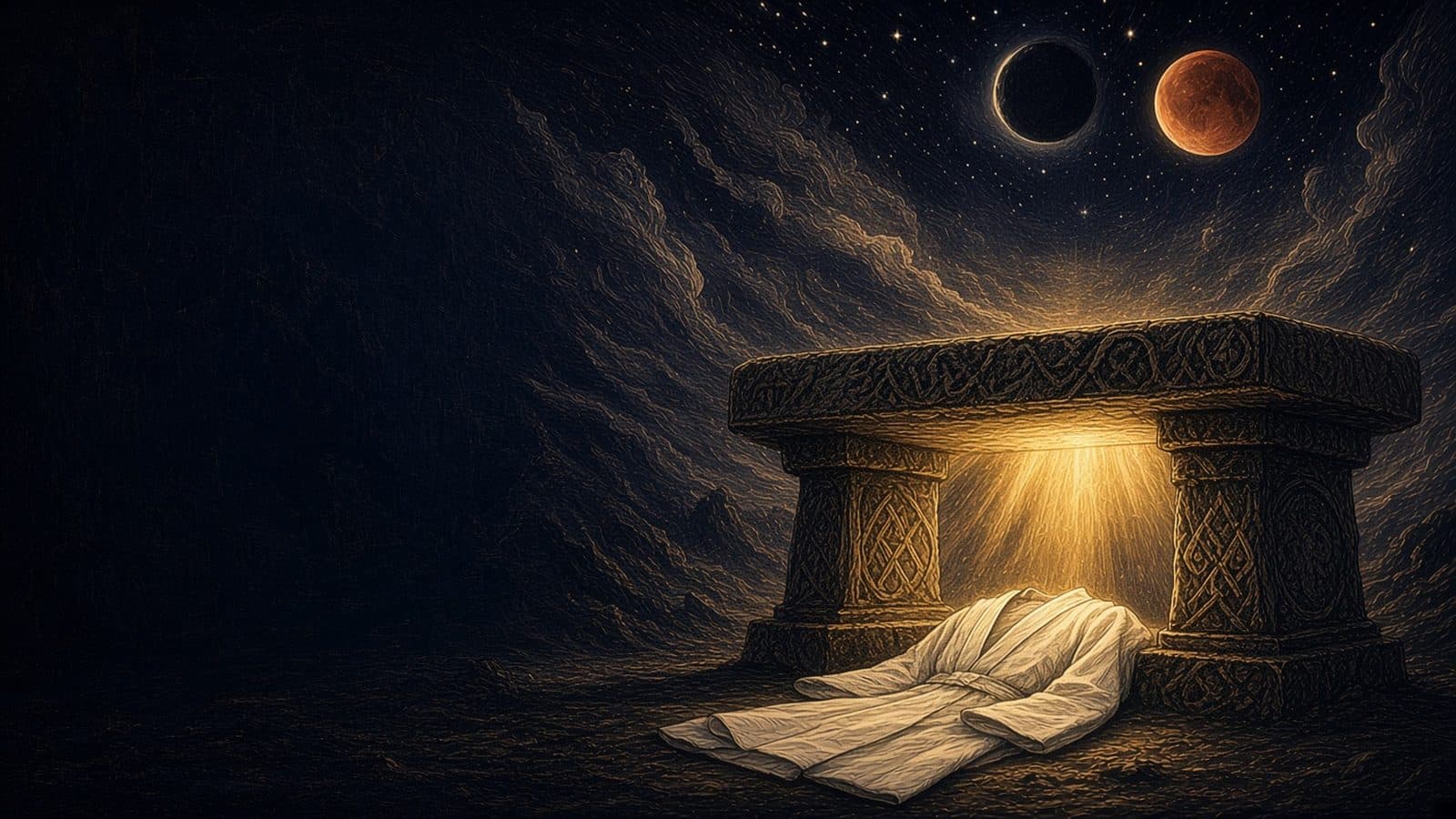
6:9-10Souls beneath the altar
When the fifth seal breaks, no horse appears. John looks "underneath the altar" and sees "the souls of those who had been killed for the Word of God, and for the testimony of the Lamb" (WEB). Their offence is the same as John's own in 1:9: they held on to God's word and Jesus's testimony.
Why beneath an altar? The picture comes from Israel's sacrifices, where the blood of the animal was poured out at the base of the altar (Leviticus 4:7), because "the life of the flesh is in the blood" (Leviticus 17:11). Many scholars think John shows these martyrs as offerings poured out to God, language Paul used of his own life (Philippians 2:17). Whatever the world thinks, their deaths were not waste. They are in the safest place in the universe, under God's own altar.
Then they cry, "How long, Master, the holy and true, until you judge and avenge our blood on those who dwell on the earth?" This is among the oldest prayers in the Bible. Abel's blood "cries to me from the ground" (Genesis 4:10), and the Psalms keep asking, "How long, Yahweh?" (Psalm 13:1). Notice whom they ask. They do not take revenge in their own hands. They bring the case to the One who is "holy and true," which is exactly what Paul urges: "Vengeance belongs to me; I will repay, says the Lord" (Romans 12:19).
6:11A robe and a little while
God's answer has three parts, and each one is tender. First, "A long white robe was given to each of them." Each one. Not one martyr is lost in a crowd. White in Revelation is the colour of victory and purity, and tomorrow we will see how these robes became white.
Second, they are told to "rest yet for a while." The Greek verb is the same one Jesus uses when he says he will give rest to the weary (Matthew 11:28). Their suffering is over. They are not asleep and forgotten, but held. Many Christians see in this scene the comfort that believers who die are with God and at peace while they wait for the final resurrection.
Third, they must wait until their fellow servants, who are also going to be killed, "should complete their course." That is the hard part. The answer to 'How long?' is neither 'never' nor 'right now.' It is 'not yet,' and the delay is not random, because God knows the number. Nobody's death catches him off guard. The same patience that makes the martyrs wait is the patience that keeps the door of mercy open (2 Peter 3:9).
There is no hint of rebuke. Asking God how long is treated as a faithful prayer, and the reply is a robe, not a lecture.
6:12-14The sky comes undone
At the sixth seal the whole stage shakes. There is "a great earthquake." The sun becomes "black as sackcloth made of hair," the rough dark cloth of mourning, and the moon goes red. The stars fall "like a fig tree dropping its unripe figs when it is shaken by a great wind." The sky is "removed like a scroll when it is rolled up," and mountains and islands are moved from their places.
John's first readers would have heard the Old Testament in every line. Joel said, "The sun will be turned into darkness, and the moon into blood" (Joel 2:31), and Isaiah said, "The sky will be rolled up like a scroll" (Isaiah 34:4). Isaiah 13:10 uses a darkened sun and moon for the fall of ancient Babylon, which means this kind of language could describe a judgment inside history as well as the last one.
That is why Christians read the scene in different ways. Some take it as a literal picture of events just before Christ returns. Some take it as the prophets' familiar poetry for God's judgment, repeated through history and reaching its height at the end. Others think the sixth seal already pictures the final day, and that the trumpets and bowls then retell the same period from new angles. These are real differences, and we can hold them gently.
What every view shares is this: the sun, the mountains, and the solid ground are not the final authority. The One who made them can shake them.
6:15-17Hiding from the Lamb
Now watch who runs. John lists seven groups: "the kings of the earth, the princes, the commanding officers, the rich, the strong, and every slave and free person." Seven is complete here, so the list covers the whole social ladder, from the emperor's court to the rowing bench. No rank offers cover.
They hide "in the caves and in the rocks of the mountains," just as Isaiah described: men go "into the caves of the rocks" "from before the terror of Yahweh" (Isaiah 2:19). Hosea has people tell the mountains, "Cover us!" and the hills, "Fall on us!" (Hosea 10:8), and Jesus himself quoted that cry on his way to the cross (Luke 23:30).
Notice what they do not do. They do not pray to God. They speak to rocks. They want to be hidden "from the face of him who sits on the throne, and from the wrath of the Lamb."
That last phrase is startling. A lamb is the gentlest of creatures, yet here he is more dreadful than an earthquake. Many see in this the truth that the One who suffered is also the One who judges, and that rejecting a love that bled is the most serious thing a person can do. The cry ends with a question that echoes Malachi 3:2 and Nahum 1:6: "who is able to stand?" Chapter 6 stops on that question, unanswered. Tomorrow we will hear the answer.
Key words in Revelation 6:9-17
- Avenge (ekdikeo)
- To give justice, to vindicate, to set the record straight. It does not mean personal spite. The martyrs are asking God as Judge to show publicly that their cause was right and evil is not allowed to stand.
- Master (despotes)
- An absolute ruler, the word for the owner of a household. Believers use it for God when they are most aware that their lives are his, and that he alone has the right to settle accounts.
- Altar (thysiasterion)
- The place of sacrifice. Putting the martyrs beneath it draws on the Old Testament picture of poured-out blood, and says their deaths are held in God's hands and counted as costly offerings.
- Wrath of the Lamb (orge)
- Not a loss of temper, but God's settled and righteous opposition to evil. Placing it beside the gentle Lamb tells us that the One who died for sinners is also the One before whom refusal becomes unbearable.
Cross references
- Genesis 4:10Abel's blood cries to God from the ground, the first record of innocent blood calling for justice.
- Psalm 13:1-2The prayer of 'How long?' is a faithful lament in Scripture, spoken by people who still trust God.
- Romans 12:19Believers leave revenge to God, which is exactly how the martyrs pray in Revelation.
- Joel 2:30-31The sun turned to darkness and the moon to blood are the prophets' signs of the coming day of the Lord.
- Isaiah 2:19-21People hide in caves and rocks from the terror of the Lord, the source of the scene in 6:15.
- Luke 23:28-31On the way to the cross Jesus quotes Hosea's cry, 'Fall on us,' and warns that judgment is coming.
Part B Three lenses on the text
The Pattern
How the whole Bible speaks here
Lay the two scenes side by side, and you see two kinds of prayer. Under the altar, people cry up to God: "How long, Master, the holy and true?" Above the earth, people cry down to rocks: "Fall on us, and hide us." Both groups are afraid. Both are asking for relief. But only one of them is talking to a person.
Now follow three little threads. The first is the verb stand. The question of 6:17 is "who is able to stand?" Chapter 7 will answer by using the very same verb: a crowd stands before the throne. The second is face. The unbelieving powerful want to be hidden from the face of the One on the throne. In Exodus 33, Moses is allowed to see only God's back, as God shields him in the cleft of a rock. The last chapter of the Bible turns the story round: "They will see his face" (Revelation 22:4). The people who hide from the face now will not see it, and the people who hide in the Rock now will see it forever. The third is the robe. In the letters, white clothing was promised to those who overcome (3:5). Here it is not earned in front of us at all: it "was given." A robe like that is a gift from the One who has already conquered.
The Glory
What this shows us of God
A world where no one ever answered for murder would be a world with a bad god, or no god at all. The martyrs under the altar are not wrong to want justice, because the longing for justice is a reflection of the God who made them. Their call, "holy and true," appeals to exactly the right attributes. A holy God cannot wave evil away, and a true God cannot pretend it did not happen.
Then comes the hardest phrase: the wrath of the Lamb. Wrath is not a spare part of God's character. It is his holiness meeting what destroys the people he loves. The only reason it does not fall on every one of us is that the Lamb has already stood where wrath falls. At the cross, God's justice and his mercy met in the same body. This means two things at once: the people hiding in the caves have no excuse, and anyone who runs to the Lamb in this life does not have to run from him in the next.
The martyrs also teach us joy. They do not pray for comfort. They pray that the name of the One who is holy would be vindicated. People who want God more than they want ease have already found what the rich and strong in the caves never discovered.
The Challenge
What it asks of us
I will be honest: I rarely pray like the martyrs. My prayers are mostly about my week. I want God to fix my schedule, not to set the world right. Yet here are people who have lost everything and still address God as "Master" and ask him, openly, how long.
So here are some uncomfortable questions. Do I know that believers in many parts of the world still lose jobs, homes, freedom, and sometimes their lives for following Jesus? Do I pray for them, or does the thought slide off me? And what would I do if my own loyalty to the testimony of Jesus cost me something real, say a promotion, a friendship, or my reputation at work? Most of us are not tested to the death. We are tested by whether we will say something awkward at dinner.
This passage does not shame us for being safe. It asks us not to waste it. If there are seven classes of people running to the caves, then there are people around us in every one of them who have never heard that the Lamb will be their refuge if they run to him instead. The robe that the martyrs received is waiting for anyone who belongs to him.
Part C Daily devotional
Reflection
Every one of us has sat in a waiting room. The chairs are uncomfortable, the magazines are old, and time seems to move in a different way. You want someone to call your name. You are afraid of what the answer will be, and you are tired of wondering.
The martyrs under the altar are in a different kind of waiting room, but I notice something about it. Someone has handed each of them a robe. Someone has told them to rest. Nobody has told them that their question is silly. In fact, by recording their "How long?" Scripture teaches me that I am allowed to ask it too.
There are things I have been waiting for far longer than I expected: a prayer for a friend, a broken relationship, a justice that has not come. This passage does not explain every delay. It simply tells me that the God who keeps the delay is the God who counts every tear and every death, and who gave his own Son to be the Lamb at the centre of this book. My waiting is not forgotten waiting.
Tomorrow John answers the question the powerful shout in the caves, "who is able to stand?" For today, I am content to know that I am held.
Questions for journaling
- What does the martyrs' prayer teach you about whether it is acceptable to bring honest questions and complaints to God?
- Why do you think John shows the kings, the rich, and the strong hiding from the Lamb rather than the weak? What does that say about where we look for security?
- What are you waiting on God for right now, and what would it look like to wait like the martyrs: with honest words, but with a robe already in your hand?
- Who do you know, locally or around the world, who is paying a price for following Jesus, and what is one specific way you could pray for or support them today?
Prayer
Father, you are holy and true, and you do not forget the blood of your servants. Thank you for the Lamb who was slain for me, so that I do not have to hide from you in the day of wrath. Teach me to pray honestly, to wait patiently, and to trust that your timing is never careless. Give strength to Christians who are suffering for your name today. Where I have made myself comfortable, wake me, and where I am weary, give me rest. Help me to speak of the Lamb to people who are afraid. In his name, Amen.
Spend five minutes praying for Christians who are persecuted, asking for their faithfulness, their families, and their safety, and write one name or country down to pray for each day this week.
They cried with a loud voice, saying, "How long, Master, the holy and true, until you judge and avenge our blood on those who dwell on the earth?"Revelation 6:10 (WEB)
Common questions about Revelation 6:9-17
What is Revelation 6:9-17 about?
The fifth seal shows martyrs asking God how long, the sixth shows the powerful hiding from the Lamb, and together they ask the question that chapter 7 will answer: who can stand when God finally judges?
Where does Revelation 6:9-17 fit in the book of Revelation?
Four riders have galloped out, and four seals are open. Now the camera swings away from the horses and looks in two other directions. The fifth seal gives us a view we have not had before: not what is happening to the world, but what the world has done to some of God's people. The sixth seal then lifts our eyes to the edge of the sky itself.
What does “Avenge (ekdikeo)” mean in Revelation 6:9-17?
To give justice, to vindicate, to set the record straight. It does not mean personal spite. The martyrs are asking God as Judge to show publicly that their cause was right and evil is not allowed to stand.
What does “Master (despotes)” mean in Revelation 6:9-17?
An absolute ruler, the word for the owner of a household. Believers use it for God when they are most aware that their lives are his, and that he alone has the right to settle accounts.
What does “Altar (thysiasterion)” mean in Revelation 6:9-17?
The place of sacrifice. Putting the martyrs beneath it draws on the Old Testament picture of poured-out blood, and says their deaths are held in God's hands and counted as costly offerings.
How can I apply Revelation 6:9-17 today?
Spend five minutes praying for Christians who are persecuted, asking for their faithfulness, their families, and their safety, and write one name or country down to pray for each day this week.
What is a good memory verse for Revelation 6:9-17?
Revelation 6:10: “They cried with a loud voice, saying, "How long, Master, the holy and true, until you judge and avenge our blood on those who dwell on the earth?"” (WEB)
Free daily email
The daily study, in your inbox
One passage a day: a careful explanation, three lenses and a short devotional, sent to you by email. Free, and you can stop whenever you like.