Day 12
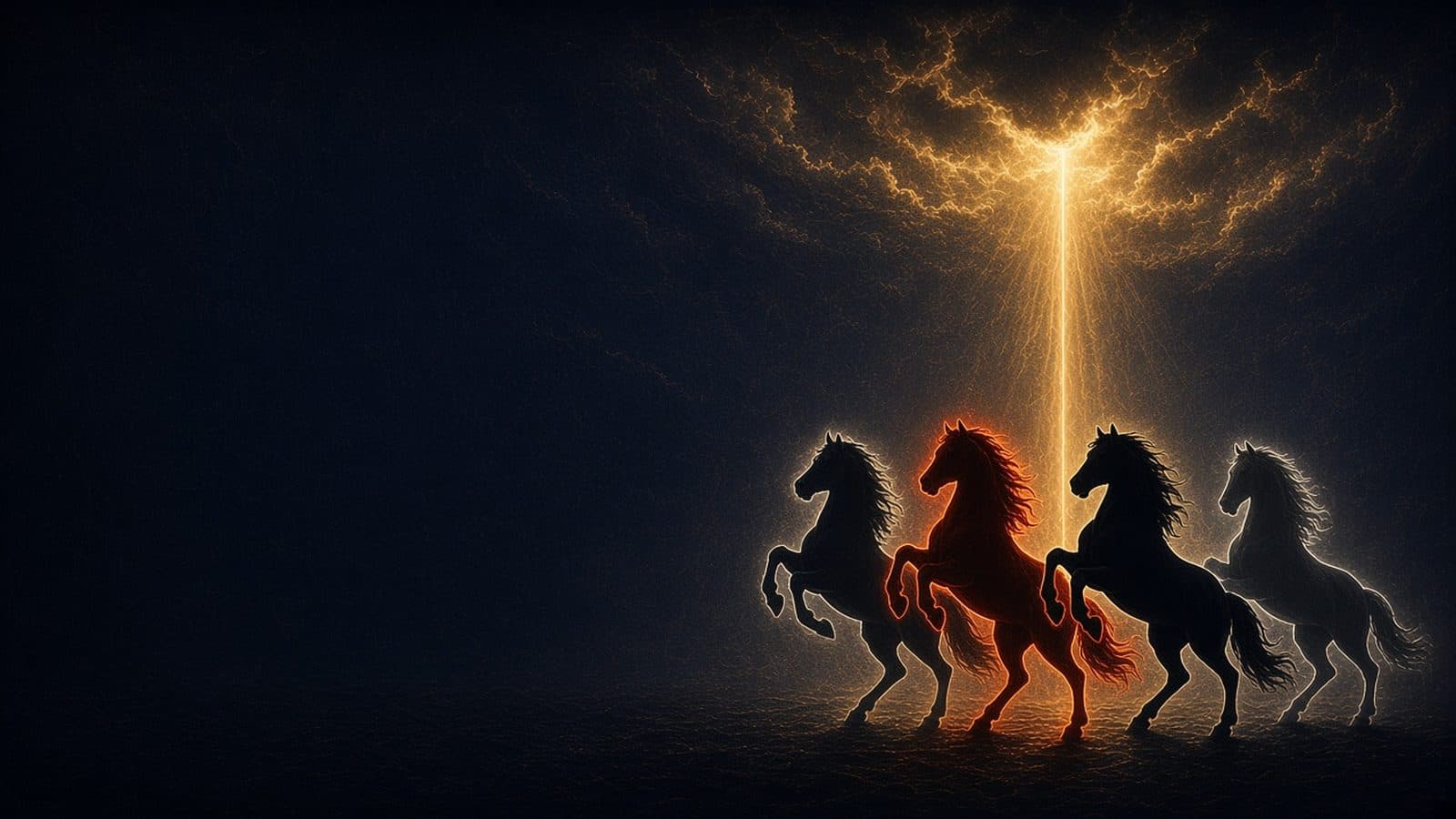
Four Horses on a Leash
Revelation 6:1-8 14 min read WEB
What is Revelation 6:1-8 about?
In short: When the Lamb breaks the first four seals, riders of conquest, war, hunger, and death gallop out, yet each one moves only because power is given to him, so even the worst forces in history answer to the One who was slain and lives.
Passage at a glance
- Passage
- Revelation 6:1-8 (WEB)
- Series
- Revelation, day 12 of 37
- Section
- The Seven Seals
- Reading time
- 14 minutes
- Topics
- Sovereignty, The Lamb, Judgment, Suffering
- Key words
- Seal (sphragis), Was given (edothe), Denarius and choenix, Death and Hades (thanatos and hades)
- Previous passage
- Revelation 5:1-14
- Next passage
- Revelation 6:9-17
Part A Context
Yesterday we stood in the throne room while every creature in heaven and on earth sang to the Lamb, because he alone was worthy to take the scroll from God's right hand (5:1-14). That scroll holds God's purpose for history, and only the Lamb who was slain can open it. Now he begins. A scroll in John's day was closed with wax seals, and its contents could be read only as each seal was broken. Here, every time a seal breaks, something moves in the world.
The first readers did not need a lecture on trouble. Conquest on distant frontiers, civil war within living memory, food shortages that struck the poor first, and sickness that ignored rank were all part of life under Roman rule. Many scholars think that is exactly why chapter 6 matters: it takes the frightening, familiar things the churches already knew and tells them who is behind the gate. These things are not loose. They are released from the throne, one at a time, by the Lamb.
Part A Explanation
6:1-2The rider on the white horse
The Lamb opens the first seal, and one of the four living creatures, the winged guardians around the throne, calls out in a voice "as with a voice of thunder" (WEB). John sees a white horse. Its rider holds a bow, is given a crown, and goes out "conquering, and to conquer." Hold onto the little phrase "was given." It returns three more times, and it quietly says that someone higher has granted permission.
Who is this rider? Faithful readers have given two main answers. Some think he is Christ, or the gospel going out in his name. White is the colour of victory in Revelation, a white-horse rider appears again in 19:11 where he is plainly Jesus, and Jesus said the good news must be preached to every nation before the end (Mark 13:10). Others think he belongs with the three riders who follow, who are all clearly dark. On that view he is conquest itself, the hunger of empires to swallow other peoples, and a counterfeit of the true victor. His bow may have reminded first readers of the mounted archers beyond Rome's eastern frontier, though many scholars are cautious about pressing that. The crown is a stephanos, a victor's wreath, not the royal diadems Jesus wears in 19:12.
Both views agree on what matters: this rider rides because the Lamb opened the seal.
6:3-4The red horse of war
The second seal brings a red horse, the colour of blood and fire. Its rider is given "a great sword" and the power "to take peace from the earth." The Greek word for the sword is machaira, the short blade of a soldier or a butcher, not a ceremonial weapon. This is close-range violence.
Look at the purpose clause: "that they should kill one another." This is not an invading army from outside but people turning on each other, neighbour against neighbour, and a peace that had been advertised on coins and monuments being lifted away. Older believers could recall how quickly the empire's stability had shaken in the civil wars after Nero's death, so the picture was not hypothetical.
The verb for 'kill' is sphazo, to slaughter. It is the same word John used of the Lamb in chapter 5, who stood "as though it had been slain." That is a deliberate echo. The ordinary violence of the fallen world and the one slaughter that rescues the world use the same word. The first fills the earth with blood. The second is how the Lamb opens the scroll.
Notice too that peace is not something humanity owns and occasionally loses. It is something taken from the earth when God permits it. Every quiet street and every night's sleep without fear is a gift.
6:5-6The black horse of hunger
The third horse is black, the colour of mourning and empty tables. Its rider holds "a balance in his hand," the scales of a grain merchant. Then comes a voice "in the middle of the four living creatures", which means it comes from the very centre of the throne: "A choenix of wheat for a denarius, and three choenix of barley for a denarius!"
Here the numbers speak. A denarius was a labourer's daily wage (Matthew 20:2). A choenix was about a litre or a quart of dry grain, roughly one person's food for a day. Many scholars think these prices are many times the normal rate. So a working man can buy enough wheat to feed himself or three portions of cheaper barley, and nothing is left for a wife or children. Bread by weight was an old picture of famine in the Bible (Leviticus 26:26; Ezekiel 4:16).
Then the voice adds: "Don't damage the oil and the wine!" Oil and wine were the produce of the vineyards and olive groves, and they belonged to people with land and money. Many readers see here a painful detail about unequal suffering: when scarcity comes, the poor feel it first while the comfortable table is still stocked. The detail also shows restraint. Even in famine, there are limits set from the throne.
6:7-8The pale horse named Death
The fourth horse is chloros, the sickly green-grey of a corpse, a word that gives us 'chlorine' and 'chlorophyll.' WEB translates it "pale." The rider has a name, and the name is "Death." Following him, like a shadow, is Hades, the realm of the dead.
His authority extends over "one fourth of the earth," and it comes through four instruments: "with the sword, with famine, with death, and by the wild animals of the earth." Here 'death' most likely means pestilence, since the Greek Old Testament often uses that word for plague. These four are not random. Ezekiel 14:21 gives almost the same list as God's "four severe judgments" on a rebellious Jerusalem: "the sword, the famine, the evil animals, and the pestilence." In Leviticus 26 the same four dangers are the warnings God attaches to the covenant. John is saying that what once fell on one city now touches the whole earth.
But count again. One fourth, not all. Three quarters are untouched. The limit tells us this is not the end, but a warning, a siren before a fire. The final defeat of Death and Hades comes in 20:14, and later in the book we will see that they do not outlast the Lamb. For now, the verse that matters is the one at the end of the first chapter, where the risen Jesus says he holds their keys (1:18).
6:1-8Four winds on a short rope
Step back and notice what John has borrowed. In Zechariah 6, a prophet sees four chariots drawn by red, black, white, and dappled horses, and an angel explains, "These are the four winds of the sky, which go out from standing before the Lord of all the earth." The colours match. The horses in Zechariah patrol the earth under orders. John remixes the picture: the horses are still sent by the Lord, but now what they carry is harm.
So how do we read the four? One approach says they describe the entire age between Jesus's first and second comings. Jesus himself listed wars, famines, and plagues, and called them "the beginning of birth pains" (Matthew 24:6-8). Another approach says they describe a specific, intensified period just before the end. A third sees them as a symbolic summary of the troubles that come repeatedly in history. These views differ, and thoughtful believers hold each of them.
What all agree on is the grammar. The crown "was given." The power "was given." The sword "was given." The authority "was given." Every one of the riders is on a leash, and the hand on the other end belongs to the One who sits on the throne and the Lamb who is worthy to open the scroll.
Key words in Revelation 6:1-8
- Seal (sphragis)
- A stamp of wax or clay pressed with a signet ring, marking ownership and authority. A sealed scroll could be opened only by someone with the right to do so, which is why the Lamb's worthiness in chapter 5 matters so much.
- Was given (edothe)
- A passive verb often used in the Bible to mean 'God allowed this.' It appears again and again in these verses and tells us that no rider acts on his own initiative.
- Denarius and choenix
- A denarius was about a day's pay for a labourer, and a choenix was about a day's grain for one person. Together they paint a picture of hunger so severe that a full day's work buys bread for one.
- Death and Hades (thanatos and hades)
- Death is the enemy that ends life, and Hades is the realm where the dead wait. Revelation pictures them as a pair, and the risen Jesus declares in 1:18 that he holds their keys.
Cross references
- Zechariah 6:1-8Four chariots with red, black, white, and dappled horses go out from the Lord of all the earth, the vision John reshapes.
- Ezekiel 14:21God's four severe judgments, sword, famine, evil animals, and pestilence, match the four instruments given to Death.
- Leviticus 26:21-26Wild animals, the sword, pestilence, and bread by weight appear as covenant warnings, an older source for the pattern.
- Matthew 24:6-8Jesus lists wars, famines, and plagues, and calls them the beginning of birth pains, not the end.
- Revelation 19:11Another rider on a white horse, plainly Jesus, which is why some read the first rider as Christ.
- Revelation 5:5-6The Lion has overcome and the Lamb stands as though slain, the One who now opens the seals.
Part B Three lenses on the text
The Pattern
How the whole Bible speaks here
There is a tidy structure here. Four horses, four living creatures calling, four winds, four corners of the earth: in Revelation, four often marks the created world, with its directions and winds. Many readers notice that the seven seals fall into two groups, four that touch the earth and three that open toward heaven, like a house with a ground floor and an upper room.
Then watch the verbs. In 5:5 the elder says the Lamb "has overcome," and the Greek verb is nikao, to conquer. In 6:2 the first rider goes out "conquering, and to conquer," the same verb. Revelation will use it for the beast who conquers by killing (13:7) and for the saints who overcome "because of the Lamb's blood" (12:11). The same word describes two kinds of victory. One wins by taking life, and the other wins by giving it. If you read the first rider as a counterfeit, this is a sharp contrast; if you read him as the gospel going out, it shows how the Lamb's conquest spreads. Either way, John makes us ask which kind of conquering we admire.
The Glory
What this shows us of God
The most startling thing in these verses is who is not in charge. Not the rider with the bow, nor Death with his name. Each is said to receive what he has, and with the black horse you can almost hear the leash: a voice from the centre of the throne announces the limits. God does not stand outside history wringing his hands. He governs even the things he hates, without ever being the author of sin, and he sets bounds on them.
Why would he allow any of it? Scripture gives a partial answer: the judgments are a call to turn, they limit evil's reach, and they display that a world in rebellion cannot enjoy God's gifts while despising the Giver. The deepest answer is at the cross. The worst act in history, the slaughter of the Son of God by lawless men, was also God's plan to rescue sinners (Acts 2:23). If God could turn that into our salvation, then no horseman is beyond his purposes.
That is comfort with weight. We do not have to explain every famine or war to trust the One who holds the scroll. The hands that were pierced for us are the hands now opening history.
The Challenge
What it asks of us
Think about the last thing you ate. Was it hard to afford? Did you give it a thought? A denarius for a quart of wheat describes a world where the arithmetic of a day's work is brutal, and this world exists today, not only in Asia long ago. The third horse tells us who pays first when things go wrong.
So I have to ask myself an uncomfortable question. If I truly believe a voice from the throne cares about the cost of bread and the protection of the poor man's table, how can my giving be an afterthought? Most of us live in the oil-and-wine part of the verse, and we are rarely hungry. That is not something to be ashamed of, but it is something to wake up to.
And what do we do with fear? It is easy to scroll through the bad news of the world and feel only dread, or to switch off and feel nothing. The Lamb opens these seals, which means neither response is right. We can pray for the hungry and the war-torn by name, and we can give, and we can sleep. It may start today with something as ordinary as setting up a regular gift to feed someone who cannot afford wheat.
Part C Daily devotional
Reflection
Some mornings the world seems to be galloping. The news arrives before the coffee, and everything on the screen seems to be coming too fast, too loud, and too large to do anything about. If that is you today, I want you to notice a small detail in Revelation 6 that is easy to skim.
The horsemen do not ride themselves out. The Lamb opens the seal. A living creature calls. The crown is given, the sword is given, the authority is given. Behind the fear is a hand, and the hand has scars.
That changes how I hold my own worries. My health, my money, my children's future, and the stability of the places I love are all things the horsemen threaten, and I am allowed to feel that. But I am not asked to carry the world. The One who opens the scroll has already borne the worst thing that could happen to a person, bearing God's judgment on a cross, and he rose. So I can look at hard things with honest eyes, grieve what needs grieving, help where I can, and still lie down in peace. The Lamb is not surprised, and he is not absent.
Tomorrow the fifth seal opens, and we will hear those who have already died for him ask the question we all eventually ask: how long?
Questions for journaling
- What is the main thing that frightens you about the future, and what changes if it is something that must be given permission before it can reach you?
- Which of the four riders (conquest, war, hunger, death) feels closest to your own life or the lives of people you love, and how do you want to bring that to the Lamb?
- Where do you act as if you were in charge of things that belong to God, and what would it look like to hand one of them back today?
- Who near you lives with the pressure of the third horse, a small income and a large need, and what is one practical way you could help this week?
Prayer
Father, you are on the throne, and your Son, the Lamb who was slain, is worthy to open every seal. Thank you that nothing reaches me or the people I love without passing through your hands. Forgive me for the times I have trusted my plans, my savings, or the state of the world more than I have trusted you. Where I am afraid, quiet me. Where I am comfortable, wake me. Teach me to feed the hungry and to pray for peace, and keep me watching the Lamb. In Jesus's name, Amen.
Pick one person or cause that is affected by hunger or conflict, give something to it today, and pray for them by name for two minutes, thanking the Lamb that he is in charge.
I saw that the Lamb opened one of the seven seals, and I heard one of the four living creatures saying, as with a voice of thunder, "Come and see!"Revelation 6:1 (WEB)
Common questions about Revelation 6:1-8
What is Revelation 6:1-8 about?
When the Lamb breaks the first four seals, riders of conquest, war, hunger, and death gallop out, yet each one moves only because power is given to him, so even the worst forces in history answer to the One who was slain and lives.
Where does Revelation 6:1-8 fit in the book of Revelation?
Yesterday we stood in the throne room while every creature in heaven and on earth sang to the Lamb, because he alone was worthy to take the scroll from God's right hand (5:1-14). That scroll holds God's purpose for history, and only the Lamb who was slain can open it. Now he begins. A scroll in John's day was closed with wax seals, and its contents could be read only as each seal was broken. Here, every time a seal breaks, something moves in the world.
What does “Seal (sphragis)” mean in Revelation 6:1-8?
A stamp of wax or clay pressed with a signet ring, marking ownership and authority. A sealed scroll could be opened only by someone with the right to do so, which is why the Lamb's worthiness in chapter 5 matters so much.
What does “Was given (edothe)” mean in Revelation 6:1-8?
A passive verb often used in the Bible to mean 'God allowed this.' It appears again and again in these verses and tells us that no rider acts on his own initiative.
What does “Denarius and choenix” mean in Revelation 6:1-8?
A denarius was about a day's pay for a labourer, and a choenix was about a day's grain for one person. Together they paint a picture of hunger so severe that a full day's work buys bread for one.
How can I apply Revelation 6:1-8 today?
Pick one person or cause that is affected by hunger or conflict, give something to it today, and pray for them by name for two minutes, thanking the Lamb that he is in charge.
What is a good memory verse for Revelation 6:1-8?
Revelation 6:1: “I saw that the Lamb opened one of the seven seals, and I heard one of the four living creatures saying, as with a voice of thunder, "Come and see!"” (WEB)
Free daily email
The daily study, in your inbox
One passage a day: a careful explanation, three lenses and a short devotional, sent to you by email. Free, and you can stop whenever you like.