Day 11
The Lion Who Is a Lamb
Revelation 5:1-14 14 min read WEB
What is Revelation 5:1-14 about?
In short: When no one in the universe can open God's sealed scroll, the Lion of Judah proves to be a slain Lamb who stands alive, and he alone is worthy because he conquered by dying, ransoming people from every nation for God.
Passage at a glance
- Passage
- Revelation 5:1-14 (WEB)
- Series
- Revelation, day 11 of 37
- Section
- The Throne Room
- Reading time
- 14 minutes
- Topics
- Jesus, Redemption, Worship, Victory
- Key words
- Worthy (axios), Lamb (arnion), Bought (agorazō)
- Previous passage
- Revelation 4:1-11
- Next passage
- Revelation 6:1-8
Part A Context
Yesterday we stood at the open door and saw the throne, and creation and the elders worshipping the One who made everything. Chapter 5 belongs to the same scene, and it brings a sudden problem. In the right hand of the One on the throne is a scroll, sealed, and no one is able to open it.
Think about who first heard this. Christians in Roman Asia lived under an empire that claimed to hold history in its fist, while their own friends were being imprisoned and killed. Their real question was: does anyone hold the story, and will it end well? The scroll is that question made visible. Whatever its details, the picture is plain. God has a purpose for his world, and unless someone can break the seals, it cannot go forward.
Part A Explanation
5:1-4The sealed scroll and the weeping apostle
"I saw, in the right hand of him who sat on the throne, a book written inside and outside, sealed shut with seven seals" (WEB). The right hand is the hand of power. The scroll is written on both sides, which means it is full, with no space for another word. Ezekiel saw a similar scroll, "written within and without" (Ezekiel 2:10). And the seven seals mean total security. Daniel was once told to "shut up the words, and seal the book, even to the time of the end" (Daniel 12:4). Now the time has come to open it.
What does the scroll contain? Christians disagree. Some think it is God's plan for history, others the title deed to creation, and others the full outworking of his judgment and redemption. The visions that follow show it is about the purposes of God for the world and his people, carried out as the seals are broken.
A mighty angel asks, "Who is worthy to open the book, and to break its seals?" Notice the word. He does not ask who is strong enough, but who is worthy. The search covers "heaven above," "the earth," and "under the earth," the whole cosmos. No one.
Then comes one of the most human lines in the book: "I wept much." An apostle cries out loud in heaven. He does not weep for himself. He weeps because it seems that God's purposes cannot proceed, and that evil may have no answer.
5:5-6The Lion heard, the Lamb seen
One of the elders says, "Don't weep. Behold, the Lion who is of the tribe of Judah, the Root of David, has overcome." Both titles are royal. Jacob blessed Judah as "a lion's cub" and promised that the scepter would not leave him "until he comes to whom it belongs" (Genesis 49:9-10). Isaiah spoke of "the root of Jesse" standing as a banner for the nations (Isaiah 11:10). A conquering king, then, and the word "overcome" means that the victory has already been won.
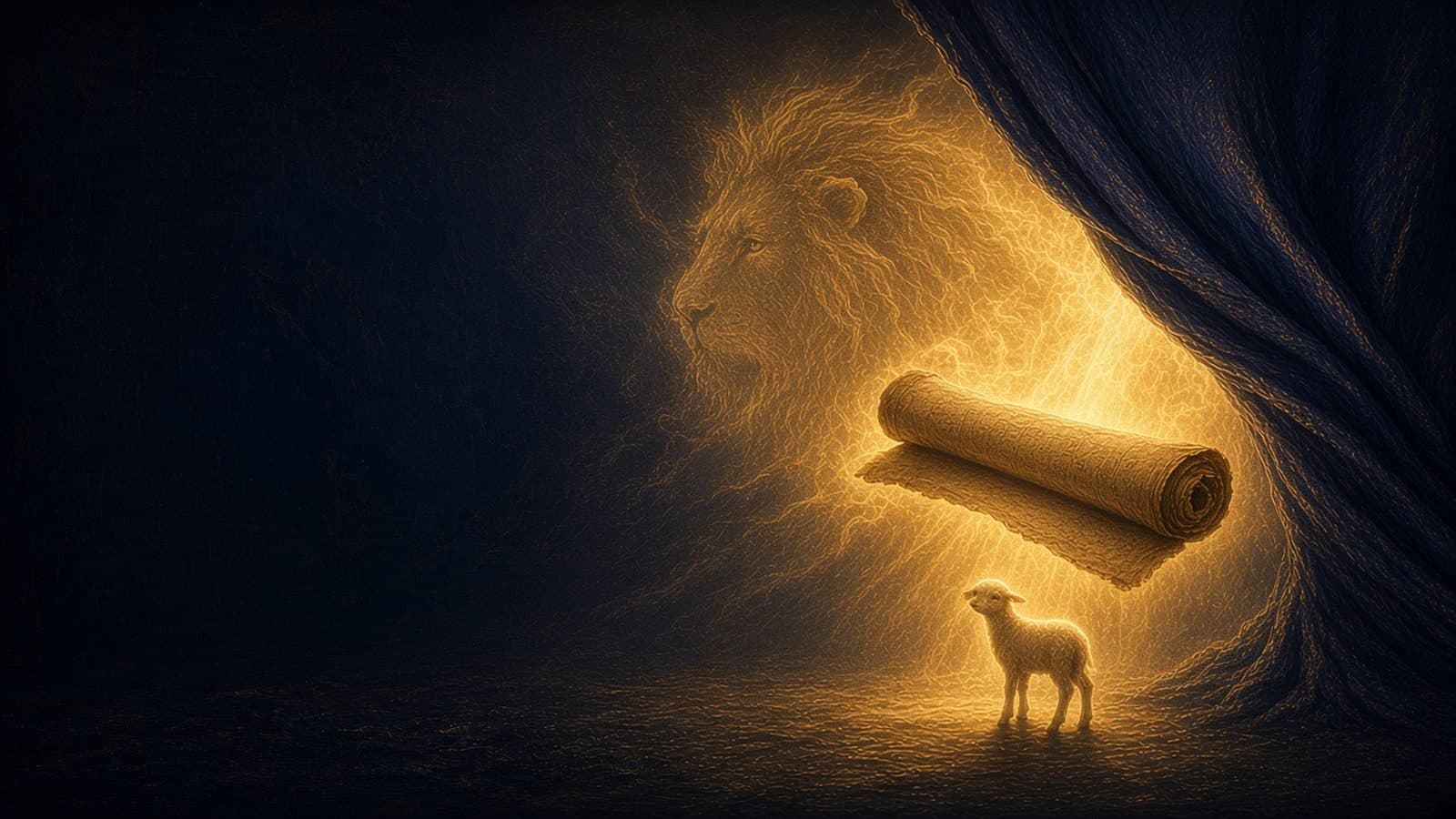
Now John turns to look, and this is the heart of the book. He has heard a Lion. What he sees is "a Lamb standing, as though it had been slain." The Greek word suggests a little lamb, and the verb for slain is the one used for the slaughter of a sacrifice. The conquest of the Lion was won as a Lamb. The picture carries layers: the Passover lamb whose blood saved households in Egypt, the servant in Isaiah who was "as a lamb that is led to the slaughter" (Isaiah 53:7), and Abraham's answer to Isaac, "God will provide himself the lamb" (Genesis 22:8).
The Lamb is standing, so he is alive, yet he still looks slain. The wounds have not been erased. He has seven horns, meaning complete power, and seven eyes, which "are the seven Spirits of God, sent out into all the earth," meaning complete knowledge. And he is "in the middle of the throne."
5:7-10He takes the scroll, and the new song begins
"Then he came, and he took it out of the right hand of him who sat on the throne." There is no struggle, only a calm, sovereign act, like the son of man receiving dominion in Daniel 7. At once the living creatures and the elders fall before the Lamb. Each has a harp and "golden bowls full of incense, which are the prayers of the saints." That detail should stop us. The prayers of ordinary believers, perhaps muttered at night, are kept in heaven as a fragrance before the throne.
Then they "sang a new song." Scripture calls for a new song whenever God does a new act of salvation (Psalm 96:1, Isaiah 42:10). The words explain why the Lamb is worthy. "You were killed, and bought us for God with your blood." The verb for "bought" belongs to the marketplace: a price was paid. The people he bought come "out of every tribe, language, people, and nation," echoing Daniel's vision of "all the peoples, nations, and languages" serving the son of man (Daniel 7:14). For readers in an empire divided by language and class, that was a startling picture of one people.
Finally, "made us kings and priests to our God, and we will reign on the earth." This repeats 1:6 and goes back to Sinai (Exodus 19:6). Christians read the timing of the reign differently, but all agree on the promise: those whom the Lamb buys will share his rule.
5:11-12Ten thousand times ten thousand
Now John hears angels beyond counting: "ten thousands of ten thousands, and thousands of thousands." This borrows from Daniel 7:10, where the same numbers surround the Ancient of Days. The same host that attends the Ancient of Days now surrounds the Lamb.
Their chorus is sevenfold: "Worthy is the Lamb who has been killed to receive the power, wealth, wisdom, strength, honor, glory, and blessing!" Seven means fullness. Each item is something the powers of the world chase and claim: power, wealth, wisdom, strength, honour, glory, praise. The empire of John's day claimed them all. Here the Lamb receives them in full, and the astonishing thing is how: by having been killed.
Look at the phrase "has been killed." The Greek is a perfect participle, which in Greek grammar often describes a past event whose effect remains. The Lamb is the one who was slain and still bears the marks. The cross is not a chapter in his past that heaven has moved beyond. It is the reason for the song, and it remains part of who he is.
Heaven does not say the Lamb is worthy because he is strong. It says he is worthy because he was killed.
5:13-14Every creature says Amen
The scene widens to its fullest. "Every created thing which is in heaven, on the earth, under the earth, on the sea, and everything in them" joins in. Remember verse 3, where the search for someone worthy covered heaven, earth and under the earth, and found no one. The same cosmos that found no champion now sings with one voice. The question that made John weep has been answered everywhere.
Notice the doxology: "To him who sits on the throne, and to the Lamb be the blessing, the honor, the glory, and the dominion, forever and ever!" One song, one set of gifts, two recipients. Elsewhere in the book, angels refuse worship that belongs to God alone (19:10, 22:8-9). The Lamb accepts it. The only way to hold both truths together is the one the church has always held: the Lamb is fully God, sharing the throne, and fully a sacrificed man who bears the wounds.
The final reaction is brief. The four living creatures say "Amen!", the "so be it" of creation, and then "the elders fell down and worshiped." The scroll is still unopened. But the One who will open it has been named, and the right response is to fall down.
Tomorrow the first seal is broken.
Key words in Revelation 5:1-14
- Worthy (axios)
- Having the right, the weight or the merit to do something. The question is not who is strong enough to open the scroll but who has the right. Only the Lamb does, because of his sacrifice.
- Lamb (arnion)
- A little lamb. Revelation uses it nearly thirty times for Christ, in contrast with the single mention of the Lion. It points to the Passover lamb and to the suffering servant, and it means the victory comes through sacrifice.
- Bought (agorazō)
- To purchase in the marketplace. It describes redemption as a price paid, the Lamb's own blood, to buy people for God out of every nation.
Cross references
- Genesis 49:8-10Judah is the lion's cub and the scepter will not leave him until the one to whom it belongs comes, the root of the title Lion of Judah.
- Isaiah 11:1-10The shoot from Jesse's stock, the Root of David standing as a banner for the nations.
- Isaiah 53:7The suffering servant led like a lamb to the slaughter, behind John's image of the Lamb slain.
- John 1:29John the Baptist points at Jesus and calls him the Lamb of God who takes away the sin of the world.
- Daniel 7:13-14The son of man receives dominion over all peoples, nations and languages, which the song of 5:9 echoes.
- Exodus 12:3-13The Passover lamb, whose blood marks and saves the household.
Part B Three lenses on the text
The Pattern
How the whole Bible speaks here
Revelation often does something clever with ears and eyes. John hears one thing and sees another, and the second reinterprets the first. Here the elder announces a Lion and John turns and sees a Lamb. The Lion is the Lamb. Later the same device appears in chapter 7: he hears a number, the 144,000 sealed from the tribes of Israel, and then he looks and sees "a great multitude, which no man could count, out of every nation." John never says one cancels the other. He lets the seeing enlarge the hearing.
Notice how little the book uses the lion. It appears once for Christ, here, and then the Lamb takes over for almost thirty appearances. Revelation teaches us, deliberately, that a lion's strength is exercised in a lamb's way.
And follow the lamb back through the Bible. Abraham says, "God will provide himself the lamb" (Genesis 22:8). Israel kills a lamb in Egypt (Exodus 12). The servant is led like a lamb to the slaughter (Isaiah 53:7). John the Baptist says, "Behold, the Lamb of God" (John 1:29). In Revelation 5 the chain reaches heaven, and we learn what Abraham had said without knowing it: the lamb that God provides is God's own Son.
The Glory
What this shows us of God
Why does heaven praise a slaughtered Lamb? Because the cross is not an accident that God had to recover from. It is the way he wins. In the cross, God's justice and mercy meet: sin is neither ignored nor excused, but borne. The Lamb takes the scroll because he has paid for the people the scroll will rescue. This is the Christ whose judgments will fall in the seals. In 6:16 the guilty cry out to be hidden from "the wrath of the Lamb," and it is no contradiction. The wrath of the Lamb is the wrath of One who has already taken wrath for his people. He is gentle and just at once.
It shows God's sovereignty, too. The worst thing humans ever did, killing the Son of God, was the very means by which God won. If he can use that, nothing in our own history is beyond him.
And there is joy in the song. "Bought us for God." We are not an afterthought but a treasure, bought at a staggering price, from every nation, and brought into the family and the kingdom. The song is new because redemption is new each time it is sung. In heaven, God's glory and the happiness of the redeemed are one and the same thing: the more they see of the Lamb, the louder they sing.
The Challenge
What it asks of us
I want to say something about tears.
John wept, loudly, in front of heaven. Most of us have learned to swallow ours: at funerals, at diagnoses, over the child who walked away from God. We think faith means keeping a straight face. But the elder does not tell John there is nothing to weep about. He tells him to look: there is someone who can open the book.
So when did you last bring a sealed thing to Jesus, honestly, tears and all? And the prayers in the bowls are worth pausing over. The petition you gave up on has not been lost. It is in heaven, kept like incense.
Then ask a harder question. We say we believe the most powerful being in the universe looks like a slaughtered lamb. Do we? Because my life often assumes the opposite: that change comes through winning arguments or being in control. The Lamb conquered by giving himself away. What would it look like for me to follow him by serving the person I resent, or by being gracious when I could win?
Last, the song names "every tribe, language, people, and nation." If that is who heaven will contain, why is my circle so narrow? Who is God asking you to love across a line you have drawn?
Part C Daily devotional
Reflection
Some days life feels like a scroll no one can open. A diagnosis that makes no sense. A prayer unanswered for years. A relationship that will not mend. You want someone to step forward and say, "I can read this. I know what it means."
John knew that feeling. He wept, and I am glad the Bible records it. Then a voice said, "Don't weep," and it did not mean that his sorrow was foolish. It meant someone had come who could open what no one else could.
What moves me most is how that someone appears. John expects a Lion. He sees a Lamb with scars. Of all the ways God could have shown his power, he shows it through wounds. The risen Christ still carries them in heaven, which tells me something about my own wounds. The worst thing that ever happened in history is the way he won. Nothing in my story is beyond redemption.
So today I will not pretend my scroll is not sealed. I will bring it, and I will let the tears come if they need to. But I will look past the scroll to the One who holds it, standing in the middle of the throne, alive. I do not have to understand what is written. I only need to know who is worthy to open it.
Questions for journaling
- Why do you think John wept so much when no one could open the scroll? What sealed things in your life or the world make you want to weep?
- The elder says "Lion," but John sees a "Lamb." What does it tell you about how Jesus uses power that his strength looks like sacrifice?
- The song says the Lamb "bought us for God with your blood." What does it feel like to be bought rather than earning your place?
- Where might God be calling you to follow the way of the Lamb this week, in how you treat someone, handle a conflict or use your influence?
Prayer
Father, thank you for the throne room, and for the scroll in your right hand. When I cannot understand what you are doing, remind me that you hold it. Lord Jesus, Lion of Judah and Lamb who was slain, you alone are worthy. Thank you that you were killed and bought me for God with your blood. Let me follow you in your way of giving myself away. Gather people from every nation to sing your praise, and make me part of that song today. Amen.
Write down one situation that feels like a sealed scroll, pray over it honestly, and end by saying aloud, "Worthy is the Lamb," then leave the note where you will see it today.
Worthy is the Lamb who has been killed to receive the power, wealth, wisdom, strength, honor, glory, and blessing!Revelation 5:12 (WEB)
Common questions about Revelation 5:1-14
What is Revelation 5:1-14 about?
When no one in the universe can open God's sealed scroll, the Lion of Judah proves to be a slain Lamb who stands alive, and he alone is worthy because he conquered by dying, ransoming people from every nation for God.
Where does Revelation 5:1-14 fit in the book of Revelation?
Yesterday we stood at the open door and saw the throne, and creation and the elders worshipping the One who made everything. Chapter 5 belongs to the same scene, and it brings a sudden problem. In the right hand of the One on the throne is a scroll, sealed, and no one is able to open it.
What does “Worthy (axios)” mean in Revelation 5:1-14?
Having the right, the weight or the merit to do something. The question is not who is strong enough to open the scroll but who has the right. Only the Lamb does, because of his sacrifice.
What does “Lamb (arnion)” mean in Revelation 5:1-14?
A little lamb. Revelation uses it nearly thirty times for Christ, in contrast with the single mention of the Lion. It points to the Passover lamb and to the suffering servant, and it means the victory comes through sacrifice.
What does “Bought (agorazō)” mean in Revelation 5:1-14?
To purchase in the marketplace. It describes redemption as a price paid, the Lamb's own blood, to buy people for God out of every nation.
How can I apply Revelation 5:1-14 today?
Write down one situation that feels like a sealed scroll, pray over it honestly, and end by saying aloud, "Worthy is the Lamb," then leave the note where you will see it today.
What is a good memory verse for Revelation 5:1-14?
Revelation 5:12: “Worthy is the Lamb who has been killed to receive the power, wealth, wisdom, strength, honor, glory, and blessing!” (WEB)
Free daily email
The daily study, in your inbox
One passage a day: a careful explanation, three lenses and a short devotional, sent to you by email. Free, and you can stop whenever you like.