Day 10
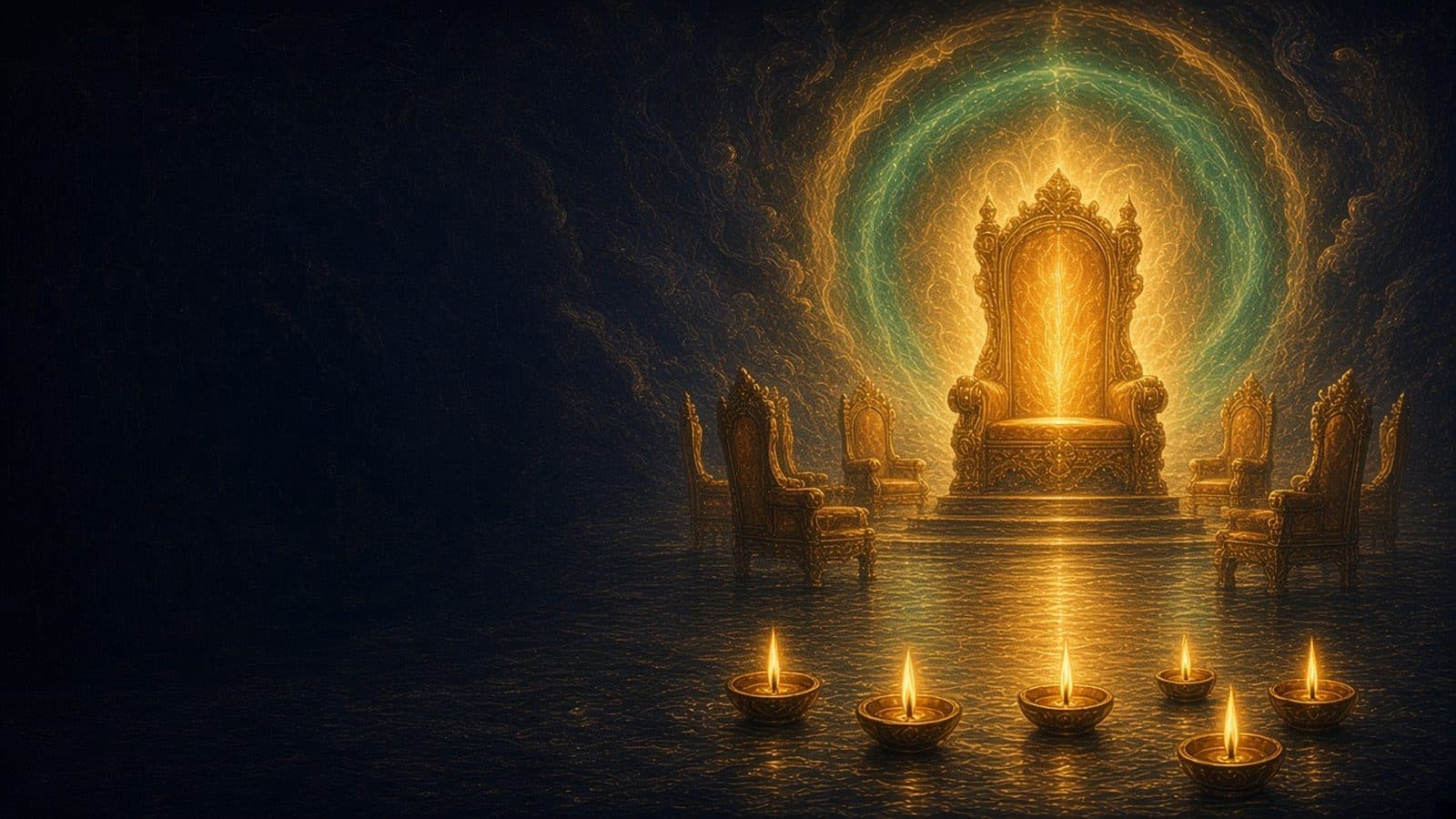
The Throne at the Centre
Revelation 4:1-11 14 min read WEB
What is Revelation 4:1-11 about?
In short: John is called through an open door into heaven, where everything turns on one throne and the One who sits on it, and creation and the redeemed answer his holiness with ceaseless worship and the surrender of their crowns.
Passage at a glance
- Passage
- Revelation 4:1-11 (WEB)
- Series
- Revelation, day 10 of 37
- Section
- The Throne Room
- Reading time
- 14 minutes
- Topics
- Worship, Holiness, Sovereignty, Creation
- Key words
- Throne (thronos), Holy (hagios), Living creatures (zōa)
- Previous passage
- Revelation 3:14-22
- Next passage
- Revelation 5:1-14
Part A Context
Yesterday's letter ended at a door, with Christ knocking and a promise that the overcomer would sit with him on his throne. Chapters 2 and 3 kept us on earth, among seven congregations with seven different problems. Now the camera lifts. For the rest of the book, earthly events will be seen from a place above them, and chapters 4 and 5 are the key to that view: one vision of heaven's throne room, in which we meet first the Creator and then the Lamb.
The first readers lived among rival thrones. Governors sat in judgment, temples to the emperors stood in Ephesus, Pergamum and Smyrna, and refusing to honour the emperor could cost a Christian dearly. Ancient writers record the king of Armenia laying his crown before an image of Nero in Rome, and some scholars think a scene like that may echo faintly here, though we cannot be sure. What is certain is the question this chapter answers: who truly rules?
Part A Explanation
4:1-3A door, a voice, a throne
"After these things I looked and saw a door opened in heaven" (WEB). The door on earth in 3:20 had Christ on the outside, knocking. Now a door stands open in heaven, and the voice that invites John in is "like a trumpet," the same voice he heard in 1:10. It is most likely Christ who says, "Come up here, and I will show you the things which must happen after this."
Some Christians read "come up here" as a picture of the church being taken to heaven before a time of great trial. Many others see it as John's own visionary ascent, given to help every reader see earthly events from heaven's side. Both agree on what the chapter does: it shows us reality from above. John is at once "in the Spirit," and what he sees is first a seat: "a throne set in heaven, and one sitting on the throne."
Notice what John does not describe. He gives no face, no height, no robe. All he offers are gemstones and light: one "like a jasper stone and a sardius," the red and the clear, shining like fire and crystal. Later, jasper will describe the glory of God shining in the new city (21:11). Scripture is reverent here, as it was when God told Moses, "You cannot see my face" (Exodus 33:20).
John adds "a rainbow around the throne, like an emerald to look at." The rainbow was the sign of God's covenant after the flood (Genesis 9:13-16). Even the seat of judgment is encircled by a promise.
4:4Twenty-four elders
Around the central throne sit "twenty-four thrones," and on them "twenty-four elders sitting, dressed in white garments, with crowns of gold on their heads." Who are they? Christians have suggested several answers. Many think they represent the whole people of God, perhaps twelve tribes of Israel and twelve apostles together, the old covenant and the new. Others see them as a high order of angels. Another idea draws on the twenty-four divisions of priests in 1 Chronicles 24, so that they stand as heaven's priesthood.
The details lean towards the first reading. The white garments are what Christ promised to the overcomers in Sardis (3:5), and the crowns echo the crown promised to Philadelphia (3:11). They sit on thrones, which recalls his promise in 3:21 to share his rule. If so, the elders are a preview: this is where the faithful of the seven churches end up. That is a great comfort for believers who felt small and persecuted: here they sit near the centre of the universe.
And yet notice that the elders are never the focus. Their thrones are smaller and set around the throne. They do not rule from the centre, and they will soon take off their crowns. Whatever authority is shared with God's people is borrowed from the One who sits in the middle.
4:5-6aThunder, lamps and a calm sea
"Out of the throne proceed lightnings, sounds, and thunders." This is Sinai again, where the mountain quaked and the people trembled (Exodus 19:16-18). A holy God is not safe to approach on our own terms, and the heavenly throne is no less awesome than the mountain.
Then "seven lamps of fire burning before his throne, which are the seven Spirits of God." John tells us what the lamps mean: the Spirit, shown in his fullness, as in 1:4. The Spirit stands before the throne as light and fire, the way a lampstand burned before the Lord in Zechariah's vision (Zechariah 4:2).
The last image in this group is easy to rush past: "something like a sea of glass, similar to crystal." In Exodus 24:10, when Israel's elders saw God, "under his feet was like a paved work of sapphire stone." In Scripture the sea often stands for chaos and for the realm from which the beast will later rise (13:1). Here, in front of God, the sea is glass. Many scholars think the image shows that everything that churns and threatens on earth is still, solid and transparent before his throne. In the end, John will say there is no more sea (21:1). Before the first judgment appears, he has already shown us that the chaos is under control.
4:6b-8The four living creatures
Now come four living creatures "full of eyes before and behind." John's readers, who knew Ezekiel 1, would have recognised them. Ezekiel saw four living beings, each with four faces: a man, a lion, an ox and an eagle. John adds the six wings from Isaiah 6, where the seraphim above the throne cried "Holy, holy, holy." He is gathering the great throne visions of the prophets into one.
Here each creature has a single face: "like a lion," "like a calf," "a face like a man," "like a flying eagle." Many interpreters see the noblest of wild animals, domestic animals, humans and birds, which together represent the created order. Their eyes suggest ceaseless attention and nothing hidden. They are creation's choir.
Their song is a threefold "holy," a Hebrew way of saying the highest degree: "Holy, holy, holy is the Lord God, the Almighty, who was and who is and who is to come!" Holiness means being utterly set apart from everything that is made and everything that is corrupt. The creatures sing it "day and night" without rest. That does not sound like drudgery. It sounds like minds so full of beauty that they cannot be silent.
Notice that their song is not about us. It simply declares who he is, in a line that echoes 1:8.
4:9-11Crowns on the glass
Whenever the creatures give "glory, honor, and thanks to him who sits on the throne," the elders respond. They "fall down," worship, and "throw their crowns before the throne." A crown was something earned or granted: the sign of status. The elders have been given crowns by grace and here they give them back.
Their words are a hymn: "Worthy are you, our Lord and God, the Holy One, to receive the glory, the honor, and the power." The title "our Lord and God" is striking. An ancient Roman biographer reports that the emperor Domitian liked to be addressed as lord and god, and many scholars hear this as a pointed contrast, though the connection is debated. Either way, the elders' worship says something the empire could not: the One who is worthy is the Creator, and not a ruler.
Then the reason: "for you created all things, and because of your desire they existed, and were created!" The word "desire" can also be translated "will." The whole universe exists because God wanted it. Creation is not an accident, a necessity or something God needed. It is the overflow of his will.
So the first thing heaven teaches is not what God does for us. It is that he is worthy, and that all things, ourselves included, exist for him. Tomorrow we see that worthiness met in a person.
Key words in Revelation 4:1-11
- Throne (thronos)
- A seat of rule and judgment. In the WEB the word, with its plural, appears fourteen times in this one chapter, and more than forty times in the whole book. Revelation is a story about who truly sits on the throne.
- Holy (hagios)
- Set apart, utterly different from everything created and corrupted. To say it three times is the Hebrew way of reaching the highest degree: holiest of all.
- Living creatures (zōa)
- Winged beings around the throne, drawn from the visions of Ezekiel and Isaiah. Many take them as representing creation at its noblest, offering ceaseless praise to the Creator.
Cross references
- Isaiah 6:1-4Isaiah sees the Lord on a high throne with six-winged seraphim crying 'Holy, holy, holy.'
- Ezekiel 1:26-28A throne above the living creatures, with a rainbow-like brightness, the closest Old Testament parallel to John's scene.
- Daniel 7:9-10Thrones are placed, the Ancient of Days sits, and thousands upon thousands stand before him.
- Exodus 19:16-18The thunder, lightning and quaking at Sinai that echo in the throne's lightnings and sounds.
- Genesis 9:12-16The rainbow as a sign of God's covenant mercy, now encircling the throne of judgment.
- Hebrews 4:16The same throne is called a throne of grace, to which believers may draw near with boldness.
Part B Three lenses on the text
The Pattern
How the whole Bible speaks here
Every great throne vision in the Bible arrives in a crisis. Micaiah sees the Lord on his throne with the host of heaven standing by while kings plot below (1 Kings 22:19). Isaiah sees him "in the year that king Uzziah died" (Isaiah 6:1), when the earthly throne has just been emptied. Ezekiel sees him among exiles by a foreign river. Daniel sees thrones set while pagan empires rise and fall (Daniel 7:9). John sees him as an exile on Patmos. The pattern is steady: when earthly thrones wobble, heaven's throne is shown.
John also gathers these earlier visions into one. The thunder of Sinai, the six wings of Isaiah, the living creatures and rainbow of Ezekiel, the thousands upon thousands of Daniel: all of them stand around this one throne. It is as if the whole Old Testament has been pressed into a single window.
And look where the book is heading. Throne language is its backbone, and thrones are in conflict. Christ speaks of "Satan's throne" in Pergamum (2:13), and later the dragon gives the beast "his power, his throne, and great authority" (13:2). The book's battle is a battle of thrones. Chapter 4 settles in advance which one is real. The others are copies, and the dragon's is a loan.
The Glory
What this shows us of God
Heaven's first act is not to tell us how much God loves us, though he does. It is to display who he is. Three times "holy," and then the plain reason for worship: he made everything, and he did so because he wanted to. God is not a needy deity who made a world to supply what he lacked. He is full, and the universe overflows from that fullness.
That fullness has an edge. The lightning and thunder are not decoration. Holiness is dangerous to a world that has turned from him. The creatures sing "holy," because holiness is what makes love trustworthy. A love that did not hate evil would not be worth having.
But there is a rainbow around the throne. Mercy circles judgment. And here the gospel presses in. The same throne is called the "throne of grace" in Hebrews 4:16, where believers are told to draw near "with boldness" because of a high priest who has gone before us. Why does this throne room not destroy us? Tomorrow's chapter answers it with a Lamb.
Finally, joy. David wrote, "In your presence is fullness of joy" (Psalm 16:11). The creatures are not worn out by endless praise. Whoever stands near the centre of all beauty has no wish to stop. God's glory and our gladness are not rivals here. The more we see of him, the more we want to sing.
The Challenge
What it asks of us
Think about the last time you were truly frightened. A phone call, a scan, a message you did not want to open. Where was the throne?
I do not mean theologically. I mean in your head, in that moment. For most of us the answer is uncomfortable. The throne was occupied by the worst-case scenario, or by our own ability to fix things. We believe God rules, yet live as if the chair is empty until we need something.
John is writing to people heading for hardship, and the first thing he shows them is not an escape plan. It is a throne, occupied. Whatever else happens, the centre of the universe is not vacant and not anxious.
Now turn it around. What sits at the centre of your day? I mean what you arrange your hours around: your phone, your career, the opinion of people you admire. The elders throw their crowns down. What are you still clutching, whether reputation, achievements or comfort?
We should be honest, too, about how flat our worship can feel next to this scene. The creatures never run out of wonder. Perhaps that is because they are looking, and we are not. Try it: read verses 8 to 11 aloud before you read your messages tomorrow. It is small, but it moves the throne back where it belongs.
Part C Daily devotional
Reflection
It is three in the morning and sleep will not come. The worries line up politely, one after another: money, a conversation I dread, someone I love who is struggling. Each one gets larger the longer I look at it.
Then I think of John. He was an old man, probably, cut off on an island, with his friends scattered and a hostile empire watching the churches. If anyone had reason to lie awake, he did. And what does he see when the door opens? Not a solution. A throne. And someone sitting on it who is not worried, not hurried, not surprised by anything.
That is what I need at three in the morning. I do not need all my questions answered. I need to know the throne is occupied. Behind every one of those worries is a God who is holy, who made everything because he wanted to, who is surrounded by a rainbow of mercy, and who has the whole world, and me, in his hands.
So tonight, or tomorrow, I will do what the elders do. I will put down the crowns I have been wearing, the pride of coping and the habit of control, and I will say what is true: Worthy are you. The worries are still there, but the throne is larger.
Questions for journaling
- What stands out most to you about the throne room, its beauty, its awe, its mercy, or its constant worship? Why do you think that is?
- When you are anxious or afraid, who or what occupies the throne in your thinking? What would it look like to hand it back?
- The elders throw down their crowns. What are you holding on to, such as reputation, success or control, that you could lay before him today?
- What is one practical way you could make worship, not only singing but adoration, a daily rhythm this week?
Prayer
Holy, holy, holy Lord God, the Almighty, who was and is and is to come, I bow before you. You made all things, and because of your will they exist. You are worthy of all glory and honour and power. Forgive me for the times I have treated your throne as empty and tried to run my own life. Thank you for the rainbow around your throne, for mercy that meets me in your holiness. I lay down my crowns, my pride and my control. Be at the centre of my day. Amen.
Read Revelation 4:8-11 aloud this morning, and then name one crown you have been holding, such as a title, an achievement or a need to be right, and lay it down in prayer.
Worthy are you, our Lord and God, the Holy One, to receive the glory, the honor, and the power, for you created all things, and because of your desire they existed, and were created!Revelation 4:11 (WEB)
Common questions about Revelation 4:1-11
What is Revelation 4:1-11 about?
John is called through an open door into heaven, where everything turns on one throne and the One who sits on it, and creation and the redeemed answer his holiness with ceaseless worship and the surrender of their crowns.
Where does Revelation 4:1-11 fit in the book of Revelation?
Yesterday's letter ended at a door, with Christ knocking and a promise that the overcomer would sit with him on his throne. Chapters 2 and 3 kept us on earth, among seven congregations with seven different problems. Now the camera lifts. For the rest of the book, earthly events will be seen from a place above them, and chapters 4 and 5 are the key to that view: one vision of heaven's throne room, in which we meet first the Creator and then the Lamb.
What does “Throne (thronos)” mean in Revelation 4:1-11?
A seat of rule and judgment. In the WEB the word, with its plural, appears fourteen times in this one chapter, and more than forty times in the whole book. Revelation is a story about who truly sits on the throne.
What does “Holy (hagios)” mean in Revelation 4:1-11?
Set apart, utterly different from everything created and corrupted. To say it three times is the Hebrew way of reaching the highest degree: holiest of all.
What does “Living creatures (zōa)” mean in Revelation 4:1-11?
Winged beings around the throne, drawn from the visions of Ezekiel and Isaiah. Many take them as representing creation at its noblest, offering ceaseless praise to the Creator.
How can I apply Revelation 4:1-11 today?
Read Revelation 4:8-11 aloud this morning, and then name one crown you have been holding, such as a title, an achievement or a need to be right, and lay it down in prayer.
What is a good memory verse for Revelation 4:1-11?
Revelation 4:11: “Worthy are you, our Lord and God, the Holy One, to receive the glory, the honor, and the power, for you created all things, and because of your desire they existed, and were created!” (WEB)
Free daily email
The daily study, in your inbox
One passage a day: a careful explanation, three lenses and a short devotional, sent to you by email. Free, and you can stop whenever you like.