Day 3
The Beast and the Number 666
Revelation 13:1-18 13 min read WEB
What is Revelation 13:1-18 about?
In short: The beast is Revelation's picture of a power that demands the worship only God deserves, and 666 is its number, which Christians read as a first-century emperor, a symbol, or a final leader, while all agree the call is to stay faithful to the Lamb.
Passage at a glance
- Passage
- Revelation 13:1-18 (WEB)
- Series
- Ten Questions People Ask About Revelation, day 3 of 10
- Section
- The Strange Figures
- Reading time
- 13 minutes
- Topics
- Beast, 666, Worship, Faithfulness, Interpretation
- Previous passage
- Revelation 22:6-12
- Next passage
- Revelation 7:1-17
Part A Context
Of all the questions people ask about Revelation, this one comes up most. It shows up in films, jokes and late-night searches, and it has probably frightened more readers than any other page in the Bible.
Take a breath before we open chapter 13. The chapter is not the end of the story. Earlier, in chapter 12, a dragon was thrown down from heaven, "having great wrath, knowing that he has but a short time" (12:12). The beast in chapter 13 is the dragon's tool, and the dragon has already lost. A few chapters later, the Lamb will overcome the beast, and those who refused it will stand with harps in their hands.
The first readers were Christians in cities that ran on Roman power, where citizens were often expected to honour the emperor as divine. When John wrote of a beast that demanded worship, they would have known at once what kind of pressure he meant. Our job is to understand that picture first, and only then ask how it speaks to us.
Part A Explanation
13:1-4A beast out of the sea
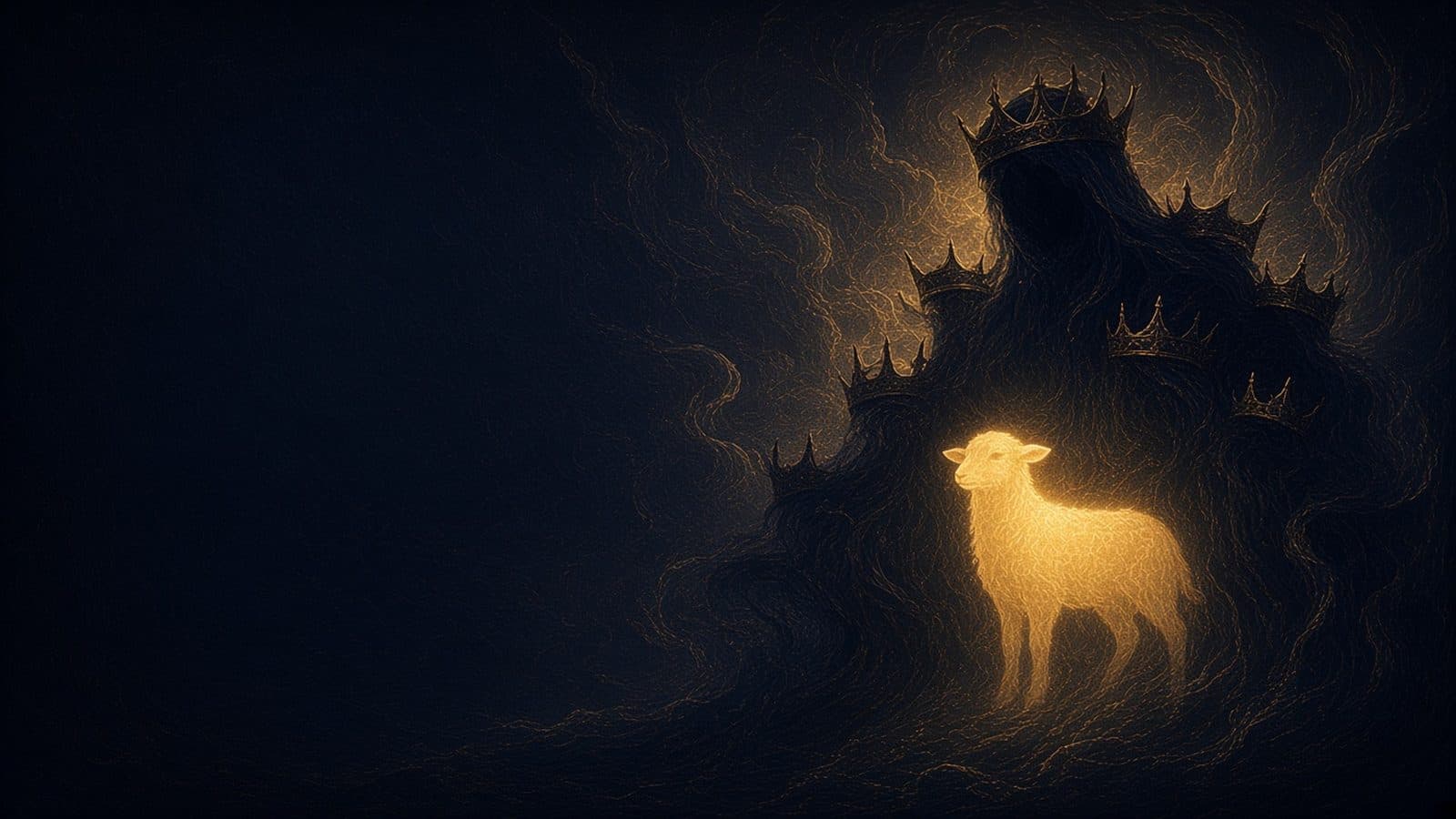
John stands on the sand and sees a beast rising from the sea, "having ten horns and seven heads. On his horns were ten crowns, and on his heads, blasphemous names" (13:1, WEB). It was "like a leopard", and "his feet were like those of a bear, and his mouth like the mouth of a lion" (13:2).
This is deliberate. Centuries earlier the prophet Daniel saw "four great animals" come up from the sea, "like a lion", "like a bear", "like a leopard" and a fourth with ten horns (Daniel 7:3-7). John has taken those separate beasts and rolled them into one. The picture says that the empires of the world, one after another, share one character: power that devours and makes itself god.
The beast borrows its authority from the dragon, and it copies the Lamb. Of one head we read, "His fatal wound was healed" (13:3), which many readers see as an imitation of death and resurrection. The crowds ask, "Who is like the beast? Who is able to make war with him?" (13:4). That is a mocking echo of Israel's song, "Who is like you, Yahweh, among the gods?" (Exodus 15:11). The beast wants the praise that belongs to God.
13:5-10A beast on a leash
Read the verbs. "A mouth speaking great things and blasphemy was given to him. Authority to make war for forty-two months was given to him" (13:5). "It was given to him to make war with the saints" (13:7). Again and again, the beast is allowed, not unleashed. Everything he has is lent to him, and the loan has a time limit, forty-two months, which is the same period as three and a half years, a number the Bible uses for a limited season of trouble.
That tells us who is really in charge. The beast is fearsome, but he is not sovereign. The Lamb is. And the people who are safe are not those with the best strategy but those whose names are written in "the book of life of the Lamb who has been killed" (13:8). The beast's worshippers are "everyone whose name has not been written" there. The Lamb's people were in his book long before the beast arrived.
Then John says something that sounds very ordinary: "Here is the endurance and the faith of the saints" (13:10). The response to the beast is not a crusade or a calculation. It is patient faithfulness.
13:11-17The helper beast and the mark
A second beast appears out of the earth. He has "two horns like a lamb", but he "spoke like a dragon" (13:11). He looks gentle and talks like the enemy. His job is to make people worship the first beast, with spectacular signs, an "image" that speaks, and a mark. Later the book calls him "the false prophet" (19:20). Many readers think of him as the voice of religion or propaganda that serves a political power.
The mark is placed "on their right hands, or on their foreheads", and without it "no one would be able to buy or to sell" (13:16-17). Forehead and hand were where God's people were told to wear his words (Deuteronomy 6:8). In chapter 7 God's servants are sealed on their foreheads, and in chapter 14 the Lamb's people have "his name, and the name of his Father, written on their foreheads" (14:1). Everyone belongs to someone, and the mark is the beast's counterfeit of belonging to God.
The pressure is economic and social: fit in or be shut out. Many scholars think first-century Christians faced pressure like this, for example when trade guilds expected a gesture of loyalty to the emperor. John says nothing at all about technology, and Unveiled does not tie the mark to any device or system.
13:18The number
"Here is wisdom. He who has understanding, let him calculate the number of the beast, for it is the number of a man. His number is six hundred sixty-six" (13:18).
Christians have read this in three main ways. A first-century emperor. In John's world letters were also numbers, and many scholars find that the name Nero Caesar, written in Hebrew letters, adds up to 666. Some old copies read 616, which fits another spelling of the same name. A symbol. Seven is the number of completeness, so six, repeated three times, is a picture of falling short again and again: a human power that reaches for divinity and never gets there. A future figure. Others expect the number to be recognised when a final leader appears.
Over the centuries many confident answers have been given, and most have aged badly. That is a good reason for humility. And notice that John calls this a matter of "wisdom". In the Bible, wisdom is not cleverness. It is knowing who God is and who is Lord. The wise reader is the one who will not bow.
1 John 2:18So who is the beast?
The honest answer is that Christians have read the beast in three overlapping ways. Some see the Roman Empire and its emperors, the beast John's first readers actually faced. Some see a pattern that repeats, so that wherever power demands the loyalty only God deserves, the beast is at work. Some expect a final figure who gathers all this into one.
John, in his letters, gives a clue that helps all three. "As you heard that the Antichrist is coming, even now many antichrists have arisen" (1 John 2:18). The spirit of the Antichrist, he says, "is in the world already" (1 John 4:3). So the New Testament treats opposition to Christ as both present and, at the end, concentrated.
For that reason Unveiled does not name any person, nation, or group today as the beast. The book's call is not to hunt for villains. It is to stay faithful to the Lamb. A reader who spends all their energy identifying the beast has probably been drawn into a distraction from what the book asks.
Key words in Revelation 13:1-18
- Beast (therion)
- A wild animal. John uses it for a power that has lost its humanity and acts like a predator, borrowing the beasts of Daniel's vision.
- Mark (charagma)
- A stamp or brand, like the ones owners put on animals or soldiers wore. It stands for who you belong to and whom you worship.
- Number of a man
- The number belongs to humanity, not to God. A human power may look huge, but it is still only a human number. Many readers also see a picture of falling short of seven, the number of completeness.
- Endurance (hypomone)
- Patient staying power under pressure. In Revelation it is the main virtue asked of God's people when the beast is at its loudest.
Cross references
- Daniel 7:3-7Four beasts rise from the sea, and John folds them into one picture of worldly power.
- Exodus 15:11'Who is like you, Yahweh?' is the song the beast's followers mock when they say, 'Who is like the beast?'
- 1 John 2:18; 4:3Opposition to Christ is already at work in the world and will be gathered up at the end.
- Revelation 14:9-12The mark goes with worshipping the beast, which is a settled choice of allegiance.
- Revelation 15:2-4Those who overcame the beast stand with harps and sing to the King of the nations.
- John 10:27-29Jesus says no one will snatch his sheep out of his hand.
Part B Three lenses on the text
The Pattern
How the whole Bible speaks here
Look at where the beast comes from. John "stood on the sand of the sea" and saw a beast "coming up out of the sea" (13:1). Follow that image.
It starts in the second verse of Genesis. "Darkness was on the surface of the deep," and God's Spirit hovered over the waters (Genesis 1:2). In the Old Testament the sea is wild and out of control, and the songs say God rules it. "You rule the pride of the sea. When its waves rise up, you calm them" (Psalm 89:9).
Now jump to the boat on Galilee. A storm, frightened men, and Jesus saying to the sea, "Peace! Be still!" (Mark 4:39). The disciples ask, "Who then is this, that even the wind and the sea obey him?" (Mark 4:41). The Old Testament had already said who rules the sea: Yahweh.
So when a beast climbs out of the sea, John's first readers, steeped in the Old Testament, would likely have heard the old story. Chaos is trying to rise again. Some scholars also link the sea with the nations (see 17:15). But look how the book finishes the thought. Those who overcame the beast stand "on the sea of glass" (15:2). And in the end, "the sea is no more" (21:1).
The pattern runs from a hovering Spirit, to a rebuked storm, to a still sea, to no sea at all. The beast comes up from the deep, but the deep has always been under God's hand.
The Glory
What this shows us of God
Why does the beast want worship? Because worship is what every human heart was made for, and a counterfeit king has to steal what only the true King deserves.
Notice what Jesus did with the same offer. The devil showed him "all the kingdoms of the world, and their glory" and said, "I will give you all of these things, if you will fall down and worship me" (Matthew 4:8-9). It was the beast's deal in advance. Jesus answered, "You shall worship the Lord your God, and you shall serve him only" (Matthew 4:10). Why would he refuse a whole world? Because worship belongs to God alone, and the Son would win his kingdom by the cross, not by the shortcut.
So how does God see the rage of the nations? "He who sits in the heavens will laugh" (Psalm 2:4). It is the calm of one who has no rival. Then the Psalm turns to mercy: "Blessed are all those who take refuge in him" (Psalm 2:12).
And how was the real power broken? Christ, on the cross, "made a show of them openly, triumphing over them in it" (Colossians 2:15). The beast roars. The Lamb has already won in blood. For those who trust him, that is not only safety. It is joy, because the one we serve is better than any who demand it.
The Challenge
What it asks of us
I have a confession. When I read about a mark on the hand and the forehead, I think about other people. I don't think about my wallet.
But listen to what the beast controls. Not first of all our thoughts. Our buying and selling (13:17). Money. Work. Whether we can get by. And Jesus said, "You can't serve both God and Mammon" (Matthew 6:24).
So here is a plain question. Who tells my money where to go? Do I give as if God is my provider, or as if the paycheque is? Do I say yes to the thing that is slightly dishonest because the job needs it? If you're like me, you might have to think about that for a minute.
I'm not saying this to make you panic. John says what is needed: "Here is the endurance and the faith of the saints" (13:10). Not heroics. Staying put. Saying no to the small thing, again and again, and trusting that the Lamb is watching, and that he is enough.
Here is God's own word to his people. "I have called you by your name. You are mine" (Isaiah 43:1). If you are his, then you are not for sale.
So do one small, quiet thing this week. Give something away. Money, time, a meal, a ride. Don't announce it. Let the Lamb see it. Then thank him that he already paid the price for you.
Part C Daily devotional
Reflection
If this chapter has ever frightened you, here is something to hold on to. The beast in Revelation 13 is loud, but he is on a leash. The Lamb has already won, and your name, if you belong to Jesus, was written in his book before the beast ever opened his mouth.
Notice what John asks of us. He does not ask us to be clever, or to be brave in a dramatic way. He asks for endurance and faith. That is something ordinary people can give: staying on the path, praying when it is hard, refusing small compromises, keeping on loving the people around us.
It may help to ask a simple question each day. Whose am I? Not 'what am I afraid of' or 'what is going to happen'. Whose am I? If the answer is 'the Lamb's', the beast can limit what you buy, but he cannot change who you belong to.
Take the weight off your shoulders. You are not required to identify the beast. You are invited to follow the Lamb, and that is a job you can begin today.
Questions for journaling
- What in this chapter has made you most anxious, and what in the rest of Revelation speaks to that fear?
- Why do you think John shows the beast as an imitation of the Lamb and of God?
- The beast's power is 'given'. How does that change the way you read the news or your own fears?
- Where are you tempted to give a person, a system or a worry the loyalty that belongs to Jesus?
- What would endurance and faith look like in your life this week?
Prayer
Lord Jesus, you are the Lamb who was killed and who lives. I confess that I am sometimes afraid, and that I sometimes bow to things that are not you to keep life comfortable. Forgive me. Thank you that my name is written in your book and that no one can snatch me out of your hand. Give me endurance and faith. Keep me from being fascinated by the beast, and make me more fascinated by you. All glory belongs to you, now and forever. Amen.
Write down one thing you tend to give your trust to besides Jesus, such as money, approval or control. Then, on that same page, write 'Whose am I?' and answer it with 'I belong to the Lamb' before you pray.
They overcame him because of the Lamb's blood, and because of the word of their testimony. They didn't love their life, even to death.Revelation 12:11 (WEB)
Common questions about Revelation 13:1-18
What is Revelation 13:1-18 about?
The beast is Revelation's picture of a power that demands the worship only God deserves, and 666 is its number, which Christians read as a first-century emperor, a symbol, or a final leader, while all agree the call is to stay faithful to the Lamb.
Where does Revelation 13:1-18 fit in the book of Revelation?
Revelation 13:1-18 is day 3 of 10 in Unveiled's study of the book of Revelation, in the section “The Strange Figures”. The beast and 666, the 144,000 and the two witnesses: who are they, and how should we hold the different readings?
What does “Beast (therion)” mean in Revelation 13:1-18?
A wild animal. John uses it for a power that has lost its humanity and acts like a predator, borrowing the beasts of Daniel's vision.
What does “Mark (charagma)” mean in Revelation 13:1-18?
A stamp or brand, like the ones owners put on animals or soldiers wore. It stands for who you belong to and whom you worship.
What does “Number of a man” mean in Revelation 13:1-18?
The number belongs to humanity, not to God. A human power may look huge, but it is still only a human number. Many readers also see a picture of falling short of seven, the number of completeness.
How can I apply Revelation 13:1-18 today?
Write down one thing you tend to give your trust to besides Jesus, such as money, approval or control. Then, on that same page, write 'Whose am I?' and answer it with 'I belong to the Lamb' before you pray.
What is a good memory verse for Revelation 13:1-18?
Revelation 12:11: “They overcame him because of the Lamb's blood, and because of the word of their testimony. They didn't love their life, even to death.” (WEB)
Free updates
Stay in the loop
Studies are published every day on the site, free to read. Sign up for the occasional update about Unveiled and the book of Revelation, plus a place to start. You can stop whenever you like.