Day 32
Chains, Thrones, and a Thousand Years
Revelation 20:1-6 14 min read WEB
What is Revelation 20:1-6 about?
In short: An angel locks the dragon away, the martyrs the world executed take their seats on thrones with Christ, and the second death has no power over those who share his resurrection.
Passage at a glance
- Passage
- Revelation 20:1-6 (WEB)
- Series
- Revelation, day 32 of 37
- Section
- The Final Victory
- Reading time
- 14 minutes
- Topics
- Millennium, Martyrs, Resurrection, Sovereignty
- Previous passage
- Revelation 19:11-21
- Next passage
- Revelation 20:7-15
Part A Context
Yesterday the beast and the false prophet were thrown alive into the lake of fire, and the kings who gathered against the Rider were struck down by the word of his mouth. One enemy is missing. The dragon, the old serpent who stood behind the beast in chapters 12 and 13, has not yet been dealt with. Chapter 20 turns to him.
Here is the most debated passage in the book, and faithful, Bible-loving Christians have read it in different ways for many centuries. We will set out the main views fairly, but we will also take time with the text, because what it says is breathtaking. John's readers lived under Rome's sword, and "beheaded for the testimony of Jesus" was not an image to them. Every court they faced called them guilty. In this chapter heaven announces its own verdict.
Part A Explanation
20:1-3The key, the chain and the pit
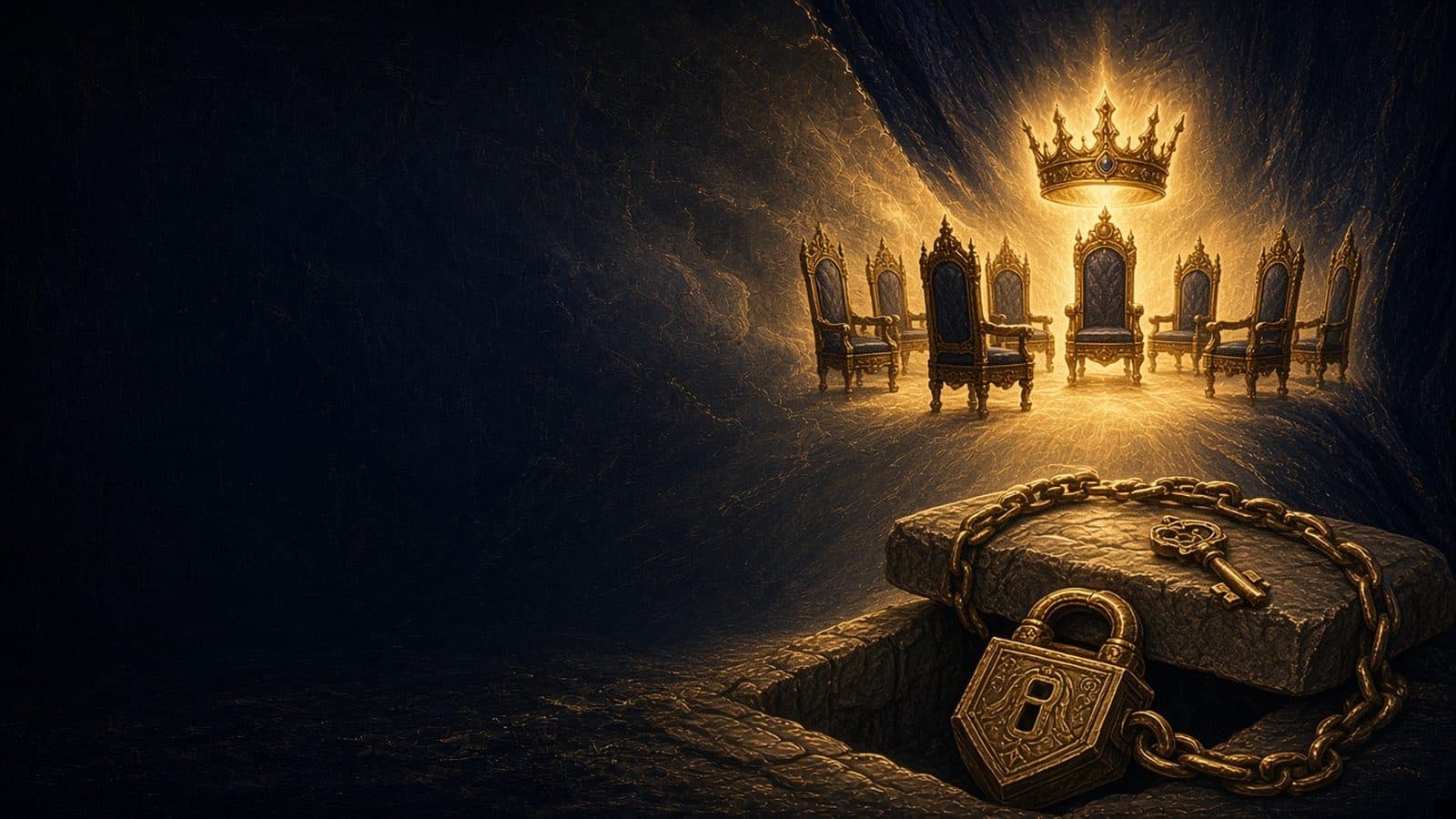
"I saw an angel coming down out of heaven, having the key of the abyss and a great chain in his hand." The abyss is the place where the powers of darkness are held (9:1-2). There a fallen star had been given its key and opened the pit; now an angel holds the key and shuts it.
The dragon is named four ways, just as in 12:9: "the dragon, the old serpent, which is the devil and Satan." The one who seemed so terrifying is seized by a single angel. No battle is recorded. He is bound "for a thousand years," cast into the abyss, shut in, and "sealed it over him," the way a stone and seal closed Daniel's den (Daniel 6:17) and later Jesus' tomb (Matthew 27:66).
The reason is stated plainly: "that he should deceive the nations no more." This is the heart of the binding. He is not stopped from existing, but from the specific work of deceiving the nations, the lie behind emperor worship and every counterfeit religion. Isaiah foresaw a time when God would imprison "the army of the high ones on high" and "the kings of the earth," shut up in the prison and, "after many days," "visited" (Isaiah 24:21-22).
And then a strange line: "After this, he must be freed for a short time." "Must" is the language of divine purpose. Even the devil's release is on God's timetable. Jesus himself spoke of binding "the strong man" to plunder his house (Matthew 12:29), and said, "Now the prince of this world will be cast out" (John 12:31).
20:4Thrones for the beheaded
"I saw thrones, and they sat on them, and judgment was given to them." The scene comes straight from Daniel 7. There "thrones were placed" and a horn "made war with the saints, and prevailed against them, until the ancient of days came, and judgment was given to the saints of the Most High" (Daniel 7:9, 21-22). Daniel's saints suffered, and then they were vindicated. So do John's.
Who sits on these thrones? John names them: "the souls of those who had been beheaded for the testimony of Jesus, and for the word of God," and "such as didn't worship the beast nor his image." The word for "beheaded" comes from the Greek for an axe. Many scholars think the second description fills out the first, so that one company of faithful witnesses is described two ways, those who died and those who refused. Others think it widens the circle to all faithful believers.
Notice the word "souls." We met these "souls" in 6:9, under the altar, crying, "How long, Master, the holy and true, until you judge and avenge our blood?" The people who sat on the lowest step in heaven now sit on thrones, and those whom Rome called guilty have judgment placed in their hands.
"They lived and reigned with Christ for a thousand years." The verb "lived" is the very one used of Jesus in 2:8: the first and the last, "who was dead, and has come to life." They share his resurrection life, and they share his throne (3:21).
20:5-6The first resurrection and the second death
"The rest of the dead didn't live until the thousand years were finished. This is the first resurrection." If there is a first resurrection, there must be a second, and Jesus did teach that all will hear his voice and come out of the tombs, "those who have done good, to the resurrection of life; and those who have done evil, to the resurrection of judgment" (John 5:28-29).
Then comes the fifth of the seven blessings in this book: "Blessed and holy is he who has part in the first resurrection. Over these, the second death has no power." The words "second death" first appeared in Jesus' letter to Smyrna, a church facing prison and death: "He who overcomes won't be harmed by the second death" (2:11). The first death is the one every body goes through. The second, as we will read in 20:14, is the final judgment. Those who belong to Jesus will go through the first at most, never the second.
And their future is not sitting on clouds. "They will be priests of God and of Christ, and will reign with him." The titles have been building since 1:6, "he made us to be a Kingdom, priests to his God and Father," and 5:10, where the redeemed are made "kings and priests" who "will reign on the earth." In Israel these roles were mostly kept apart, kings from Judah and priests from Levi. Now both belong to the people the world thought were nothing. Paul put it simply: "If we endure, we will also reign with him" (2 Timothy 2:12).
20:1-6Three main ways Christians read the thousand years
The phrase "thousand years" appears six times in verses 2 to 7, and thoughtful readers disagree about what it means.
Premillennial readers believe Christ returns before the thousand years. They see chapter 20 following chapter 19 in sequence: Satan is bound, the faithful dead rise bodily in the first resurrection, and Christ reigns on earth before a final rebellion and judgment. Some early Christian writers held this, and many believers since.
Amillennial readers believe the thousand years describes the present age, from Christ's first coming to his return. Satan is bound in the sense that he can no longer prevent the gospel from reaching the nations, and the "first resurrection" is either new life with Christ (Ephesians 2:5-6) or the faithful dead reigning with him in heaven. They see Revelation as telling the same story several times from different angles, so chapter 20 looks back over the same ground as chapter 19. This has been very widely held across the history of the church.
Postmillennial readers expect the gospel to spread so widely that a long era of blessing comes before Christ returns, and that he comes after it.
Each view takes the text seriously, and each has questions to answer. Good Christians can open the same page and see it differently, and we do not need to ridicule one another to love the Bible.
20:1-6What every orthodox reader holds
Look at what the views share, because the shared ground is large and firm. First, Christ reigns. Whether now, or visibly in the future, or both, the Lamb who was killed rules over every power. Second, Satan is a prisoner, not a rival. An angel with a chain handles him, and even his future release is something that "must" happen under God's rule. Third, the martyrs are vindicated. Those who were put to death for Jesus are not forgotten losers. They live and they reign. Fourth, resurrection is real and bodily. Christians of every view confess that the dead will be raised, "each in his own order," Christ the first fruits, then those who are his at his coming (1 Corinthians 15:23). Fifth, the second death has no power over those who belong to Jesus, because he has already passed through death and out the other side (Romans 6:9). And sixth, final judgment and a new creation follow, which is where the book is heading.
The gospel is behind all of it. "For him who knew no sin he made to be sin on our behalf; so that in him we might become the righteousness of God" (2 Corinthians 5:21). That exchange is why anyone can have "part in the first resurrection." Tomorrow the chain is unlocked, and we see the last rebellion.
Key words in Revelation 20:1-6
- Abyss (abyssos)
- A bottomless pit, in Jewish thought the prison of rebellious spirits. In Revelation it is where the powers of evil are shut in.
- Thousand years (chilia ete)
- A period of Christ's reign. Some take it literally, others as a symbol of a long, complete time. All agree that it is under God's control.
- First resurrection
- The rising of those who "lived and reigned with Christ." Some see it as a future bodily resurrection, others as new life now or as the faithful dead with Christ.
- Second death
- The final separation from God, described in 20:14 as "the lake of fire." Those who share Christ's life are beyond its reach.
Cross references
- Daniel 7:9-27Thrones are set, the saints suffer, and then judgment is given to them.
- Isaiah 24:21-23The powers on high and the kings of the earth shut up in a prison, and visited after many days.
- Matthew 12:29The strong man must be bound before his house is plundered.
- Revelation 6:9-11The souls under the altar, now seated on thrones.
- John 5:24-29Eternal life now, and a coming resurrection of life and of judgment.
- 1 Corinthians 15:20-26Christ the first fruits, and death the last enemy to be abolished.
Part B Three lenses on the text
The Pattern
How the whole Bible speaks here
This passage turns the book upside down, on purpose. In chapter 6 the souls of the martyrs were "underneath the altar," crying out, and they were given white robes and told to rest "yet for a while." In chapter 12 the dragon was thrown out of heaven. In chapter 13 he gave the beast "his authority." Here the order reverses. The dragon goes down, down, and down: thrown to earth (12:9), shut in the abyss (20:3), and then into the lake of fire (20:10). The martyrs go up: from under the altar to the seats of judgment.
Even their title fits a larger pattern. Daniel's night vision had four terrible beasts, then thrones, then "one like a son of man," and finally the kingdom "given to the people of the saints of the Most High" (Daniel 7:27). John's order is the same: beasts, then thrones, then the saints sharing the kingdom. The saints don't merely survive in this story. They inherit.
And the promise to the overcomer in the letter to Laodicea now has its fulfilment: "I will give to him to sit down with me on my throne, as I also overcame, and sat down with my Father on his throne" (3:21). He conquered by dying, and many of them by dying; in both cases the throne follows the cross. The book teaches us to read suffering as the road to a throne.
The Glory
What this shows us of God
Look at how little effort it takes. The enemy who deceived the world, threw down stars and made war on the saints is seized by an angel carrying a key. God has no rival. The Bible does not offer a cosmic contest of two equal powers. It offers one Lord, and one creature who has a chain on his neck. Even when he is let loose, the verse says he "must" be freed, which shows that evil, too, is held inside God's purposes, even when we cannot see why.
And the reason the dragon is chained is the cross. "Through death he might bring to nothing him who had the power of death, that is, the devil" (Hebrews 2:14). The accuser's best weapon was death, and Jesus took it from him by dying and rising. That is why the second death "has no power" over those who are his.
Here is the gospel in the passage: those who reign are the ones who were killed for Jesus, and they reign "with Christ." Their joy is not independence. It is nearness. "Priests of God and of Christ" means that the throne room is also the place of worship. Their greatest honour and God's greatest glory are not in competition. They are the same event: the Lamb's people sharing the Lamb's life, and giving him the praise.
The Challenge
What it asks of us
Can I say something gently? If you are like me, you may have spent more time debating the timeline of this passage than praying over what it asks of us. The debate matters. But the passage's own question is not which chart is right? It is whose side will I be on when the cost comes?
John's description is specific: thrones for those who "didn't worship the beast nor his image." Many scholars think the pressure was often quiet: a ritual at a civic festival, a nod, a small agreement to say what everyone else said. Refusing looks like that for most of us, too: not facing a sword, but declining to laugh at the joke, to fudge the number, to stay silent when someone is mocked for believing.
It will cost something. I do not know where you are most pressed to go along: a workplace, a friendship group, a family expectation, an online crowd. But you know.
The message of chapter 20 is that it is worth it. The world's verdict is not final. Those who were counted as losers are on the thrones. Choose the side that looks like the losing one today.
Part C Daily devotional
Reflection
Somewhere in most homes there is a drawer of keys nobody can identify. Some opened doors that are long gone. Some we keep just in case. Much of our anxiety is a kind of key collecting, a hope that enough plans and precautions will keep the dark outside.
Revelation 20 shows us who holds the key that matters. An angel carries the key of the abyss, and the dragon who has terrified the world is in a locked room. Elsewhere Jesus says, "I have the keys of Death and of Hades" (1:18). The keys are not lost. They are not in the enemy's pocket. They are with someone who loves us and who has already walked out of the grave.
You may be struggling to make sense of the thousand years, and that is fine. Hold the reading you believe is most faithful to the text, hold it kindly, and notice what no one disputes: evil is on a chain, the martyrs are vindicated, and the second death has no power over you if you are Christ's.
So breathe. You do not need to hold every key. Take the next small step, in the company of the one who does. He has been where you will go, and he has come back.
Questions for journaling
- What does the passage tell us about Satan's power, and how does it change the way you think about evil?
- Why do you think God seats the martyrs on thrones? What does that say about how heaven sees faithfulness?
- How can you hold your own reading of the thousand years in a way that respects other Christians?
- What does it mean to you that "the second death has no power" over those who belong to Jesus?
- Where are you being pressed to go along with something, and what would refusing look like this week?
Prayer
Father, thank you that the key is in your hand and that the enemy is on a chain. Thank you for the witnesses who were faithful to death, whom you have seated with Christ. I do not understand every detail of this chapter, but I trust the Lamb who died and rose. Let the second death have no power over me because he has made me his own. Give me courage to refuse what dishonours him, and make me gentle with those who read this passage differently. Teach me to reign with him by loving and serving. Amen.
Write Revelation 1:18 on a card or in your phone's notes and read it each time you feel anxious today, reminding yourself that Jesus holds the keys. Then pray for one Christian who sees this passage differently from you.
Blessed and holy is he who has part in the first resurrection. Over these, the second death has no power, but they will be priests of God and of Christ, and will reign with him one thousand years.Revelation 20:6 (WEB)
Common questions about Revelation 20:1-6
What is Revelation 20:1-6 about?
An angel locks the dragon away, the martyrs the world executed take their seats on thrones with Christ, and the second death has no power over those who share his resurrection.
Where does Revelation 20:1-6 fit in the book of Revelation?
Yesterday the beast and the false prophet were thrown alive into the lake of fire, and the kings who gathered against the Rider were struck down by the word of his mouth. One enemy is missing. The dragon, the old serpent who stood behind the beast in chapters 12 and 13, has not yet been dealt with. Chapter 20 turns to him.
What does “Abyss (abyssos)” mean in Revelation 20:1-6?
A bottomless pit, in Jewish thought the prison of rebellious spirits. In Revelation it is where the powers of evil are shut in.
What does “Thousand years (chilia ete)” mean in Revelation 20:1-6?
A period of Christ's reign. Some take it literally, others as a symbol of a long, complete time. All agree that it is under God's control.
What does “First resurrection” mean in Revelation 20:1-6?
The rising of those who "lived and reigned with Christ." Some see it as a future bodily resurrection, others as new life now or as the faithful dead with Christ.
How can I apply Revelation 20:1-6 today?
Write Revelation 1:18 on a card or in your phone's notes and read it each time you feel anxious today, reminding yourself that Jesus holds the keys. Then pray for one Christian who sees this passage differently from you.
What is a good memory verse for Revelation 20:1-6?
Revelation 20:6: “Blessed and holy is he who has part in the first resurrection. Over these, the second death has no power, but they will be priests of God and of Christ, and will reign with him one thousand years.” (WEB)
Free daily email
The daily study, in your inbox
One passage a day: a careful explanation, three lenses and a short devotional, sent to you by email. Free, and you can stop whenever you like.