Day 33
Before the Great White Throne
Revelation 20:7-15 13 min read WEB
What is Revelation 20:7-15 about?
In short: The devil's last deception ends in fire from heaven, the dead stand before the throne of the One who judges with perfect knowledge, and the only safe name is the one written in the Lamb's book of life.
Passage at a glance
- Passage
- Revelation 20:7-15 (WEB)
- Series
- Revelation, day 33 of 37
- Section
- The Final Victory
- Reading time
- 13 minutes
- Topics
- Final Judgment, Book Of Life, Hell, Gospel
- Key words
- Gog and Magog, Lake of fire, Book of life, Hades
- Previous passage
- Revelation 20:1-6
- Next passage
- Revelation 21:1-8
Part A Context
Yesterday ended with the faithful reigning with Christ and a warning tucked into the middle of the vision: after the thousand years, the dragon "must be freed for a short time" (20:3, WEB). Today the chain is unlocked, and the story moves quickly to its end. Satan's last move, his sentence, the last courtroom and the last enemy fill nine verses.
This is one of the sternest passages in the Bible, and it would be dishonest to soften it. It is also written for people who needed it. The first readers lived in a world where power seemed to decide everything. Courts could condemn a Christian, and the powerful rarely faced a reckoning. John answers that there is a court above every court, and every record is open there. For persecuted believers, that was good news. For everyone, it is serious news. It should be read slowly, carefully and with a trembling heart, because the Judge on this throne is the Jesus who died for sinners.
Part A Explanation
20:7-9Gog and Magog, and fire from heaven
"After the thousand years, Satan will be released from his prison, and he will come out to deceive the nations which are in the four corners of the earth, Gog and Magog, to gather them together to the war."
The names come from Ezekiel 38 and 39. There, Gog is "prince of Rosh, Meshech, and Tubal," from "the land of Magog," a great leader from the far north who comes against God's people when they are living "securely" (Ezekiel 38:2, 8). God turns him around, as with hooks in the jaws, and destroys the invader with hail, fire and sulfur (38:22) until the weapons are burned and the birds feast (39:9, 17-20). In John's use, the names have grown. Gog and Magog are no longer one northern prince. They are the nations from "the four corners of the earth," as many as "the sand of the sea." John uses them as a symbol of the world's last rebellion. He does not give them a map reference, and neither should we.
The army surrounds "the camp of the saints, and the beloved city," Zion, the city God "loved" (Psalm 78:68; 87:2). But there is no battle. "Fire came down out of heaven from God and devoured them." As in chapter 19, a single sentence ends the war. Ezekiel had said it: "I will send a fire on Magog" (39:6).
Why does it happen at all? Premillennial readers say this shows that even after a thousand years of peace the human heart still needs more than good conditions. Amillennial readers see a picture of the final rebellion at the end of the age, the same gathering described in 16:14-16 and 19:19. Either way, the deception is ended.
20:10The end of the deceiver
"The devil who deceived them was thrown into the lake of fire and sulfur, where the beast and the false prophet are also. They will be tormented day and night forever and ever."
Notice the order. The beast and the false prophet have been in the lake since 19:20, and they are "also" there still. The lake of fire is not a passing punishment. John's language is as strong as he can make it: "day and night forever and ever." The devil's end is final. The first promise of the Bible said the serpent's head would be crushed (Genesis 3:15), and Paul told the church in Rome, "the God of peace will quickly crush Satan under your feet" (Romans 16:20). Here is the last chapter of that promise.
Here we must be honest about what the text says. Evil is finally and irreversibly judged, and Jesus said the same: "the eternal fire which is prepared for the devil and his angels" (Matthew 25:41). We should not shrink this to comfort ourselves, and we should not decorate it with speculation. A sober reader keeps to what the Bible says.
There is mercy in it. A world where the serpent stayed free would be a world where no child, no prayer and no promise was ever safe. The end of the deceiver is the end of the lie. And notice that the fire was "prepared for the devil and his angels," not for people. That should make us grieve all the more when anyone ends up there.
20:11-12The great white throne
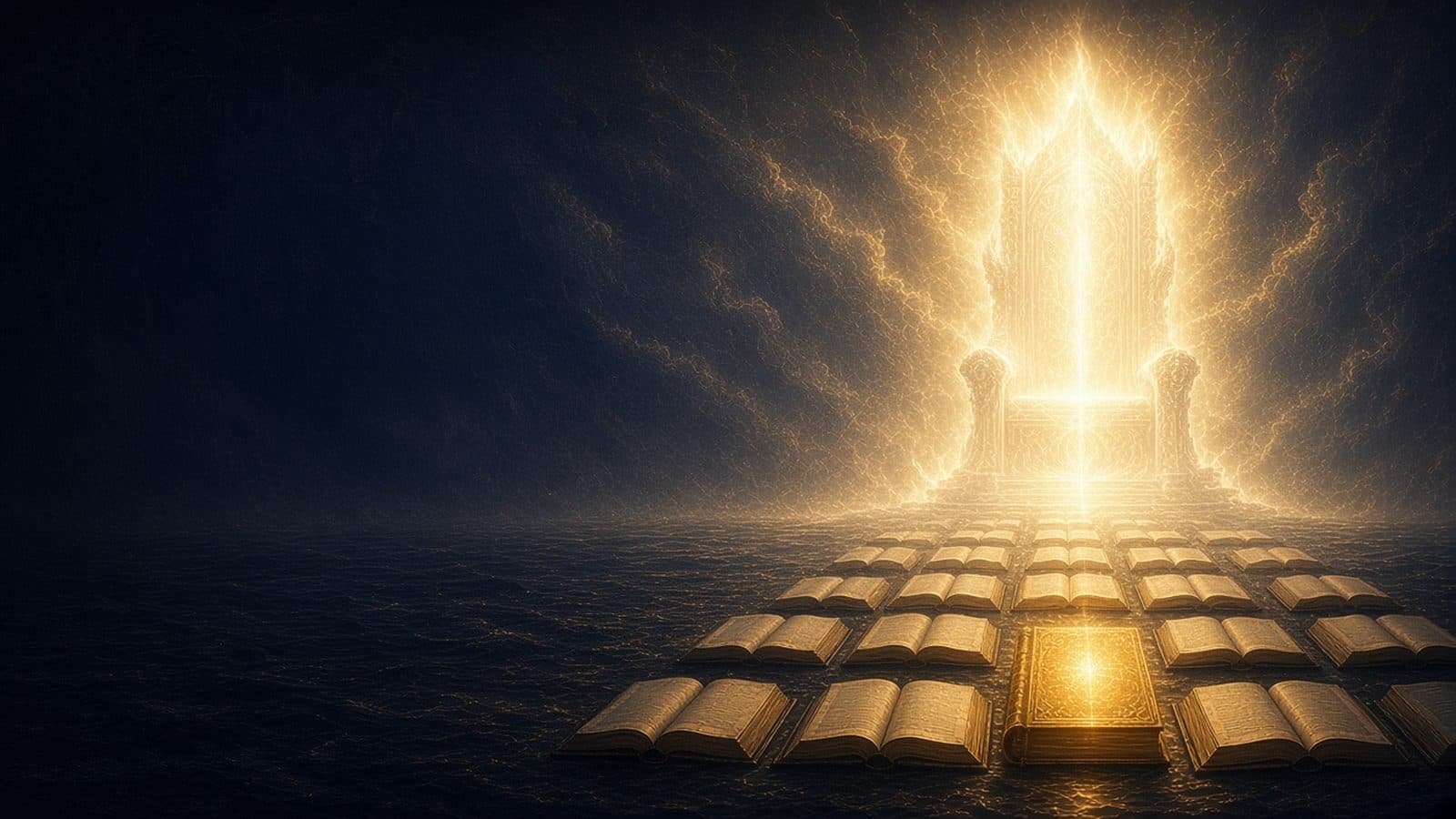
"I saw a great white throne, and him who sat on it, from whose face the earth and the heaven fled away. There was found no place for them." This is the most majestic image in the book. Creation itself cannot stand before the face of God, and there is nowhere to hide. It brings to mind the people in 6:15-17 who ask the mountains to fall on them and hide them from "the face of him who sits on the throne."
The throne is white, which means pure. The Judge goes unnamed, but the New Testament tells us who he is. "The Father judges no one, but he has given all judgment to the Son" (John 5:22), and God "has appointed a day in which he will judge the world in righteousness by the man whom he has ordained" (Acts 17:31). The Judge is Jesus. The one who bore our sin is the one who weighs it.
"I saw the dead, the great and the small, standing before the throne, and they opened books." Daniel saw it first: "The judgment was set. The books were opened" (Daniel 7:10). The books record deeds, and nothing is missing: "God will bring every work into judgment, with every hidden thing" (Ecclesiastes 12:14). No one is too small to be overlooked or too great to escape. Every wrong done in secret, every injustice that was never punished on earth, is known. This is the answer to the cry of the martyrs and to every unheard victim.
And then: "Another book was opened, which is the book of life." The first set records what people did. The second records whom God has claimed. The dead "were judged out of the things which were written in the books, according to their works."
20:13-15Death dies, and one name matters
"The sea gave up the dead who were in it. Death and Hades gave up the dead who were in them." No grave is too deep or too forgotten, no body too lost, and no ocean too wide. Every person who has ever lived is brought before the throne.
Then comes a line of astonishing hope in the middle of dread: "Death and Hades were thrown into the lake of fire." Death and Hades rode together in 6:8, on the pale horse that killed with the sword, famine and wild beasts. They have been the last word on every funeral. Jesus had said, "I have the keys of Death and of Hades" (1:18). Now they are thrown away. Paul had written that "the last enemy that will be abolished is death" (1 Corinthians 15:26), and Isaiah that God "has swallowed up death forever" (Isaiah 25:8). It is done. For those who belong to Christ, the grave will never have the last word again.
"This is the second death, the lake of fire." And then the verse that all the others lead to: "If anyone was not found written in the book of life, he was cast into the lake of fire."
There is no gloating here and no detailed description. The verse says what the standard is: not who is clever or religious, but whether the name is written. And that book is described elsewhere as "the book of life of the Lamb who has been killed" (13:8). Tomorrow, John will hear a voice from the throne saying, "Behold, I am making all things new."
Key words in Revelation 20:7-15
- Gog and Magog
- In Ezekiel, a northern prince and his land who attack God's people and are destroyed. In Revelation the names stand for the nations gathered in one last rebellion.
- Lake of fire
- The final place of judgment, prepared for the devil and his angels. It is called "the second death."
- Book of life
- The record of those who belong to God. In Revelation it belongs to the Lamb who was killed, and so entry depends on his death for sinners.
- Hades
- The realm of the dead, the usual Greek translation of Sheol. In this chapter it is judged and ended along with Death.
Cross references
- Ezekiel 38:1-23; 39:1-29Gog and Magog: the northern prince, the fire and sulfur, and God's glory among the nations.
- Daniel 7:9-10Thrones set, and the books opened before the Ancient of Days.
- John 5:22-29The Son is given all judgment, and those who hear his word pass from death into life.
- 1 Corinthians 15:24-26Death is the last enemy to be abolished.
- Colossians 2:13-15The record that stood against us was nailed to the cross.
- Ezekiel 33:11God takes no pleasure in the death of the wicked and calls them to turn.
Part B Three lenses on the text
The Pattern
How the whole Bible speaks here
Ezekiel gives us the best map to this chapter. His book moves in three steps: the valley of dry bones that live (chapter 37), the invasion of Gog and Magog (chapters 38-39), and then the vision of a new temple and a river of life (chapters 40-48). Many scholars notice that Revelation follows the same order. Here are the faithful dead coming to life (20:4-6), then Gog and Magog (20:7-9), and then the holy city, the river of life and the tree (chapters 21-22). John is not copying. He is finishing what Ezekiel began.
Look also at the second death. It first appears in the letter to Smyrna: "He who overcomes won't be harmed by the second death" (2:11). It is repeated at 20:6 and 20:14, and again at 21:8. The promise to the overcomers in the early chapters now has its counterpart in the final chapters. And the promise in the letter to Sardis, "I will in no way blot his name out of the book of life" (3:5), is answered by the book opening here.
Finally, notice who walks away. Death and Hades, who have trailed the horsemen since chapter 6, are cast out. The enemy who has followed every funeral is finally escorted to the exit. John arranges the book so that the last things to die are the things that killed us.
The Glory
What this shows us of God
The throne is white because God is holy. He will not call evil good, and he will not call himself unjust. The books are opened because he is just: nothing is hidden, nothing is forgotten, and no one is condemned on rumour. This is not a God who tosses a coin or loses his temper. It is the God of Psalm 9:8, who "will judge the world in righteousness." Every wrong will be named and answered.
But the passage is more than law. The books contain our sins too, and anyone would be lost if the scene ended with them. So look at the second book, and at whose it is: "the book of life of the Lamb who has been killed" (13:8). Paul says of Jesus' cross that God was "wiping out the handwriting in ordinances which was against us; and he has taken it out of the way, nailing it to the cross" (Colossians 2:14). The charge sheet was nailed to the cross, and the name was written in the Lamb's book. That is the gospel in the middle of the judgment.
None of this is gleeful. God says, "I have no pleasure in the death of the wicked" (Ezekiel 33:11), and Peter says he is "not wishing that any should perish" (2 Peter 3:9). The throne is glorious because it is just, and the book is glorious because it is mercy.
The Challenge
What it asks of us
Can we be honest? Most of us avoid this chapter, partly because we do not want to sound harsh. But if we believe it, then people we love may stand before that throne without the Lamb's name. How are we living if we believe that?
Paul did not shrug about it. Of his own people who had not believed, he wrote, "I have great sorrow and unceasing pain in my heart" (Romans 9:2). When did you last feel something like that? When did you last pray by name, with tears, for a friend or a family member who does not know Jesus? When did you last say a single word to them?
This is not meant to shame. I am asking myself too. If a building were on fire and the people inside were asleep, you would not worry about being polite, and you would not decide who deserves rescue. You would shout.
It is also for the quiet follower who lies awake afraid of the books. Jesus said, "He who hears my word, and believes him who sent me, has eternal life, and doesn't come into judgment, but has passed out of death into life" (John 5:24). Your name has been written by the one who died to write it. Live like it, and invite others to the same book.
Part C Daily devotional
Reflection
Think of the oldest handwriting you own, perhaps a name tape sewn into a school coat. Someone sat down with a pen and wrote your name there, and what it said was simple: this one is mine.
Revelation 20 is heavy, and I do not want to rush past it: the great white throne, the opened books, the sea giving up its dead, the second death. Nothing sentimental here. But in the middle of the sternest scene in the Bible there is a book with names in it, and the Lamb who was killed wrote them.
That is the thing to hold today. You will not be judged by a stranger. The Judge is the one who died for you, and he knows every page of the other books. He has already dealt with them on the cross. He says to everyone who thirsts, "Come."
If you are not sure that your name is there, do not wait until you feel good enough. "He who desires, let him take the water of life freely" (22:17). And if you are sure, then thank him slowly, and let the thought of those whose names you carry in your heart make you brave enough to speak.
Questions for journaling
- The scene shows creation fleeing from the face of the Judge. What does this tell you about the holiness of God?
- Why is it important that the Judge is Jesus himself? How does that change the way you think about the books?
- Death and Hades are thrown into the lake of fire. What does it mean for you that death itself will die?
- Which three people do you most want to see written in the book of life? How could you pray for each of them this week?
- What is one honest conversation about Jesus that you have been avoiding?
Prayer
Father, you are holy, and the earth and the heaven cannot stand before your face. I thank you that the Judge on that throne is the Lamb who died for me, and that he has written my name in his book. Keep me from fear and from carelessness. Teach me to weep for the people I love who do not know you, and give me the courage to speak. Thank you that death itself will die. Help me to trust your justice and to wait for the new creation, where you will make all things new. Amen.
Write down the names of three people you love who do not follow Jesus, and pray for each by name today. Then choose one and ask God for a simple way to show them kindness this week and a gentle chance to speak about him.
If anyone was not found written in the book of life, he was cast into the lake of fire.Revelation 20:15 (WEB)
Common questions about Revelation 20:7-15
What is Revelation 20:7-15 about?
The devil's last deception ends in fire from heaven, the dead stand before the throne of the One who judges with perfect knowledge, and the only safe name is the one written in the Lamb's book of life.
Where does Revelation 20:7-15 fit in the book of Revelation?
Yesterday ended with the faithful reigning with Christ and a warning tucked into the middle of the vision: after the thousand years, the dragon "must be freed for a short time" (20:3, WEB). Today the chain is unlocked, and the story moves quickly to its end. Satan's last move, his sentence, the last courtroom and the last enemy fill nine verses.
What does “Gog and Magog” mean in Revelation 20:7-15?
In Ezekiel, a northern prince and his land who attack God's people and are destroyed. In Revelation the names stand for the nations gathered in one last rebellion.
What does “Lake of fire” mean in Revelation 20:7-15?
The final place of judgment, prepared for the devil and his angels. It is called "the second death."
What does “Book of life” mean in Revelation 20:7-15?
The record of those who belong to God. In Revelation it belongs to the Lamb who was killed, and so entry depends on his death for sinners.
How can I apply Revelation 20:7-15 today?
Write down the names of three people you love who do not follow Jesus, and pray for each by name today. Then choose one and ask God for a simple way to show them kindness this week and a gentle chance to speak about him.
What is a good memory verse for Revelation 20:7-15?
Revelation 20:15: “If anyone was not found written in the book of life, he was cast into the lake of fire.” (WEB)
Coming soon
The daily devotional, in your inbox
We’re preparing an emailed edition of each day’s study. Signup isn’t open yet, and nothing you type here is collected.