Day 31
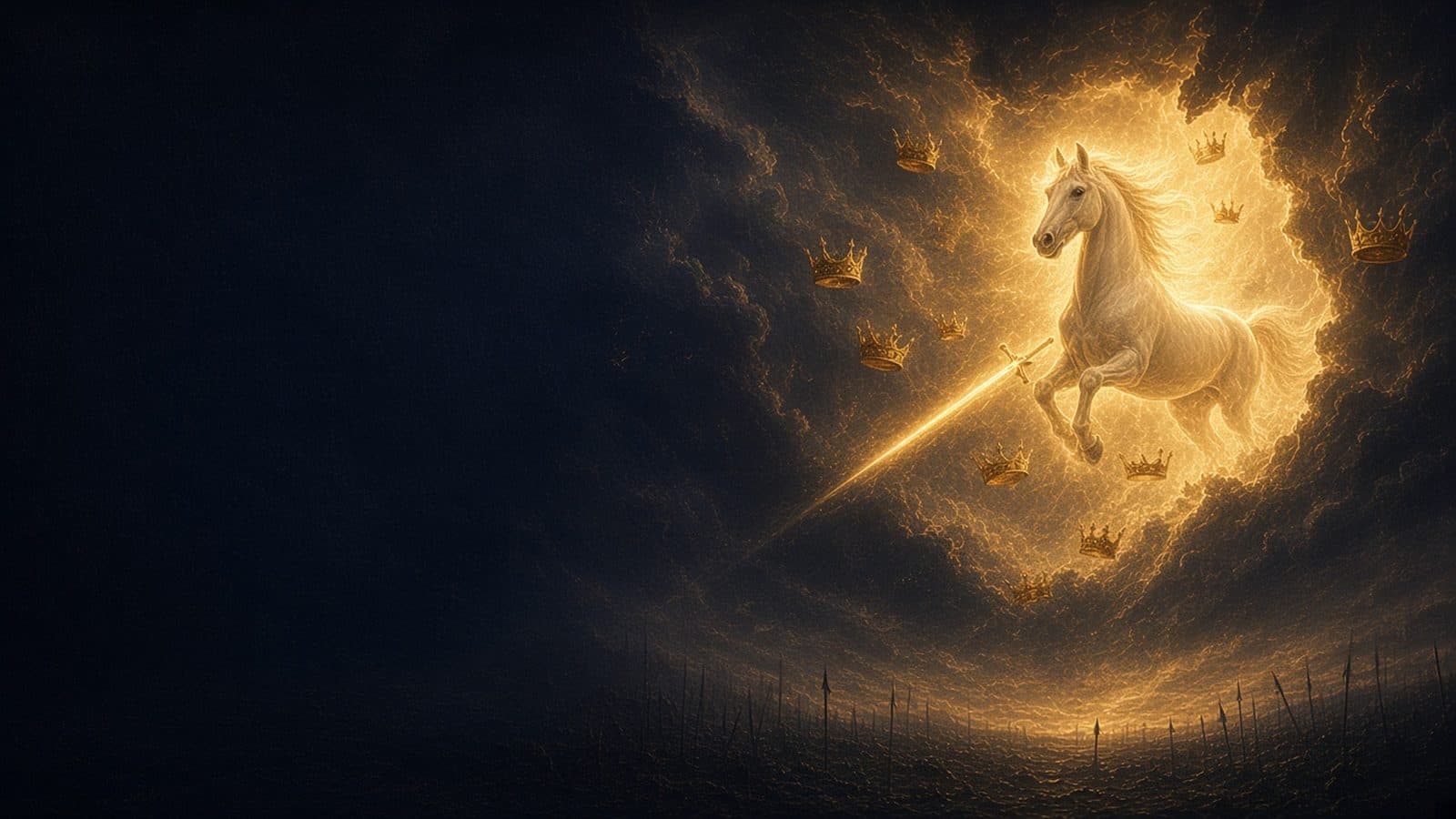
The Rider Called Faithful and True
Revelation 19:11-21 13 min read WEB
What is Revelation 19:11-21 about?
In short: Heaven opens and Jesus comes out as the Word of God on a white horse, King of kings, who defeats the beast and the false prophet and every rebel army with nothing but the word of his mouth.
Passage at a glance
- Passage
- Revelation 19:11-21 (WEB)
- Series
- Revelation, day 31 of 37
- Section
- The Final Victory
- Reading time
- 13 minutes
- Topics
- Second Coming, Victory, Kingship, Judgment
- Key words
- Faithful and True (pistos kai alethinos), The Word of God (ho logos tou theou), Sword from the mouth (rhomphaia), Lake of fire
- Previous passage
- Revelation 19:1-10
- Next passage
- Revelation 20:1-6
Part A Context
Yesterday closed with an angel's rebuke and a quiet statement: "the testimony of Jesus is the Spirit of Prophecy" (19:10, WEB). The wedding is announced, and the bride is ready. Now the camera lifts, and the book that has shown us letters, seals, trumpets and bowls turns to the moment all of them were pointing toward.
The first readers lived in a world of imperial victory. Roman power celebrated its generals with parades, festivals and coins that proclaimed the emperor's conquests, and cities in Asia competed to honour him. Christians were told daily who was lord. Revelation 19 answers with a very different procession. Notice what it does not contain. There is no extended account of fighting and no clever tactics. The heavens open, the Rider comes, and the verdict falls. Some readers connect it to the gathering at Armageddon (16:14-16) and to the kings who "will war against the Lamb" in 17:14. The outcome is the same in every case: the Lamb overcomes.
Part A Explanation
19:11-13Heaven opened, and a rider comes out
"I saw the heaven opened." Earlier in the book John was invited in. A door stood open in heaven (4:1), and the temple was opened (11:19; 15:5). Now heaven itself is opened, and someone comes out. When Jesus was baptised, "the heavens were opened to him" (Matthew 3:16). The Son who went down to the water now rides out of the sky to the world.
His first name is "Faithful and True." In the letter to Laodicea he was "the Amen, the Faithful and True Witness" (3:14). Everything he has promised, he does. Next come the words, "in righteousness he judges and makes war." Those two verbs do not belong together in our minds, but they do in Isaiah's picture of the Messiah, who will judge the poor "with righteousness" and, "with the breath of his lips," will "kill the wicked" (Isaiah 11:4).
His eyes are "a flame of fire," as in 1:14, and on his head are "many crowns." The dragon wore seven crowns (12:3) and the beast ten (13:1), borrowed authority. The Rider's many crowns are his by right. There is a name no one knows but him, a sign that no one has the measure of the King.
"He is clothed in a garment sprinkled with blood." The battle has not begun, so whose blood is it? Some link it to Isaiah 63:1-3, the warrior whose garments are stained from the wine press. Many take it as his own blood on the cross, the true source of his victory (5:6; 12:11). The two readings are not rivals. His name is "The Word of God."
19:14-16The armies, the sword and the name
"The armies which are in heaven followed him on white horses, clothed in white, pure, fine linen." That is the same linen as the bride's gown (19:8), and the same white as the robes washed in the Lamb's blood (7:14). The army and the bride are one people. Notice, too, what they are not given. No weapon is mentioned. They follow; he fights.
The weapon is from his mouth: "a sharp, double-edged sword, that with it he should strike the nations." We saw this sword in the first vision (1:16) and in the warnings of chapters 2 and 3. The picture comes from Isaiah 11:4, and Paul has the same picture in 2 Thessalonians 2:8: the lawless one, "whom the Lord will kill with the breath of his mouth." His word is the sword.
"He will rule them with an iron rod" points to Psalm 2:9, the psalm where the nations rage and God's Anointed is given the earth. We heard it at 12:5. He also "treads the wine press of the fierceness of the wrath of God, the Almighty," the picture first drawn in 14:19-20 and taken from Isaiah 63. That is a terrifying image, and it should be. The same King who was gentle with sinners is the one all rebellion must face.
Finally, "he has on his garment and on his thigh a name written": "KING OF KINGS, AND LORD OF LORDS." The title promised to the Lamb in 17:14 is at last displayed in full. The emperor's titles were stamped on the coins in every pocket. This one is written on the Rider.
19:17-18The other supper
An angel stands "in the sun," the brightest place in the sky, and calls to every bird: "Come! Be gathered together to the great supper of God, that you may eat the flesh of kings, the flesh of captains, the flesh of mighty men."
This is a dreadful reversal of yesterday. In 19:9, the guests were invited to "the marriage supper of the Lamb." Here, the birds are invited to "the great supper of God." There are only two suppers, and everyone is at one or the other. The Lamb's table is for those who have come in answer to his call. The other is for those who have refused it.
The invitation comes from Ezekiel 39:17-20, where the prophet is told to call the birds and animals to a great sacrifice on the mountains of Israel after the defeat of Gog. We will meet Gog and Magog by name in 20:8. For now notice that John borrows Ezekiel's image to say that the enemies of God come to the end that the prophets said they would.
The list of victims, "kings," "captains," "mighty men," "free and slave," "small and great," runs through every rank of society. The same ranks hid in the caves from "the wrath of the Lamb" (6:15-17). In 19:5 "small and great" praised God. The divide is not by rank, but by who stands with the Lamb.
19:19-21The battle that never happens
"I saw the beast, and the kings of the earth, and their armies, gathered together to make war against him who sat on the horse." This is the battle the book has been preparing since the sixth bowl. What follows is astonishingly brief: "The beast was taken, and with him the false prophet." There is no description of struggle. They are seized.
The two figures are the beast of 13:1-10 and the second beast of 13:11-18, now called the false prophet, "who worked the signs in his sight" and deceived those who took the mark. "These two were thrown alive into the lake of fire that burns with sulfur." It is the first time the lake of fire appears, and it will not be the last. "The rest were killed with the sword of him who sat on the horse, the sword which came out of his mouth."
Christians have understood the timing of this battle in different ways. Some see 19:19-21 and 20:7-10 as two separate conflicts, one before and one after the thousand years. Others think they are two views of the same last conflict. All agree on the main point: the powers that persecuted God's people, the empire that demanded worship and the lie that supported it, do not survive his appearing.
This scene is not given to Christians as a licence for violence. His armies are dressed in linen. Paul says, "Don't seek revenge yourselves, beloved, but give place to God's wrath" (Romans 12:19). Judgment belongs to the Rider. And the dragon who gave the beast his power (13:4)? He is not mentioned here. Tomorrow an angel comes down with a key and a chain.
Key words in Revelation 19:11-21
- Faithful and True (pistos kai alethinos)
- "Faithful" means trustworthy: he keeps his word. "True" means real, as opposed to counterfeit. Together they set him against the false powers that promise and do not deliver.
- The Word of God (ho logos tou theou)
- The name links this Rider to the Word who was with God and was God (John 1:1) and through whom everything was made. His speech is both creation and judgment.
- Sword from the mouth (rhomphaia)
- A large sword. It is a picture of the power of Christ's spoken word, not a metal weapon. The enemies are defeated by what he says.
- Lake of fire
- The final place of judgment for God's enemies. It appears here for the first time and returns in chapters 20 and 21.
Cross references
- Isaiah 11:1-5The Messiah who judges the poor with righteousness and strikes with the breath of his lips.
- Isaiah 63:1-6The warrior from Edom whose garments are stained from the wine press.
- Psalm 2The nations rage, and God's King receives them with an iron rod.
- Ezekiel 39:17-20The invitation to the birds to a great sacrificial feast after Gog falls.
- 2 Thessalonians 2:8The lawless one killed by the breath of the Lord's mouth.
- Zechariah 9:9The King who comes humble, on a donkey: the same King, a different coming.
Part B Three lenses on the text
The Pattern
How the whole Bible speaks here
Put chapter 1 next to chapter 19 and you will hear an echo. In the first vision John saw one "like a son of man" with eyes like "a flame of fire" and a sharp two-edged sword coming out of his mouth (1:14-16). Here are the same eyes, the same sword. In 1:5 he is "the faithful witness" and "the ruler of the kings of the earth"; here he is Faithful and True and KING OF KINGS. The Jesus at the centre of the lampstands is the Jesus on the horse. The whole book is a set of portraits of one person.
Now add the donkey. Matthew tells us that Jesus entered Jerusalem "humble, and riding on a donkey," fulfilling Zechariah 9:9. Many see the donkey as the mount of a king coming in peace, and the horse as the mount of a king going to war. Those two animals mark two comings of the same King. The first time he came to be judged, and bore the sentence himself. The second time he comes to judge. The blood on the Rider's robe is the bridge between them: he is the Lion who is also the Lamb (5:5-6).
One more pattern: in chapter 6 a rider on a white horse "came out conquering, and to conquer" (6:2). Interpreters differ about him, and many think he is a counterfeit, conquest without love. Chapter 19 gives us the real conqueror, whose victory is won by his word.
The Glory
What this shows us of God
The words "in righteousness he judges and makes war" make some of us uneasy. We prefer a gentle Jesus. But think of a world without a judge: every murderer unaccountable, every tyrant safe, every cry of the oppressed met with silence. That would not be love. God's wrath is what his love looks like when it meets what destroys the people it made. The Rider's war defends everything good.
Notice the winepress in Isaiah 63. The warrior says, "I have trodden the wine press alone; and of the peoples, no one was with me," and then gives the reason: "the year of my redeemed has come." His fury and his rescue are one act.
And it is effortless. There is no struggle on this field. The word that made the light ("Let there be light," Genesis 1:3) is the word that ends the war. The evil that has spent the whole book frightening and persecuting God's people is overcome by a sentence. His glory is not that the enemy is strong and he is stronger. It is that the enemy was never in the same class.
The Rider is also the one who stopped Saul on the Damascus road: "Saul, Saul, why do you persecute me?" (Acts 9:4). The persecutor was not destroyed; he was called. Today the invitation is open, and the door of mercy stands open until the heavens do.
The Challenge
What it asks of us
Can we ask the question that we most avoid? When the Rider comes, which side am I on?
It is tempting to read this passage and cheer for the Rider against our enemies: the people we think are wrong, the party we dislike, the neighbour who has hurt us. But he is "Faithful and True," and that cuts through everything, including me. He is not coming to endorse my side. He is coming to put the world right, and I am part of what needs putting right. The only safe place to be is among those wearing his linen, following him on foot, washed in his blood.
Look also at the army. They carry no weapon. They follow. Many of us are impatient and want to take God's justice into our own hands, in our words, on the internet, in our grudges. But Paul says to "give place to God's wrath." Our task is to be faithful and true ourselves.
That is a challenge in small things. Do I keep my promises? Is my yes really yes? Am I the same person in private as in public? He is the rider named Faithful and True, and we are the people who bear his name. Heaven is going to open. We should live as if we believe it will, and as if we want to be found among those following him.
Part C Daily devotional
Reflection
Think of the one person whose word you have never had to check. You do not read the small print. You do not ask for a receipt. If they say they will be there, they are there. For most of us that person is rare, and we feel quietly rich to have known them.
Revelation 19 gives that person a name and a horse. Faithful and True. Jesus does not make promises he cannot keep, and he does not say one thing and do another. Every promise in this book, that the dragon will fall, that the martyrs will be vindicated, that tears will be wiped away, is signed by someone whose word has never failed.
If the blood on his robe is his own, as many think, I find it moving that it is there before the battle. He goes out with the marks of what he has already done for us. We do not follow a general who stayed safely behind. We follow the one who gave his life, and whose word, when it comes, cannot be resisted.
So whatever is heavy on you today, a difficult conversation, an illness, a fear for someone you love, remember who is coming. It is not someone who will break his word. It is the one whose word made the world. Wait for him, follow him, and trust him.
Questions for journaling
- What do the names given to the Rider in 19:11-16 tell you about who Jesus is? Which one speaks to you most today?
- His robe is "sprinkled with blood" before the battle starts. What does this suggest about how Jesus wins?
- The armies who follow him carry no weapons. What might that teach us about how we respond to wrong and injustice?
- Where do you struggle to trust that Jesus is "Faithful and True" right now?
- What is one small way you could be more faithful and true in your own words and promises this week?
Prayer
Father, thank you that heaven will open and your Son will ride out, Faithful and True. He is King of kings and Lord of lords, and I bow to him. Thank you that his robe was marked with blood for me before any battle was fought. Forgive me for wanting to take your justice into my own hands. Make me faithful in small things, and true in what I say. Keep me among those who follow him in white linen, and help me to trust you in everything that is heavy today. Amen.
Make a list of any promises you have made recently, to a family member, a colleague or a friend. Keep one of them today, or honestly tell the person you cannot, and thank Jesus that he is Faithful and True.
I saw the heaven opened, and behold, a white horse, and he who sat on it is called Faithful and True. In righteousness he judges and makes war.Revelation 19:11 (WEB)
Common questions about Revelation 19:11-21
What is Revelation 19:11-21 about?
Heaven opens and Jesus comes out as the Word of God on a white horse, King of kings, who defeats the beast and the false prophet and every rebel army with nothing but the word of his mouth.
Where does Revelation 19:11-21 fit in the book of Revelation?
Yesterday closed with an angel's rebuke and a quiet statement: "the testimony of Jesus is the Spirit of Prophecy" (19:10, WEB). The wedding is announced, and the bride is ready. Now the camera lifts, and the book that has shown us letters, seals, trumpets and bowls turns to the moment all of them were pointing toward.
What does “Faithful and True (pistos kai alethinos)” mean in Revelation 19:11-21?
"Faithful" means trustworthy: he keeps his word. "True" means real, as opposed to counterfeit. Together they set him against the false powers that promise and do not deliver.
What does “The Word of God (ho logos tou theou)” mean in Revelation 19:11-21?
The name links this Rider to the Word who was with God and was God (John 1:1) and through whom everything was made. His speech is both creation and judgment.
What does “Sword from the mouth (rhomphaia)” mean in Revelation 19:11-21?
A large sword. It is a picture of the power of Christ's spoken word, not a metal weapon. The enemies are defeated by what he says.
How can I apply Revelation 19:11-21 today?
Make a list of any promises you have made recently, to a family member, a colleague or a friend. Keep one of them today, or honestly tell the person you cannot, and thank Jesus that he is Faithful and True.
What is a good memory verse for Revelation 19:11-21?
Revelation 19:11: “I saw the heaven opened, and behold, a white horse, and he who sat on it is called Faithful and True. In righteousness he judges and makes war.” (WEB)
Free daily email
The daily study, in your inbox
One passage a day: a careful explanation, three lenses and a short devotional, sent to you by email. Free, and you can stop whenever you like.