Day 19
The Kingdom Changes Hands
Revelation 11:15-19 13 min read WEB
What is Revelation 11:15-19 about?
In short: When the seventh trumpet sounds, heaven does not describe a catastrophe but sings a coronation: the rule of the world passes openly to God and his Christ, the nations meet their judgment, the faithful receive their reward, and God's covenant faithfulness stands revealed.
Passage at a glance
- Passage
- Revelation 11:15-19 (WEB)
- Series
- Revelation, day 19 of 37
- Section
- The Seven Trumpets
- Reading time
- 13 minutes
- Key words
- Kingdom (basileia), Christ (christos), Ark of the covenant, Destroy those who destroy (diaphtheiro)
- Previous passage
- Revelation 11:1-14
- Next passage
- Revelation 12:1-17
Part A Context
What does it sound like when history reaches its turning point? Yesterday ended with two witnesses raised to their feet and a short, ominous line: the second woe is past, and the third is coming quickly. After six trumpets of rising alarm, we are braced for the worst yet.
Instead, the seventh angel blows his trumpet, and heaven answers with singing. There is no new plague and no description of destruction. The most terrible trumpet in the series is the one that produces a song.
For churches in Roman Asia, this was the answer to a very practical question: who is really in charge? Their cities displayed the emperor's images and called him lord. Believers were pressed to agree. Revelation 11:15-19 lifts the curtain and shows that the real transfer of authority is happening elsewhere. Many scholars think this scene gives a summary of the end that the rest of the book will unpack from other angles, while others see it as the next step in a sequence. Either way, it is the high point of the trumpets, and it stands at the hinge of the whole book.
Part A Explanation
11:15The announcement
"The seventh angel sounded, and great voices in heaven followed, saying, 'The kingdom of the world has become the Kingdom of our Lord, and of his Christ. He will reign forever and ever!'" (WEB)
Look at the grammar of the announcement. The word for "kingdom" is singular. The world has many rulers and many kingdoms, but one overarching rule is passing, as if all the separate thrones merge into a single throne. And it "has become" the Kingdom of the Lord, stated as done even though much of the story still lies ahead. Heaven speaks of it as finished because God has decided it.
Behind this stands a temptation scene. In Matthew 4:8-9 the devil showed Jesus "all the kingdoms of the world, and their glory," and offered them in exchange for worship. Jesus refused the shortcut and took the road to the cross. Now the kingdoms come to him as a gift, by the right route and in the right way.
"His Christ" means his Messiah, his Anointed One. The line gathers up Psalm 2 and Daniel 7:13-14, where dominion is given to the one like a son of man. And "He will reign forever and ever" echoes the song of Moses after the Red Sea: "Yahweh shall reign forever and ever" (Exodus 15:18). The God who defeated Pharaoh is the same God who will defeat every power that exalts itself.
11:16-17A thanksgiving with something missing
The twenty-four elders, who represent the whole people of God in heaven, fall on their faces. Their worship has a shape we should notice: they thank before they ask. "We give you thanks, Lord God, the Almighty, the one who is and who was; because you have taken your great power, and reigned."
Compare that with the way God is named earlier in the book. In 1:4 and 1:8, and again in the worship of 4:8, he is the one "who is and who was and who is to come." Here the third part is gone. John has dropped "who is to come." Why? Many readers believe it is because he has now come. The One for whom creation was waiting has arrived, and there is no more waiting.
The elders also say God has "taken" his power. He did not lack power before, and the throne room has been secure since chapter 4. What changes is that his power is now exercised openly and finally against everything that opposed it. Patience has done its work. What was always true is now seen to be true.
Worship is the right response here. We do not simply learn that God reigns. We bow. In the Bible, knowing who is on the throne is never only information. It is a summons to fall on our faces and say thanks.
11:18Four things at once
Verse 18 is packed. "The nations were angry, and your wrath came, as did the time for the dead to be judged, and to give your bondservants the prophets, their reward, as well as to the saints, and those who fear your name, to the small and the great; and to destroy those who destroy the earth."
First, the nations' anger. This is Psalm 2 compressed. In Psalm 2 the nations rage against "Yahweh, and against his Anointed," and God answers from heaven. Notice the order: their anger, then his wrath. The nations rage against God, and God's reply is not a tantrum but a verdict.
Second, the judgment of the dead. Every person gives an account to the One who made them.
Third, the reward. "Reward" in the Bible is not a wage that God owes. It is what a generous Father delights to give, and Psalm 115:13 sees it reaching "both small and great." The prophets, the saints, and the unnamed who fear his name are all gathered: no one is forgotten.
Fourth, the destroying of destroyers. In Greek the same verb appears twice: God will "ruin the ruiners." Everything that spoils what God has made, through violence, injustice, and idolatry, will be dealt with. That is not cruelty. A world without this verse would be a world where evil has the last word. Wrath here is God's holy refusal to let it.
11:19The ark in the open temple
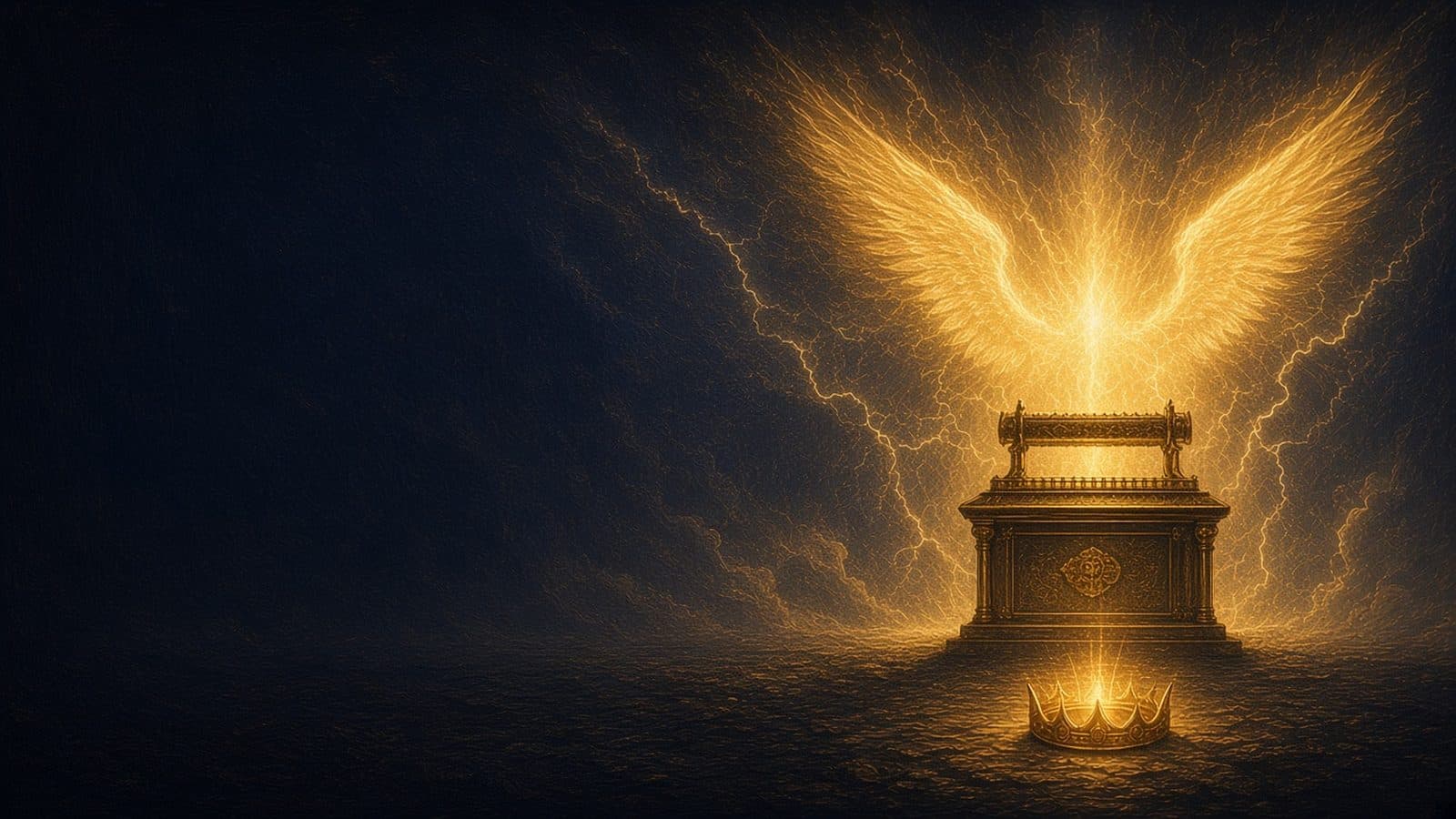
The last verse is a surprise. "God's temple that is in heaven was opened, and the ark of the Lord's covenant was seen in his temple. Lightnings, sounds, thunders, an earthquake, and great hail followed."
The ark of the covenant was the golden chest in the Holy of Holies, with a lid called the mercy seat, where God met his people (Exodus 25:21-22). Once a year the high priest sprinkled blood on it to atone for the nation's sin (Leviticus 16:14-15). Many scholars think the ark was lost when Babylon destroyed the first temple, and the prophet Jeremiah even foretold a day when people would no longer say, "the ark of Yahweh's covenant!" (Jeremiah 3:16). Here it appears again in the true temple in heaven.
Why the ark, and why now? Because it reminds us who this King is. He is the God of the covenant. The throne that judges the nations is the throne of the mercy seat. The book of Hebrews says Christ entered the greater tabernacle "through his own blood" and obtained "eternal redemption" (Hebrews 9:12). The ark is the proof that God's judgment and his mercy come from the same faithfulness.
The thunder, lightning, earthquake, and hail now familiar from 4:5 and 8:5 grow again, with hail added. The same set of signs will return at 16:18-21, and it is a way of saying that the God of the covenant is also a consuming fire. Both are true.
And the lightning has not finished. Tomorrow, in chapter 12, a new sign appears in the sky, and the focus turns from the throne to the war behind the throne: a woman, a child, and a dragon.
Key words in Revelation 11:15-19
- Kingdom (basileia)
- Royal rule, not merely a territory. It describes the reign of a king over those who belong to him. Here it is singular: all rule is gathered into God's one reign.
- Christ (christos)
- The Greek form of 'Messiah,' meaning the Anointed One. The title links Jesus with the promised king of Psalm 2 and Daniel 7 who receives the nations.
- Ark of the covenant
- The golden chest in the Holy of Holies, with the mercy seat on top, where God met his people and where atonement blood was sprinkled. Its appearance in heaven shows that God's reign rests on his covenant mercy.
- Destroy those who destroy (diaphtheiro)
- One Greek verb used twice: to ruin the ruiners. God puts an end to everything that corrupts and spoils what he made.
Cross references
- Psalm 2:1-9The nations rage against the Lord and his Anointed, and God installs his King; the outline behind verses 15-18.
- Daniel 7:13-14Dominion, glory, and a kingdom given to the son of man, whom John now sees realised.
- Exodus 15:18'Yahweh shall reign forever and ever,' the song of Moses taken up in heaven.
- Matthew 4:8-10The devil offers the kingdoms of the world for worship, and Jesus refuses the shortcut.
- Exodus 25:21-22The ark and mercy seat, where God meets his people.
- Philippians 2:9-11Every knee bowing and every tongue confessing Jesus as Lord, the human side of the heavenly shout.
Part B Three lenses on the text
The Pattern
How the whole Bible speaks here
Psalm 2 is the skeleton of these five verses, and once you see it you cannot unsee it. The psalm begins with the nations raging and the kings taking counsel against the Lord and his Anointed. Then heaven laughs and speaks in wrath. Then God installs his King and gives him the nations. Then there is a warning, and a blessing for all who take refuge in him. Revelation 11:15-18 runs along the same track: the kingdom of the world passes to the Lord and his Christ, the nations are angry, God's wrath arrives, the dead are judged, and the faithful are rewarded. John has taken a royal psalm, one that many scholars think was used when Israel's kings were crowned, and slid it under the end of history.
Then notice the pattern in the sevens. The seventh seal brought silence in 8:1, and the seventh trumpet brings a shout. The seventh bowl will bring a single voice: "It is done!" (16:17). Each seventh is the doorway to something larger, and each carries the same signs of the throne, lightning, voices, thunder, and quaking, growing a little more each time. Revelation is not a straight line but a spiral, returning to the same throne with louder and louder acclaim.
And the dropped phrase, "who is and who was," where the book has always said "who is to come," quietly completes the sequence. The God who was coming has come.
The Glory
What this shows us of God
The glory of God is not only seen in what he does, but in what he takes back. For a long time it has looked as though the kingdom of the world belonged to someone else. The elders do not say God has finally grown strong enough. They say he has "taken" his power. That means the delay was not weakness. He was waiting, and his patience was the exercise of kingship, not its absence.
Notice what the song holds together. Wrath and reward appear in the same sentence. The same God who judges the dead gives his servants their due. That is not a contradiction. A God who did not judge evil would not be good, and a God who did not reward his people would not be generous. His justice and his mercy are not opponents; they are two faces of one holiness.
But how do rebels like us come to be among the rewarded, "the small and the great" who fear his name? Only because of the cross. There Christ "stripped the principalities and the powers" and "made a show of them openly, triumphing over them" (Colossians 2:15), and he bore the wrath we deserved. The ark in the temple speaks of the blood on the mercy seat. This coronation is not the end of grace. It is grace's finest hour: the King who is crowned is the Lamb who was slain, and he brings his people into his kingdom with him.
The Challenge
What it asks of us
Here is what strikes me about this scene. The elders sing the victory song while the nations are still angry. Nothing on earth has visibly changed. The kingdom "has become" the Lord's before most people can see it.
That is the question for us. Can we live today as if the final vote has already been counted? Most of us can't. We trust God on Sunday and then spend Monday managing our fears as if everything depended on us. We keep our options open in case the Lord's rule turns out to be small. If Revelation 11:15 is true, if every kingdom is already on its way to becoming his, then our anxieties are lower than they feel, our loyalties belong to him alone, and our small obedience is not wasted.
It also asks something of our worship. The elders did not merely nod. They fell on their faces. When did you last get low in prayer, with no agenda, just thanks? When did your worship cost you comfort or pride?
And one more thing. "Reward" is for those who fear his name, from the small to the great. If you feel small, hear that: you are exactly the person this verse names. Nobody who loves him has been forgotten. Let that settle you, and then go and live like a citizen of a kingdom that is coming whether or not anyone is watching.
Part C Daily devotional
Reflection
Picture a child standing in an airport arrivals hall, staring at the board. The flight has landed, but the doors have not opened yet. The hall looks the same as it did an hour ago. People are still waiting, bags are still on the floor. But everything has changed, because the one they are waiting for is already here, just out of sight.
That is something like the scene in heaven. The seventh trumpet has sounded, and a voice says, "The kingdom of the world has become the Kingdom of our Lord, and of his Christ." On earth it still looks as though anger, noise, and trouble are in charge. But in heaven the thing is settled, and the song has begun.
You may be living in a long arrivals hall. A diagnosis. A family strain. A season of waiting for something to be made right. Revelation does not tell you the waiting is easy. It tells you it is not endless, and that the One for whom you wait is the One who "has taken" his power and will reign forever.
Today, sing it, even in a whisper, before you can see it. The King has not forgotten you.
Questions for journaling
- The seventh trumpet brings songs, not plagues. What does that tell you about where the book of Revelation is going?
- The phrase 'who is to come' is missing from the elders' praise. What does it mean to you that God has come and there is no more waiting?
- Verse 18 holds wrath and reward together. Which of those two is harder for you to believe, and why?
- Where do you most need to remember that the Kingdom is already the Lord's, in a situation that feels out of your control?
- What would it look like to worship this week with your whole self, not only with your mind?
Prayer
Father, I give you thanks, Lord God, the Almighty, the one who is and who was. Thank you that the kingdom of the world is yours and that Jesus is the King who reigns forever. Forgive me for living as if the world's rulers or my worries had the last word. I fall before you in worship, because you have taken your great power. Thank you for your mercy seat, and for the blood of Jesus that brings me near. Teach me to sing before I see, and to rest in a kingdom that cannot be shaken. Amen.
Read Revelation 11:15-18 aloud today, standing or kneeling, and then name three situations that feel out of control and say over each one, "This too is under the reign of our Lord and of his Christ."
The seventh angel sounded, and great voices in heaven followed, saying, "The kingdom of the world has become the Kingdom of our Lord, and of his Christ. He will reign forever and ever!"Revelation 11:15 (WEB)
Common questions about Revelation 11:15-19
What is Revelation 11:15-19 about?
When the seventh trumpet sounds, heaven does not describe a catastrophe but sings a coronation: the rule of the world passes openly to God and his Christ, the nations meet their judgment, the faithful receive their reward, and God's covenant faithfulness stands revealed.
Where does Revelation 11:15-19 fit in the book of Revelation?
What does it sound like when history reaches its turning point? Yesterday ended with two witnesses raised to their feet and a short, ominous line: the second woe is past, and the third is coming quickly. After six trumpets of rising alarm, we are braced for the worst yet.
What does “Kingdom (basileia)” mean in Revelation 11:15-19?
Royal rule, not merely a territory. It describes the reign of a king over those who belong to him. Here it is singular: all rule is gathered into God's one reign.
What does “Christ (christos)” mean in Revelation 11:15-19?
The Greek form of 'Messiah,' meaning the Anointed One. The title links Jesus with the promised king of Psalm 2 and Daniel 7 who receives the nations.
What does “Ark of the covenant” mean in Revelation 11:15-19?
The golden chest in the Holy of Holies, with the mercy seat on top, where God met his people and where atonement blood was sprinkled. Its appearance in heaven shows that God's reign rests on his covenant mercy.
How can I apply Revelation 11:15-19 today?
Read Revelation 11:15-18 aloud today, standing or kneeling, and then name three situations that feel out of control and say over each one, "This too is under the reign of our Lord and of his Christ."
What is a good memory verse for Revelation 11:15-19?
Revelation 11:15: “The seventh angel sounded, and great voices in heaven followed, saying, "The kingdom of the world has become the Kingdom of our Lord, and of his Christ. He will reign forever and ever!"” (WEB)
Free daily email
The daily study, in your inbox
One passage a day: a careful explanation, three lenses and a short devotional, sent to you by email. Free, and you can stop whenever you like.