Day 20
The Dragon Has Already Lost
Revelation 12:1-17 14 min read WEB
What is Revelation 12:1-17 about?
In short: Behind the trumpets and the pressure on the church stands a dragon at war with God's people and God's Son, but the Child has been caught up to the throne, the accuser has been thrown down, and the Lamb's blood and his people's faithful testimony have already overcome him.
Passage at a glance
- Passage
- Revelation 12:1-17 (WEB)
- Series
- Revelation, day 20 of 37
- Section
- The Cosmic Conflict
- Reading time
- 14 minutes
- Topics
- Spiritual Warfare, Victory, Gospel, Perseverance
- Key words
- Sign (semeion), Dragon, serpent, devil, Satan, Accuser (kategoros), Time, times, and half a time
- Previous passage
- Revelation 11:15-19
- Next passage
- Revelation 13:1-10
Part A Context
Many readers see chapter 12 as the start of the book's second half. So far John has shown us what happens on earth: letters, seals, trumpets. Now he pulls the camera back and shows us the war behind the war. Yesterday ended with the temple in heaven opened and the ark of the covenant in view, with thunder and lightning rolling out from the throne. Today, what appears in that heaven is a sign: a woman, a child, and a monster.
The first readers in Asia may have recognised parts of the picture. Many scholars think a familiar Greek myth lies in the background, in which a serpent hunts a pregnant goddess and her child survives to kill it, a story used to praise rulers. John seems to take a tale people already knew and tell the true one. The dragon is real. The Child is Jesus. And the world's pressure on the church is the dragon's rage at a battle he has already lost.
Part A Explanation
12:1-2A woman clothed with the sun
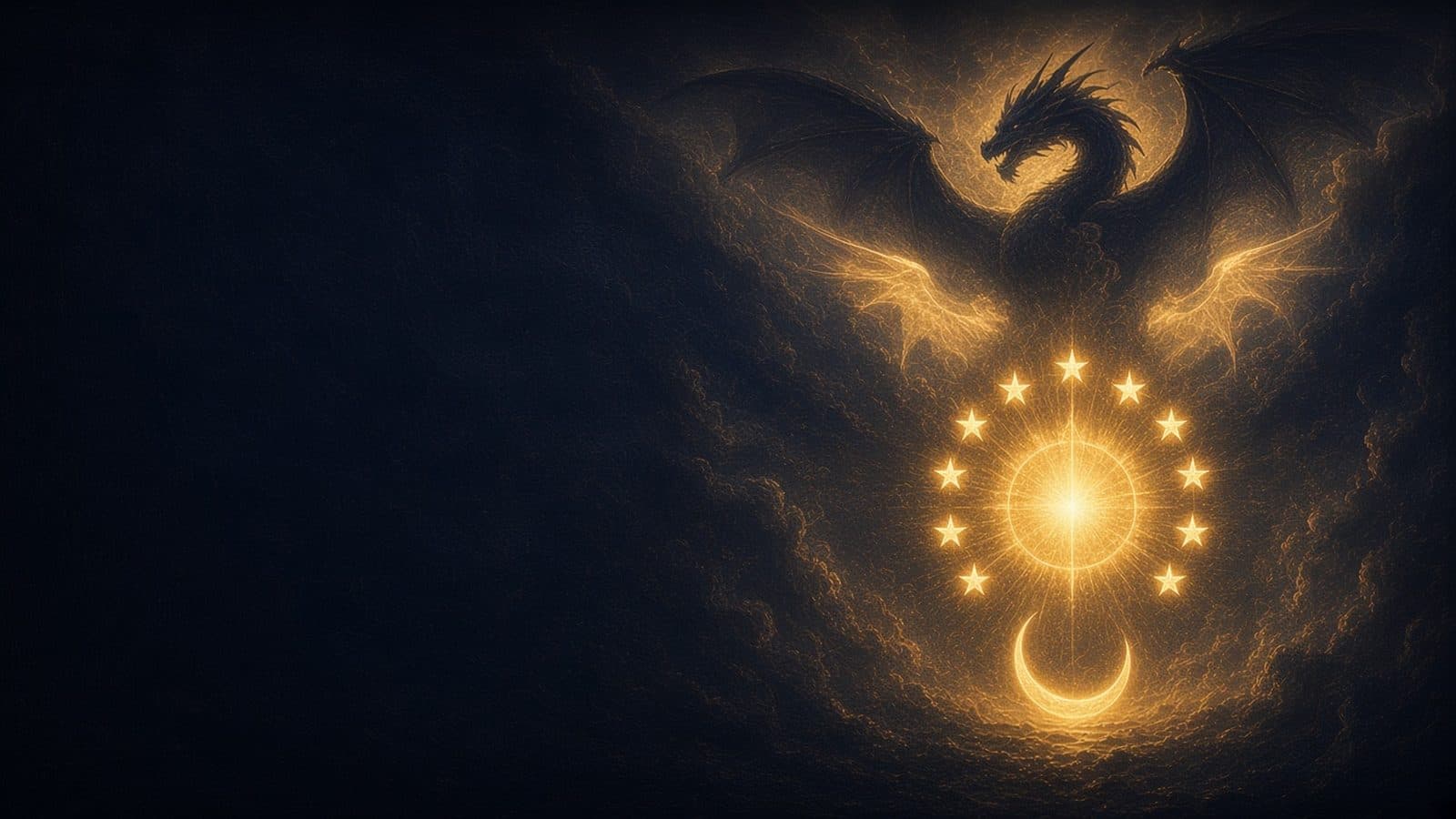
"A great sign was seen in heaven: a woman clothed with the sun, and the moon under her feet, and on her head a crown of twelve stars" (WEB). The word "sign" matters: this is a symbol, a picture that points beyond itself, not a woman seen on earth.
The sun, moon, and stars come from Joseph's dream, where they stood for Jacob's family (Genesis 37:9-10), and the twelve stars point to the twelve tribes of Israel. In the city of 21:12-14 the gates carry the names of the tribes and the foundations the names of the apostles. So most interpreters take the woman as the people of God, the Israel from whom the Messiah came and the church he gathers. Some see Mary, the Messiah's mother, as the first and fullest picture of the woman, though most think the sign is larger than one person. John does not say, and it is better to hold the pattern than to force a single name.
She is in labour, crying out in pain. The prophets used birth pangs for the long ache of God's people waiting for a deliverer. Isaiah 66:7-8 pictures Zion in labour, and Micah 5:3 speaks of "she who is in labor" until the ruler arrives. Salvation came through a people in pain.
12:3-6The dragon and the Child
A second sign: "a great red dragon, having seven heads and ten horns, and on his heads seven crowns." In the Old Testament, God promises to kill "the dragon that is in the sea" (Isaiah 27:1) and Pharaoh is called "the great monster" in Ezekiel 29:3. The seven crowns imitate a rule that belongs to the Lamb. His tail sweeps "one third of the stars of the sky" to earth, echoing the horn in Daniel 8:10 that cast stars down, and many take this to mean the angels who followed him.
Then the dragon stands before the woman, waiting to devour the Child at birth. Pharaoh ordered every Hebrew son thrown into the river (Exodus 1:22). Herod killed the boys of Bethlehem (Matthew 2:16). Behind them stood the one who has been at war with the woman's offspring since Genesis 3:15.
The Child is "a son, a male child, who is to rule all the nations with a rod of iron." That is Psalm 2:9, the same psalm we met yesterday. And then the extraordinary sentence: "Her child was caught up to God, and to his throne." John skips from the manger to the throne. His whole life, death, and resurrection are folded into those few words, and the rest of the chapter tells how the cross changed the war.
The woman flees to the wilderness, where God has prepared a place to nourish her for 1,260 days, the same period we met in chapter 11.
12:7-12War in heaven
"There was war in the sky. Michael and his angels made war on the dragon." Michael is the great prince who stands for God's people in Daniel (Daniel 10:13, 10:21, 12:1). The result is quick. Of the dragon and his angels we read, "They didn't prevail, neither was a place found for them any more in heaven."
Then John interprets his own symbol: "The great dragon was thrown down, the old serpent, he who is called the devil and Satan, the deceiver of the whole world." The dragon is the serpent of Genesis 3. "Devil" means slanderer, "Satan" means adversary, and he is also "the accuser of our brothers," who accuses them "before our God day and night," as he did against Job (Job 1:9-11) and against the high priest in Zechariah 3:1.
When did this happen? Interpreters differ. Some place it before creation, some at the end, and many hear it as the meaning of the cross and resurrection. Jesus said, "I saw Satan having fallen like lightning from heaven" (Luke 10:18), and "Now the prince of this world will be cast out" (John 12:31), in the last week of his life.
Heaven's loud voice explains how the victory came: "They overcame him because of the Lamb's blood, and because of the word of their testimony. They didn't love their life, even to death." They conquered by dying. The blood answers the accuser, the testimony defies him, and their readiness to die shows he cannot hold them.
The voice ends in joy for the heavens and a warning for earth: the devil is furious, "knowing that he has but a short time."
12:13-16Eagle's wings and a swallowing earth
Thrown down, the dragon turns his rage on the woman. But "Two wings of the great eagle were given to the woman," which recalls God's words at Sinai: "I bore you on eagles' wings, and brought you to myself" (Exodus 19:4). She flies to the wilderness, where she will be nourished "for a time, and times, and half a time," the same three and a half years in another form, taken from Daniel 7:25.
The serpent then spews water "like a river" to sweep her away. A flood from the mouth fits slander, persecution, and every lie that hopes to wash God's people away. Then comes a surprise: "The earth helped the woman, and the earth opened its mouth and swallowed up the river which the dragon spewed out of his mouth." That is Exodus language again, for when God stretched out his right hand at the sea, "The earth swallowed them" (Exodus 15:12).
The wilderness is a place of danger and also of provision. Israel was fed with manna there, and Elijah was fed there by an angel. The church's wilderness years are not a sign that God has left. They are where he carries and nourishes. And the help comes from an unexpected place, the earth itself. God is not short of ways to protect his own.
Many scholars take the wilderness and the 1,260 days as the whole age between the Child's ascension and his return, while others see a more specific moment. All agree that the woman is kept.
12:17The rest of her offspring
"The dragon grew angry with the woman, and went away to make war with the rest of her offspring, who keep God's commandments and hold Jesus' testimony."
The final verse is where the camera lands on us. The Child has been caught up and the woman is kept, so who is left for the dragon to fight? "The rest of her offspring." That is the church, the people who belong to Jesus and so share his enmity with the serpent. It is the last echo of Genesis 3:15: "I will put hostility between you and the woman, and between your offspring and her offspring. He will bruise your head, and you will bruise his heel."
That old promise has now been fulfilled in two moves. The woman's offspring, Jesus, has bruised the serpent's head. The serpent, defeated, now turns to bruise the heels of those who follow him. And yet the same promise is given to us in Romans 16:20: "the God of peace will quickly crush Satan under your feet."
Two marks identify these people: they keep God's commandments, and they hold the testimony of Jesus. Obedience and witness are the visible badge of belonging.
The dragon has taken his stand. Where will he turn next? Tomorrow, in chapter 13, he takes his stand by the sea and calls up a beast.
Key words in Revelation 12:1-17
- Sign (semeion)
- A symbol that points beyond itself. The woman and the dragon are not seen on earth like ordinary objects; they are pictures that reveal a deeper reality.
- Dragon, serpent, devil, Satan
- Four names for one enemy: a monster of chaos, the serpent of Eden, the slanderer, and the adversary. John says plainly in 12:9 who the dragon is.
- Accuser (kategoros)
- A prosecutor in a courtroom. Satan's work is to charge God's people with guilt before God. Verse 11 shows the answer: the blood of the Lamb.
- Time, times, and half a time
- Three and a half years in Daniel's language, the same span as 1,260 days and 42 months. Many scholars take it as a limited period of pressure that God measures and cuts short.
Cross references
- Genesis 3:15The first promise: hostility between the serpent and the woman's offspring, who will crush his head.
- Genesis 37:9-10Joseph's sun, moon, and stars, the source of the woman's heavenly clothing.
- Psalm 2:7-9The Son who rules the nations with a rod of iron, quoted of the Child in verse 5.
- Job 1:6-11Satan as accuser before God, charging a believer with false motives.
- Exodus 19:4God bears Israel on eagles' wings, the pattern for the woman's escape.
- Romans 8:33-34No charge can stand against God's chosen, because Christ died, was raised, and intercedes.
Part B Three lenses on the text
The Pattern
How the whole Bible speaks here
Open Genesis 3 and Revelation 12 side by side and you will find the same cast: a serpent, a woman, offspring, enmity. In Eden the serpent whispered and the woman listened. Here the dragon roars and the woman is carried to safety. The thing promised in Genesis, a seed who will crush the serpent's head, is now born, taken up, and enthroned.
Notice also that John replays the Exodus inside the same vision: a tyrant who devours children, an escape on eagles' wings, a wilderness, provision, an earth that swallows the pursuer. The Exodus was the pattern God set for rescue, and the cross is where the great rescue was won.
And remember where this goes. A woman clothed with the sun now, and in chapter 17 another woman, sitting on a beast, drunk with the blood of the saints, called Babylon. Two women, two cities, two destinies: one clothed in heavenly light and kept by God, the other dressed in purple and scarlet, soon to fall. Revelation asks us over and over which woman we belong to.
The Glory
What this shows us of God
If this chapter teaches one thing about God, it is that no enemy, however huge, is ever his equal. The dragon has seven heads and seven crowns, yet he is simply "thrown down," a passive verb. Michael fights, but the victory comes "because of the Lamb's blood." It is won by a sacrifice, not a clash of equals.
That is the wonder of the gospel: we were guilty, and the accuser had true material. And yet Paul asks, "Who could bring a charge against God's chosen ones? It is God who justifies. Who is he who condemns? It is Christ who died, yes rather, who was raised from the dead, who is at the right hand of God, who also makes intercession for us." The accuser has nothing left to say, because the debt was nailed to the cross (Colossians 2:14) and the one who paid it sits on the throne.
Notice too the sovereignty. The Child is "caught up" before the dragon touches him, the woman has "a place prepared by God," and the dragon has "but a short time." God does not remove all suffering from the story, and verse 11 says some "didn't love their life, even to death." But even the dragon's fury is held within a time God has set. His glory is not that the enemy never rages. It is that he rules the rage and turns it into worship.
The Challenge
What it asks of us
Let's get practical about the voice of the accuser. You know it. It speaks at three in the morning and in the quiet after you have failed again: God is tired of you, you are not really a Christian. We treat these as our own thoughts and agree with them. Revelation says someone has been making these speeches day and night, and gives an answer: the blood of the Lamb. It is not a feeling or a technique. It is a fact about what Jesus has already done.
Then there is the second weapon: "the word of their testimony." When did you last tell someone what Jesus has done for you, plainly, without apologising? That is how the dragon is beaten, one ordinary person at a time.
And then the hardest line: "They didn't love their life, even to death." I am not sure many of us are close to that. Comfort is a quiet danger. Peter warned, "Be sober and self-controlled. Be watchful. Your adversary, the devil, walks around like a roaring lion, seeking whom he may devour." We should not be obsessed with the enemy, or naive about him. We should be so in love with the Lamb that the enemy has little to hold.
Part C Daily devotional
Reflection
There is a moment in a long illness when a doctor says the thing you have waited to hear: the worst is behind you. You still feel weak, and the corridors still smell of antiseptic. But everything has changed, because the outcome has been decided.
Revelation 12 gives you something like that moment for the Christian life. The dragon is real, and the pain is real, and there are days when you will feel his accusations pressing in like a flood. But heaven has already announced: "Now the salvation, the power, and the Kingdom of our God, and the authority of his Christ has come." The accuser has been thrown down. The Child is on the throne. You are among the woman's offspring, and the woman is kept.
You are not asked to defeat the dragon today. The Lamb's blood has done that. You are asked to keep trusting him, keep telling the truth about him, and keep loving him more than your own comfort. Overcoming looks like faithfulness: a prayer in the dark, an honest word at work, a refusal to believe the lie.
The dragon has lost. Walk today as someone who knows it.
Questions for journaling
- John explains his symbol in 12:9: the dragon is the old serpent, the devil and Satan. Why do you think it matters that he tells us plainly who the enemy is?
- What accusations does the enemy bring against you most often? How does 'the Lamb's blood' answer each of them?
- Verse 11 says the saints overcame by the blood and by their testimony, not by force. What does that say about how Christians are called to fight?
- Where in your life are you tempted to love your own comfort more than faithfulness to Jesus?
Prayer
Father, thank you that the dragon has already lost. Thank you that your Son was caught up to your throne and that the accuser has been thrown down. When the enemy tells me I am too guilty and too weak, remind me that the blood of the Lamb has spoken for me. Keep me in the wilderness when I must be there, and feed me with your care. Give me courage to speak of Jesus, and a heart that loves him more than my own life. To you, and to the Lamb, be the glory. Amen.
The next time a thought of accusation or shame arises today, answer it aloud with Revelation 12:11 and the words, "my sin has been answered by the blood of the Lamb." Then tell one person this week one thing Jesus has done for you.
They overcame him because of the Lamb's blood, and because of the word of their testimony. They didn't love their life, even to death.Revelation 12:11 (WEB)
Common questions about Revelation 12:1-17
What is Revelation 12:1-17 about?
Behind the trumpets and the pressure on the church stands a dragon at war with God's people and God's Son, but the Child has been caught up to the throne, the accuser has been thrown down, and the Lamb's blood and his people's faithful testimony have already overcome him.
Where does Revelation 12:1-17 fit in the book of Revelation?
Many readers see chapter 12 as the start of the book's second half. So far John has shown us what happens on earth: letters, seals, trumpets. Now he pulls the camera back and shows us the war behind the war. Yesterday ended with the temple in heaven opened and the ark of the covenant in view, with thunder and lightning rolling out from the throne. Today, what appears in that heaven is a sign: a woman, a child, and a monster.
What does “Sign (semeion)” mean in Revelation 12:1-17?
A symbol that points beyond itself. The woman and the dragon are not seen on earth like ordinary objects; they are pictures that reveal a deeper reality.
What does “Dragon, serpent, devil, Satan” mean in Revelation 12:1-17?
Four names for one enemy: a monster of chaos, the serpent of Eden, the slanderer, and the adversary. John says plainly in 12:9 who the dragon is.
What does “Accuser (kategoros)” mean in Revelation 12:1-17?
A prosecutor in a courtroom. Satan's work is to charge God's people with guilt before God. Verse 11 shows the answer: the blood of the Lamb.
How can I apply Revelation 12:1-17 today?
The next time a thought of accusation or shame arises today, answer it aloud with Revelation 12:11 and the words, "my sin has been answered by the blood of the Lamb." Then tell one person this week one thing Jesus has done for you.
What is a good memory verse for Revelation 12:1-17?
Revelation 12:11: “They overcame him because of the Lamb's blood, and because of the word of their testimony. They didn't love their life, even to death.” (WEB)
Free daily email
The daily study, in your inbox
One passage a day: a careful explanation, three lenses and a short devotional, sent to you by email. Free, and you can stop whenever you like.