Day 16
The Abyss Opens, Hearts Stay Closed
Revelation 9:1-21 13 min read WEB
What is Revelation 9:1-21 about?
In short: The fifth and sixth trumpets unleash terrifying, tightly limited forces from the abyss and the Euphrates, yet the saddest line in the chapter is that the survivors still refuse to repent.
Passage at a glance
- Passage
- Revelation 9:1-21 (WEB)
- Series
- Revelation, day 16 of 37
- Section
- The Seven Trumpets
- Reading time
- 13 minutes
- Topics
- Repentance, Spiritual Warfare, Idolatry, Mercy
- Previous passage
- Revelation 8:1-13
- Next passage
- Revelation 10:1-11
Part A Context
Yesterday four trumpets struck land, sea, rivers, and sky, a third of each, and then an eagle in mid-heaven cried out three woes over the trumpets still to come. Now the first two woes arrive. The fifth trumpet is the first woe, and the sixth is the second.
These scenes drew on pictures John's readers knew. Locust swarms were a dreaded fact of life in the ancient Near East, and the prophet Joel had used a locust army to describe the day of the Lord. The Euphrates was the far edge of the Roman world, beyond which lay the Parthian kingdom, a rival the empire respected and feared. The "abyss" was a Jewish and Christian way to speak of the prison of evil spirits. John weaves all of these into scenes that are meant to unsettle, not to be decoded like a map. As you read, keep one question in your pocket: what do the survivors do at the end?
Part A Explanation
9:1-6A key, a pit, and a swarm
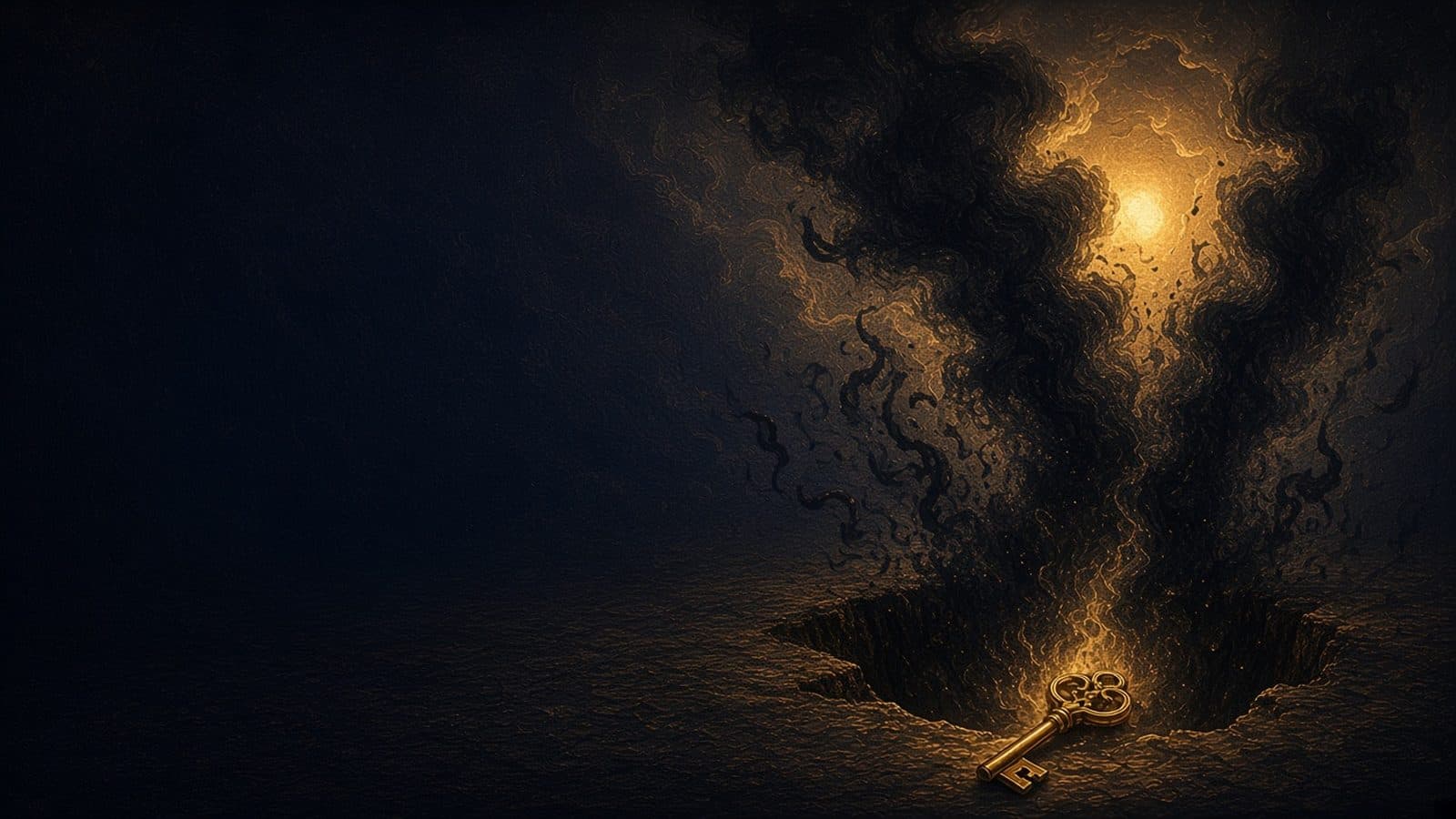
At the fifth trumpet, John says, "I saw a star from the sky which had fallen to the earth. The key to the pit of the abyss was given to him" (WEB). In Revelation, stars can stand for angels (1:20), and this star is a "he." Who is he? Some think he is Satan, recalling Jesus's words, "I saw Satan having fallen like lightning from heaven" (Luke 10:18). Others think he is a fallen angel, and others an angel acting under God's orders, as in 20:1, where an angel comes down holding the same key. The text does not decide for us. What it does say is that the key "was given." The star owns nothing.
He opens the pit, and "smoke went up out of the pit, like the smoke from a burning furnace," darkening the sun and the air. It recalls the smoke over Sodom (Genesis 19:28). In Luke 8:31, demons begged Jesus not to send them into the abyss, which tells us how they felt about it.
Out of the smoke come locusts, with "power was given to them, as the scorpions of the earth have power." Yet they are told not to harm the grass or trees, but only "those people who don't have God's seal on their foreheads." These are the sealed ones of chapter 7, now protected. Their torment lasts "five months," a period many think reflects a locust season, and it is torment, "not to kill them." People will "seek death, and will in no way find it." The limits are as striking as the horror.
9:7-12Locusts with faces
John's description is a nightmare assembled from parts. The locusts look "like horses prepared for war," wear "something like golden crowns," and "their faces were like people's faces." They have "hair like women's hair" and teeth "like those of lions." They wear iron breastplates, their wings thunder like chariots, and their tails sting like scorpions. Nothing in nature looks like this. That is the point. John is not describing an insect; he is describing something that mixes animal power with human cunning.
The background is Joel, who wrote of an invading locust army, saying "Their appearance is as the appearance of horses, and as horsemen, so do they run" (Joel 2:4). In Joel, the locusts are the army of the Lord on the day of the Lord, and so it is here. Behind Joel stands the eighth plague of Egypt (Exodus 10:14-15), a swarm that covered the land and left nothing green.
These creatures have a king, "the angel of the abyss," whose name is Abaddon in Hebrew and Apollyon in Greek. Both mean destroyer. Abaddon is an Old Testament word for the place of ruin, appearing in phrases like "Sheol and Abaddon" (Proverbs 27:20). Some scholars also hear a pun on the name of the god Apollo, whom some in Asia revered, though that is debated.
How should we read the swarm? Many Christians see demonic powers loosed on a world that has cut itself off from God. Others see symbols of warfare and human cruelty, and some expect a literal future event. Whichever you choose, the passage ends: "The first woe is past."
9:13-19Four angels at the great river
The sixth trumpet sounds, and a voice comes "from the horns of the golden altar which is before God." That is the altar of incense and prayer we visited yesterday, and the horns are the corners where blood was applied for atonement. The voice commands: "Free the four angels who are bound at the great river Euphrates!" They had been "prepared for that hour and day and month and year." Nothing here is improvised. The timetable is God's.
The Euphrates mattered. It was the northeastern edge of the land promised to Abraham (Genesis 15:18), and invaders like Assyria and Babylon had come from beyond it (Isaiah 8:7-8). In John's day, it marked the border beyond which Rome faced the Parthians. The river says: judgment can come from outside the walls.
The army numbers "two hundred million." John adds, "I heard the number of them," as if he could hardly believe it. Many scholars think the number is not a headcount but a way of saying 'overwhelming,' since John uses similar huge numbers for angels in 5:11. The horses have lions' heads, with "fire, smoke, and sulfur" from their mouths, like the fire that fell on Sodom, and they kill "one third of mankind." Their tails are like serpents.
Some read these horsemen as demonic hordes, others as human armies, and others as a combination of both. Whichever you hold, notice again that they are released only by a voice from the altar, and that they kill one third, not all.
9:20-21The rest who would not turn
This is where the chapter has been heading. After all of this, "The rest of mankind, who were not killed with these plagues, didn't repent of the works of their hands, that they wouldn't worship demons, and the idols of gold, and of silver, and of brass, and of stone, and of wood; which can't see, hear, or walk."
The description of idols echoes the Psalms. Psalm 115 says idols "have mouths, but they don't speak. They have eyes, but they don't see." Daniel told a king that his gods "don't see, or hear, or know" (Daniel 5:23). The tragedy is that people give their worship to things that cannot move, while the living God who can move mountains is ignored.
The sins John lists, "their murders, their sorceries, their sexual immorality, or their thefts," run through a good part of the Ten Commandments: worshipping other gods, taking life, sexual sin, and stealing. The word for sorcery, pharmakeia, is related to our word 'pharmacy,' and in the ancient world it covered both drugs and magical arts.
The point of the trumpets was never merely to hurt. They were meant to wake people, as the plagues of Egypt were meant to bring Pharaoh to his knees, and Pharaoh instead hardened his heart (Exodus 9:34). Suffering does not automatically soften a heart. It can set it like concrete. We will see the same thing in 16:9 and 16:11. And yet the very fact that the trumpets sound at all is a mercy. A God who had given up on the world would have stopped warning it.
Key words in Revelation 9:1-21
- Abyss (abyssos)
- Literally 'bottomless,' the deep pit where evil spirits are held in Jewish and Christian thought. Its key is given, not owned, which means even the powers of darkness cannot leave their prison without permission.
- Abaddon and Apollyon
- Hebrew and Greek names for 'Destroyer.' Abaddon is an Old Testament word for ruin and the realm of the dead, and here it becomes the name of the king of the locusts.
- Repent (metanoeo)
- To turn the mind around, which leads to turning the life around. Repentance is not just being sorry about consequences. It is a change of direction toward God.
- Sorcery (pharmakeia)
- The use of drugs, potions, and spells to control or escape reality. In the ancient world it was linked to idolatry and to attempts to manipulate the spirit world instead of trusting God.
Cross references
- Joel 2:1-5A locust army that looks like horsemen, announced by a trumpet on the day of the Lord, the main background for the fifth trumpet.
- Exodus 10:14-15The eighth plague of Egypt, a swarm that darkened the land and stripped it bare.
- Luke 8:31Demons beg Jesus not to send them to the abyss, showing it as a prison under his authority.
- Psalm 115:4-7Idols have mouths, eyes, and feet that do nothing, the picture behind the end of the chapter.
- Romans 2:4God's kindness is meant to lead to repentance, the purpose behind every warning.
- Revelation 20:1-3An angel holds the key of the abyss and binds the dragon, so God's authority over it is clear.
Part B Three lenses on the text
The Pattern
How the whole Bible speaks here
Watch the keys. In 1:18, the risen Jesus says, "I have the keys of Death and of Hades." In 9:1, a fallen star is "given" the key of the abyss. In 20:1, an angel comes down with that same key and locks the dragon in. John wants us to see that when the powers of darkness touch the key, it has first been placed in their hand, and the One with the master keys has the last word.
Then look at the list in 9:20-21: idols, murder, sexual immorality, and theft. That echoes the Ten Commandments, which begin with no other gods and carry on through killing, adultery, and stealing. The people of the earth are not simply suffering plagues; they are breaking the covenant in public, and refusing to come back.
And mark the numbers. The fifth trumpet's torment lasts five months, and the sixth army comes at a precise hour, day, month, and year. The first limits the time; the second sets it exactly. A third are killed. A fraction, a limit, a clock. Even demonic evil in Revelation is always held within a measure.
The Glory
What this shows us of God
This chapter forces us to ask what kind of God is on the throne, and the answer is startling: one who governs even the powers we fear most. The demonic forces here have to be given a key, told what to harm and what to spare, and limited to a set time. No devil in Revelation runs free. God is not afraid of the abyss, and he is not threatened by an army of two hundred million.
Why do hard things like these happen? Part of the answer is in the last verses: the judgments are warnings, calling people to turn from idols to the living God. His patience is real, and so is his justice. A world that worships what cannot see, hear, or walk is cut off from the only source of life, and living with that is its own torment, a sorrow God does not want us to choose.
Here is the gospel. The seal on the forehead guards God's people from the locust's sting. Repentance itself is a gift: the early church marvelled, "God has also granted to the Gentiles repentance to life!" (Acts 11:18). The same Lamb who died for sinners opens hearts that no trumpet can crack. And that is why we can pray for people who seem unmovable, with hope.
The Challenge
What it asks of us
The scariest sentence in this chapter is the quietest one: they "didn't repent." After the smoke and the scorpions and the armies, nothing changed. I find that frightening, because I know my own heart can be like that. Pain does not always make me humble. Sometimes it makes me bitter, or distracted, or busy.
It is easy to read verses 20 and 21 and think of 'them,' the pagans, the unbelievers. But the list begins with the works of their hands. What have I made and bowed to? A career? An image? A screen? The idols in this chapter are made of silver and gold, and mine are made of notifications and comfort, and they do exactly what ancient idols did. They cannot see, hear, or walk, but I keep going back to them.
So here is the invitation. Do not wait for a trumpet. Turning is easier early than late. Is there one thing God has been warning you about, gently, for weeks? Today is a good day to turn.
Part C Daily devotional
Reflection
Make a fist right now. Squeeze it tight, tighter than is comfortable, and hold it. For the first few seconds it feels like strength. Then it begins to ache, and you realise you have been keeping hold of something that is hurting you.
That is what Revelation 9 shows me about the human heart. After every warning, the survivors keep a tight grip on idols, on their sins, and on their own way, and they cannot see that the grip is what hurts. Repentance is the moment you open your hand.
I am not describing something that only happens to people in a vision. I have clenched my own hand around resentment, around a habit, around a part of my life I did not want God to touch, and there was a sorrow in me that I would not call by its name. What I love about the God of this chapter is that even while the trumpets sound, the door to repentance stays open. His warnings are not a trap; they are a hand on the shoulder.
And if you belong to him, you are sealed. The sting that torments the world cannot finally harm what he has marked as his own. So open your hand today. Let him have what you have been holding.
Tomorrow, a mighty angel comes down with a little scroll, and John is told to eat it.
Questions for journaling
- What stands out to you about the limits placed on the locusts and the army, and what does that tell you about who is really in control?
- The survivors in verses 20 and 21 do not repent. When pain or difficulty comes into your life, does your heart usually soften or harden? Why do you think that is?
- What might be an idol in your life, something made by your hands or screen or schedule that gets the trust and attention that belongs to God?
- What is one specific thing you need to confess and turn from today, and who could you tell so that you do not carry it alone?
Prayer
Father, you hold every key, and nothing in the abyss or at the river moves without your word. Thank you for the seal you have placed on your people, and for the Lamb who bought us with his blood. Forgive me for the idols I have made and the warnings I have ignored. Soften my hard places. Grant me repentance, and give it also to people I love who seem far from you. Keep me tender when you correct me, and let me turn quickly. Lead me home, and help me to trust your kindness. In Jesus's name, Amen.
Make a fist, and as you slowly open it, name aloud one thing you have been holding on to instead of trusting God, confess it to him, and tell one trusted person.
They were told that they should not hurt the grass of the earth, neither any green thing, neither any tree, but only those people who don't have God's seal on their foreheads.Revelation 9:4 (WEB)
Common questions about Revelation 9:1-21
What is Revelation 9:1-21 about?
The fifth and sixth trumpets unleash terrifying, tightly limited forces from the abyss and the Euphrates, yet the saddest line in the chapter is that the survivors still refuse to repent.
Where does Revelation 9:1-21 fit in the book of Revelation?
Yesterday four trumpets struck land, sea, rivers, and sky, a third of each, and then an eagle in mid-heaven cried out three woes over the trumpets still to come. Now the first two woes arrive. The fifth trumpet is the first woe, and the sixth is the second.
What does “Abyss (abyssos)” mean in Revelation 9:1-21?
Literally 'bottomless,' the deep pit where evil spirits are held in Jewish and Christian thought. Its key is given, not owned, which means even the powers of darkness cannot leave their prison without permission.
What does “Abaddon and Apollyon” mean in Revelation 9:1-21?
Hebrew and Greek names for 'Destroyer.' Abaddon is an Old Testament word for ruin and the realm of the dead, and here it becomes the name of the king of the locusts.
What does “Repent (metanoeo)” mean in Revelation 9:1-21?
To turn the mind around, which leads to turning the life around. Repentance is not just being sorry about consequences. It is a change of direction toward God.
How can I apply Revelation 9:1-21 today?
Make a fist, and as you slowly open it, name aloud one thing you have been holding on to instead of trusting God, confess it to him, and tell one trusted person.
What is a good memory verse for Revelation 9:1-21?
Revelation 9:4: “They were told that they should not hurt the grass of the earth, neither any green thing, neither any tree, but only those people who don't have God's seal on their foreheads.” (WEB)
Free daily email
The daily study, in your inbox
One passage a day: a careful explanation, three lenses and a short devotional, sent to you by email. Free, and you can stop whenever you like.