Day 8
A Little Strength, an Open Door
Revelation 3:7-13 14 min read WEB
What is Revelation 3:7-13 about?
In short: To a small, pressed church that has kept his word, Christ the holy and true King, who holds the key of David, sets an open door that no one can shut, promising to keep them, crown them and make them permanent in the presence of God.
Passage at a glance
- Passage
- Revelation 3:7-13 (WEB)
- Series
- Revelation, day 8 of 37
- Section
- Letters to the Churches
- Reading time
- 14 minutes
- Topics
- Faithfulness, Endurance, Mission, Security
- Key words
- Key of David, Keep (tēreō), Open door
- Previous passage
- Revelation 3:1-6
- Next passage
- Revelation 3:14-22
Part A Context
Yesterday's letter ended with a few faithful names in a sleeping church, promised white garments and a name that would never be erased. Today we meet a whole congregation that looks like those few.
Philadelphia lay south-east of Sardis. It was a younger city, founded in the second century BC and named, as many scholars think, for Attalus II, whose loyalty to his brother earned him the nickname Philadelphus, brother-lover. It stood in earthquake country. An ancient geographer reports that tremors were so frequent that many residents preferred to live in the countryside, and after the great quake of AD 17 the city was rebuilt, with coins suggesting it took a new name for a time to thank the emperor.
Like Smyrna, Philadelphia receives no rebuke. The church was small, with "a little power," and under pressure from neighbours who denied that its members belonged to God's people. To such a church Christ speaks with nothing but tenderness.
Part A Explanation
3:7The Holy One with the key
Christ introduces himself in three ways. "He who is holy, he who is true" (WEB) are claims the Old Testament makes for God alone. "Holy" means set apart in perfect purity, and "true" means genuine, the real thing among counterfeits. Later the martyrs under the altar will call him "the holy and true" (6:10). A church whose neighbours dismissed it needs to hear that the One speaking is the genuine Lord.
The third title is the key. "He who has the key of David, he who opens and no one can shut, and who shuts and no one opens." This borrows from Isaiah 22, where God removes a palace steward who had misused his office and appoints Eliakim in his place: "I will lay the key of David's house on his shoulder. He will open, and no one will shut. He will shut, and no one will open." The key meant control of the king's house, and who came and went.
Christ is the true Son of David (5:5, 22:16), and the key is his. The comparison is deliberate and favourable. Even Eliakim's trusted position, Isaiah adds, would one day give way (22:25). Christ's does not. In 1:18 he held the keys of Death and Hades, and here he holds the key of the kingdom. Whatever he opens, no emperor, council or hostile neighbour can lock.
3:8An open door and a little power
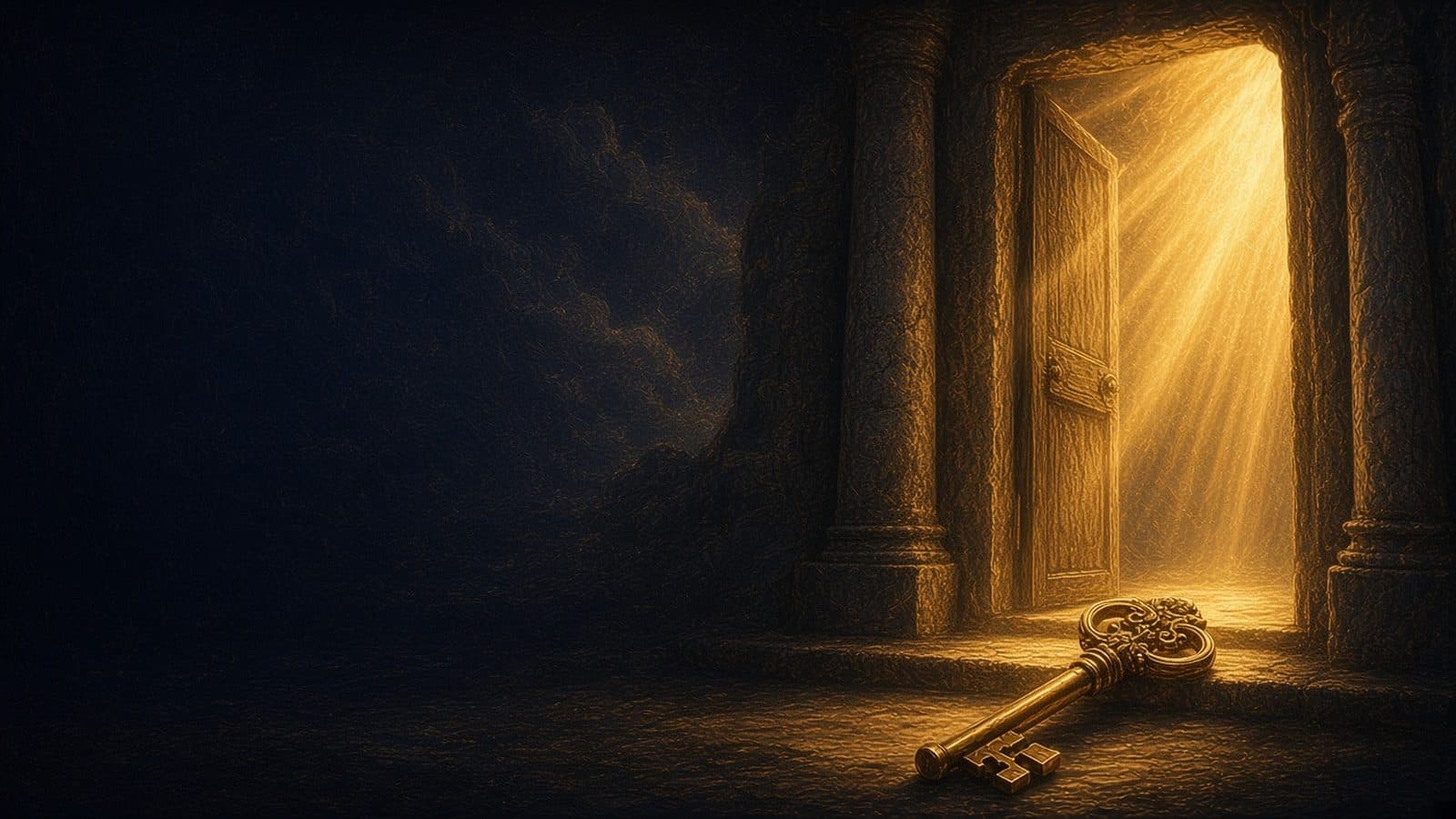
"I know your works" comes with a surprising parenthesis: "behold, I have set before you an open door, which no one can shut." Then three short facts: "you have a little power, and kept my word, and didn't deny my name."
Christ does not say "little power" as a rebuke. He simply records it. Philadelphia was small, perhaps in numbers, perhaps in influence and money. The Lord who asked through Zechariah, "who despises the day of small things?" (Zechariah 4:10) does not despise it now. What he highlights is not size but two forms of loyalty: they kept his word and they did not deny his name. Those are the very things that cost something when a church is under pressure.
What is the open door? Many think it is an opportunity for the gospel, since Paul uses the same picture of doors opening for the message (1 Corinthians 16:9, Colossians 4:3). Others think it is access to the kingdom and to God's presence, because the key-holder of verse 7 is the one who opens it, and a door opens in heaven in the very next chapter (4:1). The two fit together: the Lord who opens the way into his kingdom also opens the way to speak of it.
What matters is who set it there. Christ placed the door, so no one can close it.
3:9Those who say they are Jews
This verse needs careful handling. The phrase "synagogue of Satan" has sometimes been twisted into excuses for hatred of Jewish people, and Scripture offers no support for that. It is a grief the church must own. John, Jesus and the first Christians in Asia were themselves Jewish. What we see here is a family dispute about a question each side thought was vital: who truly belongs to the people of the Messiah?
Paul argued in the same way when he wrote that a true Jew is "one inwardly," whose praise is "from God" (Romans 2:29). Satan means adversary or accuser, so the title describes what some in that community were doing to the believers, and it is not a statement about an ethnic group. Smyrna's letter used the same phrase (2:9).
Then comes a remarkable reversal. In Isaiah, the nations come and bow before Israel and acknowledge that God is with her (Isaiah 45:14, 49:23). Here, Christ says the ones who claimed the honour will come and bow "before your feet," and the reason is not revenge but this: "to know that I have loved you."
Christians differ over whether this describes repentance and faith or a final acknowledgement before the Lord. Either way, the church does not have to win the argument. Christ will vindicate his people, and his purpose is that the world should know he loved them.
3:10-11Kept, because they kept
A single Greek verb, tēreō, ties these verses to verse 8. They "kept" his word. They "kept" his command to endure. Therefore he says, "I also will keep you from the hour of testing, which is to come on the whole world." They kept, so he keeps. The KJV renders the middle phrase "the word of my patience," which suggests an endurance that is Christ's own, shared with those who follow him.
What does "keep you from" mean? Christians have read it in three main ways. Some believe it speaks of believers being taken out before a future time of great trial. Others point to John 17:15, where Jesus prays that the Father will "keep them from the evil one" while they remain in the world, and read it as protection in the trial. Others see a first-century crisis that foreshadows every later one. What all agree on is the promise itself: the Lord guards those who have been faithful, and no testing will find them abandoned. The hour falls on "those who dwell on the earth," John's phrase for people whose home and trust are in this world (6:10).
Verse 11 gives two commands: "I am coming quickly! Hold firmly that which you have, so that no one takes your crown." To hold firmly is to keep gripping what he gave, his word and his name. The crown is the victor's wreath, and they will wear it because he gave it.
3:12-13A pillar that never leaves
"He who overcomes, I will make him a pillar in the temple of my God, and he will go out from there no more." Many commentators notice how well this promise fits a city whose residents were used to running outside at the first tremor. A small, shaky congregation is promised that it will become the one thing left standing, a pillar, and that it will never have to flee again.
The temple here is not a building of stone. In the New Jerusalem John will see "no temple," because "the Lord God, the Almighty, and the Lamb, are its temple" (21:22). To be a pillar in that temple is to be fixed forever in God's own presence.
Then three names are written on the overcomer. The first is "the name of my God," which marks belonging. The second is "the name of the city of my God, the new Jerusalem, which comes down out of heaven from my God," which gives citizenship, and which is our first glimpse of what chapter 21 will describe. The third is "my own new name," the name of Christ himself, whose fullness is still to be revealed.
Owned by God, a citizen of his city, bound up with the Son. A church that felt small and nameless is given three names by the One who holds the key.
Key words in Revelation 3:7-13
- Key of David
- A symbol of delegated royal authority, taken from Isaiah 22. Christ holds it as the true Son of David, so he alone decides who enters his kingdom, and what he opens cannot be shut.
- Keep (tēreō)
- To guard, watch over or hold fast. In these verses the church keeps Christ's word and command, and Christ promises to keep the church. Faithfulness and protection travel in both directions.
- Open door
- A biblical picture of opportunity or access. Here it likely points both to a chance to share the gospel and to entry into God's kingdom, and in either case Christ sets it open.
Cross references
- Isaiah 22:20-25Eliakim receives the key of David's house, the background for Christ's title, with a hint that human stewards eventually fail.
- Revelation 2:8-11Smyrna, the other church that receives no rebuke, is also poor, opposed and promised a crown.
- Zechariah 4:6-10God's work is done by his Spirit and not by might, and the day of small things is not to be despised.
- John 17:15Jesus prays for his people to be kept from the evil one while they remain in the world.
- Revelation 21:22In the new city there is no separate temple, because God and the Lamb are its temple.
- 1 Corinthians 16:8-9Paul speaks of an open door for the gospel together with many adversaries, much as Philadelphia faced.
Part B Three lenses on the text
The Pattern
How the whole Bible speaks here
Set Smyrna beside Philadelphia and you will see a pair. These are the only two of the seven churches that receive no rebuke. Both are poor or small. Both are opposed by those who "say they are Jews." Both are promised a crown, in 2:10 and in 3:11. The Lord who loves strength in weakness holds up the two smallest congregations as his models of faithfulness, one near the start of the sequence and one near the end.
Now follow the key. In 1:18 the risen Christ holds the keys of Death and Hades. In 3:7 he holds the key of David. Other keys appear later, and they are lent: in 9:1 the key of the abyss is given to a fallen star, and in 20:1 an angel carries it as a servant under orders. Only Christ's keys are his own. John teaches us to ask whenever a door opens or shuts in this book: whose hand is on the key?
One more detail. Verse 8 puts the open door first and the church's small strength second. The order matters. The door does not wait for the strength.
The Glory
What this shows us of God
When God wants to display his power, he often chooses a place where nothing else could explain it. Philadelphia had "a little power." That is not an obstacle he has to get around. It is the setting he picks. Zechariah heard the principle long before: "Not by might, nor by power, but by my Spirit," says Yahweh of Armies. Paul heard it from Christ himself when he was told that power is made perfect in weakness (2 Corinthians 12:9). A strong church might take the credit. A little church that stands cannot.
The same sovereignty shows in the key. Opening and shutting belong to Christ alone, and that includes history's great and small doors. And his aim in vindicating his people is not to humiliate their opponents but "to know that I have loved you." The holiness of Christ is never cold. It is the holiness of a love that has been tested and proved.
Where is that love most clearly seen? In the One who holds the key, who is also the Lamb who was slain. The door into the Father's presence was opened by his sacrifice, "a new and living way, through the veil, that is to say, his flesh" (Hebrews 10:20). The open door was bought at the cross. And the joy of the promise is that it is no reward for strength. It is a gift to those who have little and keep trusting him.
The Challenge
What it asks of us
Be honest: how strong does your faith have to feel before you will do something with it?
Most of us wait. We wait until we know more, pray better, have more time, a bigger platform or a braver personality. Meanwhile there is an open door in front of us: a neighbour who keeps coming into conversation, a colleague who has noticed something different, a relative who would listen if someone asked. We stand looking at the door, wondering whether we are ready.
Jesus does not measure the way we do. He does not mention numbers, talent or influence. He mentions two things: you kept my word, and you did not deny my name. The second one makes me uncomfortable. It is rarely dramatic. Most of us deny him by staying quiet when speaking would cost a raised eyebrow or an awkward lunch. When did you last let someone know, in a small way, that you belong to Jesus?
And then "hold firmly that which you have." The temptation for a weary church is not a loud betrayal. It is slow drift. Perseverance is a quiet, daily thing, and a very great one.
Which door has the Lord set before you today? Do not wait to feel big enough. He holds the key.
Part C Daily devotional
Reflection
I think of the people who are in every church but are almost never on the platform. The woman who arrives early to set out chairs. The man who has prayed for the same wayward son for twenty years. The student who is the only believer in her flat and still says grace over a plate of toast. They would never call themselves powerful, and they would not argue if you called them small.
Jesus's letter to Philadelphia is for people like that. He does not say, "Try harder." He does not say, "You should have done more." He says, "I know your works." He has seen the chairs, the prayers, the toast. He sets a door in front of them and says no one can shut it. He promises to keep them and to make them a pillar that is never shaken.
Maybe you feel small today. Your faith may feel like a thin thread, and your efforts may feel unnoticed. The One who holds the key of David is not looking for impressive. He is looking for those who keep his word and carry his name. That is enough for him to build a life on. Rest in that today, and then take one small step through the door he has opened. Tomorrow we meet the last of the seven, a church that believed it had everything.
Questions for journaling
- What does verse 8 tell you about how Jesus measures a church or a Christian? How does that compare with how you tend to measure yourself?
- Where do you feel you have only "a little power" right now, and what would it mean to bring that to Christ rather than hide it?
- What open door has the Lord put in front of you, whether a person, a conversation or a task, that you have been standing beside?
- Which small, practical step could you take this week to hold firmly to what he has given you, and what might make you drift from it?
Prayer
Lord Jesus, you are holy and true, and you hold the key of David. You open and no one can shut. Thank you that you do not despise small things, and that you know my works, even those no one else sees. Keep me faithful to your word and unashamed of your name. Show me the door you have set before me, and give me courage to walk through it. Keep me in every hour of testing. Amen.
Name one open door, such as a person, an invitation or a conversation, and take one small step through it today: send the message, make the offer or say the prayer aloud with someone.
I know your works (behold, I have set before you an open door, which no one can shut), that you have a little power, and kept my word, and didn’t deny my name.Revelation 3:8 (WEB)
Common questions about Revelation 3:7-13
What is Revelation 3:7-13 about?
To a small, pressed church that has kept his word, Christ the holy and true King, who holds the key of David, sets an open door that no one can shut, promising to keep them, crown them and make them permanent in the presence of God.
Where does Revelation 3:7-13 fit in the book of Revelation?
Yesterday's letter ended with a few faithful names in a sleeping church, promised white garments and a name that would never be erased. Today we meet a whole congregation that looks like those few.
What does “Key of David” mean in Revelation 3:7-13?
A symbol of delegated royal authority, taken from Isaiah 22. Christ holds it as the true Son of David, so he alone decides who enters his kingdom, and what he opens cannot be shut.
What does “Keep (tēreō)” mean in Revelation 3:7-13?
To guard, watch over or hold fast. In these verses the church keeps Christ's word and command, and Christ promises to keep the church. Faithfulness and protection travel in both directions.
What does “Open door” mean in Revelation 3:7-13?
A biblical picture of opportunity or access. Here it likely points both to a chance to share the gospel and to entry into God's kingdom, and in either case Christ sets it open.
How can I apply Revelation 3:7-13 today?
Name one open door, such as a person, an invitation or a conversation, and take one small step through it today: send the message, make the offer or say the prayer aloud with someone.
What is a good memory verse for Revelation 3:7-13?
Revelation 3:8: “I know your works (behold, I have set before you an open door, which no one can shut), that you have a little power, and kept my word, and didn’t deny my name.” (WEB)
Free daily email
The daily study, in your inbox
One passage a day: a careful explanation, three lenses and a short devotional, sent to you by email. Free, and you can stop whenever you like.