Day 35
The Bride Who Is a City
Revelation 21:9-27 13 min read WEB
What is Revelation 21:9-27 about?
In short: John is shown the Lamb's bride as a shining city with open gates, no temple and no night, where God and the Lamb are the light and only those written in the Lamb's book of life belong.
Passage at a glance
- Passage
- Revelation 21:9-27 (WEB)
- Series
- Revelation, day 35 of 37
- Section
- New Creation
- Reading time
- 13 minutes
- Topics
- New Jerusalem, The Bride, Holiness, Light
- Key words
- Bride and wife, Jasper, Twelve, Profane
- Previous passage
- Revelation 21:1-8
- Next passage
- Revelation 22:1-5
Part A Context
Yesterday the one on the throne promised to make all things new, to give the water of life freely, and to be the God of everyone who overcomes. Today a guide shows John what that new world looks like up close. It takes the rest of the chapter, nineteen verses, to describe a single city.
Here we need to read as the first readers did. They knew the city of Rome, with its markets, temples and emperor worship. They also knew the beautiful Jerusalem of the prophets, now long under Roman power. John gives them the city that outlasts every empire. Like the visions before it, this one is symbolic, and the numbers and materials are meant to be read, not surveyed. Gold and gems speak of glory, holiness and completeness. As we walk through the gates, keep asking what the city says about God and about the people who live in him.
Part A Explanation
21:9-11Come, I will show you the bride
One of the angels who had the seven bowls came and said to John, "Come here. I will show you the wife, the Lamb's bride."
John is promised a bride, and what he sees is a city. The Bible is comfortable with this. The "wife" and "the holy city" are two ways to picture the same people in the same relationship with God. Isaiah promised, "as a bridegroom rejoices over his bride, so your God will rejoice over you" (Isaiah 62:5), and Paul said Christ gave himself up for the church "that he might present the assembly to himself gloriously" (Ephesians 5:25-27).
The angel is one of the seven who held the bowls. John is carried away "in the Spirit" "to a great and high mountain" (21:10), as Ezekiel was set "on a very high mountain" to see a city (Ezekiel 40:2).
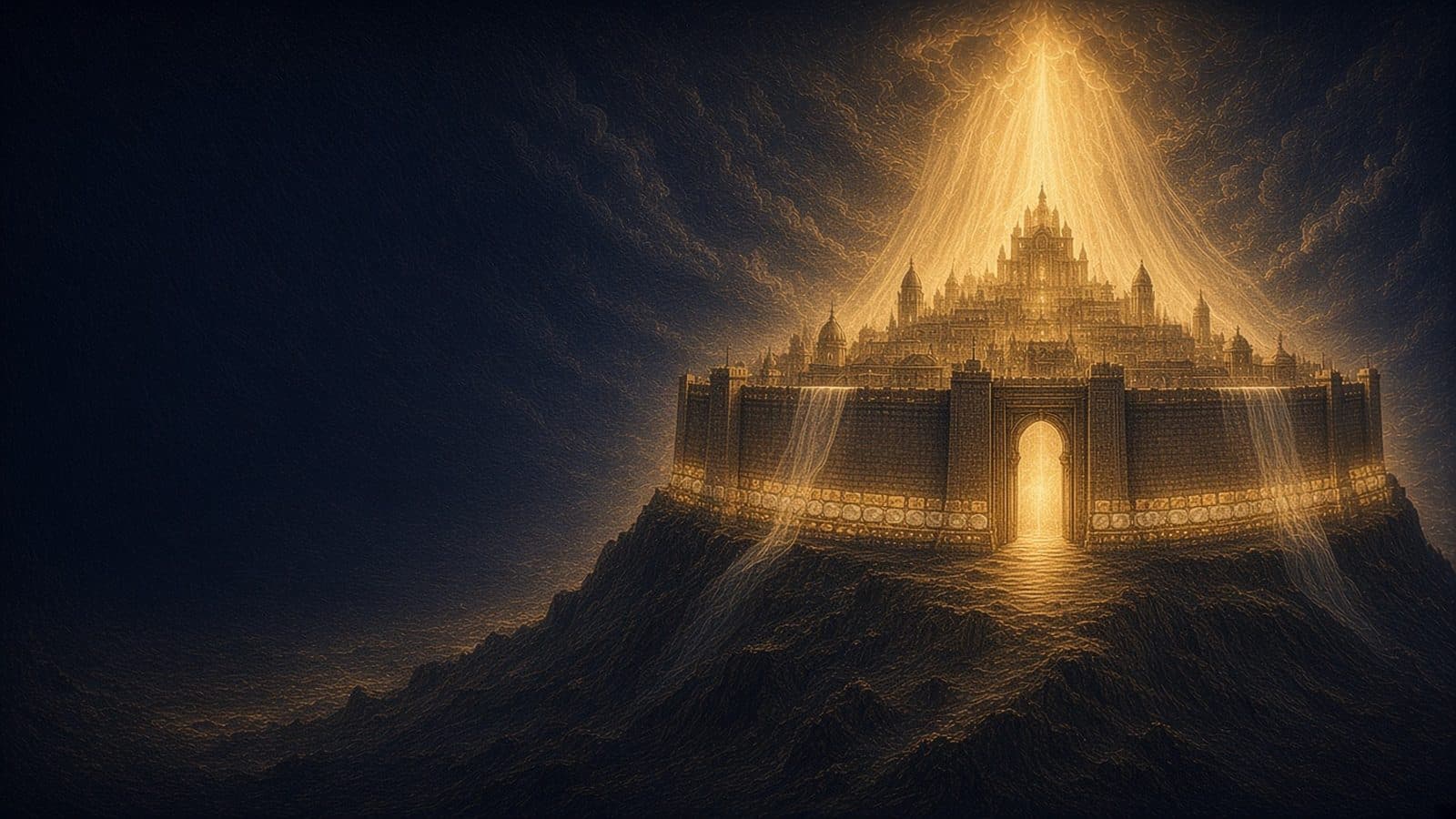
The city has "the glory of God." Its light is "like a most precious stone, as if it were a jasper stone, clear as crystal." The same stone is used to describe the one on the throne (4:3). The city shines with God's glory, not its own.
21:12-14Gates and foundations
The city has "a great and high wall; having twelve gates, and at the gates twelve angels; and names written on them, which are the names of the twelve tribes of the children of Israel." Three gates face each of the four directions, just as Ezekiel's vision of the restored city placed three gates on each side, named for the tribes (Ezekiel 48:30-34).
Then something new: "The wall of the city had twelve foundations, and on them twelve names of the twelve Apostles of the Lamb." The people of the old covenant are on the gates. The people of the new covenant are on the foundations. These are not two cities, and they are not two peoples. It is one city, and one people of God. Paul said the same: "you are fellow citizens with the saints, and of the household of God, being built on the foundation of the apostles and prophets, Christ Jesus himself being the chief cornerstone" (Ephesians 2:19-20).
Why a wall at all? In the ancient world a wall meant protection, and it also marked who was inside. But here the gates are never shut (21:25), and angels stand at them. Many readers take it as a picture of perfect security without fear. God promised that he would be "a wall of fire" around his city and "the glory in the middle of her" (Zechariah 2:5). There is a boundary, and there is also peace.
21:15-21Measured, golden and jewelled
The angel carries "a golden reed to measure the city." In Ezekiel, a man with a measuring reed measures the temple (Ezekiel 40:3). Measuring in the Bible often suggests that something belongs to God and is kept in his care. The result is a perfect shape: "Its length, width, and height are equal." The number is twelve thousand stadia on each side, a number built from twelve multiplied by a thousand. Most readers take it as a sign of completeness and fullness, not as a distance to be converted into miles. The wall is 144 cubits, twelve times twelve.
A perfect cube would have reminded readers who knew the temple of the Most Holy Place, the inner sanctuary of Solomon's temple, which was "twenty cubits in length, and twenty cubits in width, and twenty cubits in its height" (1 Kings 6:20), overlaid with gold. Many scholars see the point here. The whole city is the place where God dwells.
The materials say the same. "The city was pure gold, like pure glass." The twelve foundation stones echo the stones on the high priest's breastplate, which carried the names of the twelve tribes (Exodus 28:21), though the lists are not identical. Isaiah had promised, "I will set your stones in beautiful colors" (Isaiah 54:11). And "the twelve gates were twelve pearls," each gate one pearl.
21:22-23No temple, no sun
"I saw no temple in it, for the Lord God, the Almighty, and the Lamb, are its temple."
For a Jewish reader, this is almost shocking. The temple was the centre of life, the place where God met his people and sin was dealt with. John's whole vision has been full of temple language. Now there is no temple, because nothing stands between God and his people anymore. The whole city is full of his presence, and its temple is a person, or rather two: the Lord God and the Lamb. That is the temple John himself points to, when he explains that Jesus "spoke of the temple of his body" (John 2:21).
"The city has no need for the sun, neither of the moon, to shine, for the very glory of God illuminated it, and its lamp is the Lamb." Isaiah promised, "Yahweh will be your everlasting light" (Isaiah 60:19). Here the light of God's glory shines out through the Lamb. The Lamb who was killed is not a past event the city has moved beyond. He is how the light reaches everyone in it.
At the very end of Ezekiel, the city is given a name: "Yahweh is there" (Ezekiel 48:35). Revelation seems to answer that name.
21:24-27Open gates, many nations, one book
"The nations will walk in its light. The kings of the earth bring the glory and honor of the nations into it." Isaiah saw the same thing: "Nations will come to your light, and kings to the brightness of your rising" (Isaiah 60:3). These are the "kings of the earth" who earlier shared in Babylon's sins (17:2), and now they bring their glory to the Lamb. Many readers see this as the great multitude "out of every nation and of all tribes, peoples, and languages" (7:9), now redeemed. Some also see the best of human culture being cleansed and carried in. The text does not say, so we should hold that thought gently.
"Its gates will in no way be shut by day (for there will be no night there)." Isaiah had said it: "Your gates also shall be open continually" (Isaiah 60:11). A city with open gates and no night has nothing left to fear.
Then comes the verse that holds everything together: "There will in no way enter into it anything profane, or one who causes an abomination or a lie, but only those who are written in the Lamb's book of life." We met that book on Day 33. The city is for those whose names are in it, and that is a matter of the Lamb's grace, not of human merit. Everything unclean stays out, so nothing unclean will ever spoil it again.
Tomorrow John is shown "a river of water of life, clear as crystal, proceeding out of the throne of God and of the Lamb" (22:1).
Key words in Revelation 21:9-27
- Bride and wife
- The Lamb's people, pictured as a woman prepared for her wedding. The city and the bride are two pictures of the same people with the same Lord.
- Jasper
- A clear, shining stone. John uses it for the one on the throne (4:3) and for the city (21:11), suggesting that the city shines with God's own radiance.
- Twelve
- The number of the tribes of Israel and of the apostles. It points to the whole people of God, old and new, gathered into one city.
- Profane
- Anything common, unclean or opposed to God's holiness. It cannot enter the city, so the new creation can never be spoiled again.
Cross references
- Ezekiel 40:1-4; 48:30-35A very high mountain, a measured city with tribal gates, and the name "Yahweh is there."
- Isaiah 54:11-12God promises to set the city's stones, gates and walls with precious jewels.
- Isaiah 60:1-22Nations come to the light, the gates stand open, and God is the everlasting light.
- 1 Kings 6:19-22The inner sanctuary of the temple, a golden cube.
- Ephesians 2:19-22God's people are a household built on the apostles with Christ as the cornerstone.
- Zechariah 2:1-5A man with a measuring line, and God as a wall of fire and the glory in the middle.
Part B Three lenses on the text
The Pattern
How the whole Bible speaks here
Revelation tells a tale of two women and two cities, and today the second one arrives. In chapter 17, "one of the seven angels" said "Come here," and John saw a woman on a beast, "decked with gold and precious stones and pearls" (17:4). Her city, Babylon, is described in the next chapter as a place where the merchants sell "gold, silver, precious stones, pearls" and even "people's bodies and souls" (18:12-13). Now the same kind of angel says "Come here," and John sees a bride, and a city of gold, precious stones and pearls.
The materials are the same. What is different is what they are used for. In Babylon, they are worn as bait and bought with human lives. In the holy city, they are the street under your feet and the gates you walk through.
Look also at the setting. The prostitute is seen in a wilderness. The bride is seen on a high mountain, in the light. One city offers a cup full of abominations (17:4). The other offers "the water of life freely." John is not giving us two travel guides. He is asking us which city we are in love with, and which city will have our names on its gates.
The Glory
What this shows us of God
The most striking thing about this city is where its light comes from. It has no sun, no moon, no lamp of its own. "The very glory of God illuminated it, and its lamp is the Lamb." The glory of God, which Moses could not look at (Exodus 33:20) and which no sinner could survive, is here the light that shows everything as it is. And it reaches the people through the Lamb. Paul said it this way: God "has shone in our hearts, to give the light of the knowledge of the glory of God in the face of Jesus Christ" (2 Corinthians 4:6). The Lamb who was slain is the lamp.
That is also why the city can be holy and welcoming at the same time. Nothing profane enters, because God is holy. But those who do enter were once as unclean as anyone. The great multitude before the throne "washed their robes, and made them white in the Lamb's blood" (7:14). The bride is spotless because the Bridegroom made her so, not because she managed it herself.
And the joy is the point. "A day in your courts is better than a thousand," the psalmist sang (Psalm 84:10). In this city, God's glory is not a price people pay to enter. It is the very thing they enter to enjoy.
The Challenge
What it asks of us
Let's ask a plain question: which city are we actually building? Most of us would say we long for the new Jerusalem. But look at where our time goes. We spend our best hours, our best money and our sharpest attention on securing a small, comfortable corner of the old city, with its walls, its gold and its lights that go out.
The writer to the Hebrews said, "For we don't have here an enduring city, but we seek that which is to come" (Hebrews 13:14). Do we seek it? Or do we only say so on Sundays? Jesus said, "where your treasure is, there your heart will be also" (Matthew 6:21). So check your treasure. What would you grieve to lose? What do you think about when your mind is free?
There is also the quieter challenge of the bride. The people God is making ready for his wedding are not an abstract crowd. They are the actual church, including the person in your pew who irritates you. The names on those gates are real names. If Christ loves them enough to give himself for them, we can love them enough to forgive, to serve and to turn up.
The gates are open. Live like someone who has already seen the light.
Part C Daily devotional
Reflection
Think about the moment at a wedding when the doors open and everyone turns to see the bride. For a second the whole room goes quiet. The person at the front looks at the one they love, and nothing else in the world matters.
Revelation 21 is that moment, stretched across the whole of the new creation. The bride is not a perfect person who earned her place. She is the people of God, made ready by the one who gave himself for her. The picture is all radiance, and the gates stay open.
If you are a believer, this is about you. Your name is not hidden in a crowd. You are part of the city, and one day you will be home. On the days when you feel small, unclean or tired of the church, remember what the Lamb is doing. He is preparing a bride, and he will finish what he began.
And if you are not sure that you belong, the invitation is plain. The only names allowed in are those written in the Lamb's book of life, and God's invitation to the thirsty stands (21:6). You do not have to make yourself clean before you approach. Go to him as you are, and trust what he has done.
Questions for journaling
- What does it tell you that John was promised a bride and was shown a city? How might the church be both a people and a place of God's presence?
- Why do you think there is no temple in the city? What does that say about what Jesus has done for us?
- The gates have the names of the tribes of Israel and the foundations the names of the apostles. What does that teach you about the unity of God's people across history?
- Which city are you most tempted to love, the city of gold you can build now or the city that comes down from God? What would change if you chose the second?
- Is there someone in your church you find it hard to love? What is one way you could serve them this week?
Prayer
Father, thank you for the city that comes down from you, a place where you are the light and the Lamb is the lamp. Thank you that its gates are open to everyone who trusts him. Forgive me for loving the lesser city, with its gold and its comfort. Make me long for the better one. Help me to love your church, the bride, as Jesus does, and to serve those whose names are on your gates. Keep my name written in the Lamb's book of life, and bring me home. Amen.
Choose one fellow believer you find hard to love, and thank God for them by name today. Then do one small thing for them, such as a message of encouragement or an offer to help.
The city has no need for the sun, neither of the moon, to shine, for the very glory of God illuminated it, and its lamp is the Lamb.Revelation 21:23 (WEB)
Common questions about Revelation 21:9-27
What is Revelation 21:9-27 about?
John is shown the Lamb's bride as a shining city with open gates, no temple and no night, where God and the Lamb are the light and only those written in the Lamb's book of life belong.
Where does Revelation 21:9-27 fit in the book of Revelation?
Revelation 21:9-27 is day 35 of 37 in Unveiled's study of the book of Revelation, in the section “New Creation”. The last two chapters end the Bible: a new heaven and a new earth, God living with his people, the holy city, the river and the tree of life, and a closing invitation to come to Jesus.
What does “Bride and wife” mean in Revelation 21:9-27?
The Lamb's people, pictured as a woman prepared for her wedding. The city and the bride are two pictures of the same people with the same Lord.
What does “Jasper” mean in Revelation 21:9-27?
A clear, shining stone. John uses it for the one on the throne (4:3) and for the city (21:11), suggesting that the city shines with God's own radiance.
What does “Twelve” mean in Revelation 21:9-27?
The number of the tribes of Israel and of the apostles. It points to the whole people of God, old and new, gathered into one city.
How can I apply Revelation 21:9-27 today?
Choose one fellow believer you find hard to love, and thank God for them by name today. Then do one small thing for them, such as a message of encouragement or an offer to help.
What is a good memory verse for Revelation 21:9-27?
Revelation 21:23: “The city has no need for the sun, neither of the moon, to shine, for the very glory of God illuminated it, and its lamp is the Lamb.” (WEB)
Free updates
Stay in the loop
Studies are published every day on the site, free to read. Sign up for the occasional update about Unveiled and the book of Revelation, plus a place to start. You can stop whenever you like.