Day 23
The Song Only the Redeemed Sing
Revelation 14:1-13 14 min read WEB
What is Revelation 14:1-13 about?
In short: While the beasts demand worship from the shore, the Lamb stands on Mount Zion with a company who carry his name, and three angels announce the eternal Good News, the fall of Babylon, and a solemn warning, so that the saints can persevere and the dying in Christ can rest.
Passage at a glance
- Passage
- Revelation 14:1-13 (WEB)
- Series
- Revelation, day 23 of 37
- Section
- The Cosmic Conflict
- Reading time
- 14 minutes
- Topics
- Redemption, Judgment, Perseverance, Hope
- Previous passage
- Revelation 13:11-18
- Next passage
- Revelation 14:14-20
Part A Context
After two chapters of monsters, the next verse is a mountain.
Yesterday closed with a number and a call for wisdom, and the church was left under pressure: a mark on the right hand, a ban on the market, a beast with a great mouth. John knows how that feels to read. So the camera lifts and the scene changes, as it did between the sixth and seventh seals in chapter 7 and in the heavenly worship at the end of chapter 11. Chapter 14 does not erase the beasts. It puts them in their true setting by showing who is standing where.
The beast stood by the sea. The Lamb stands on Mount Zion. The beast gave a mark to his followers; the Lamb puts a name on his. The beast has a roaring mouth, and heaven has a song. Then three angels fly with messages for the whole earth, and a voice from heaven speaks a blessing over those who die faithful. It is a chapter that holds comfort and warning in the same hands, so read it slowly and do not drop either one.
Part A Explanation
14:1-3Zion and the new song
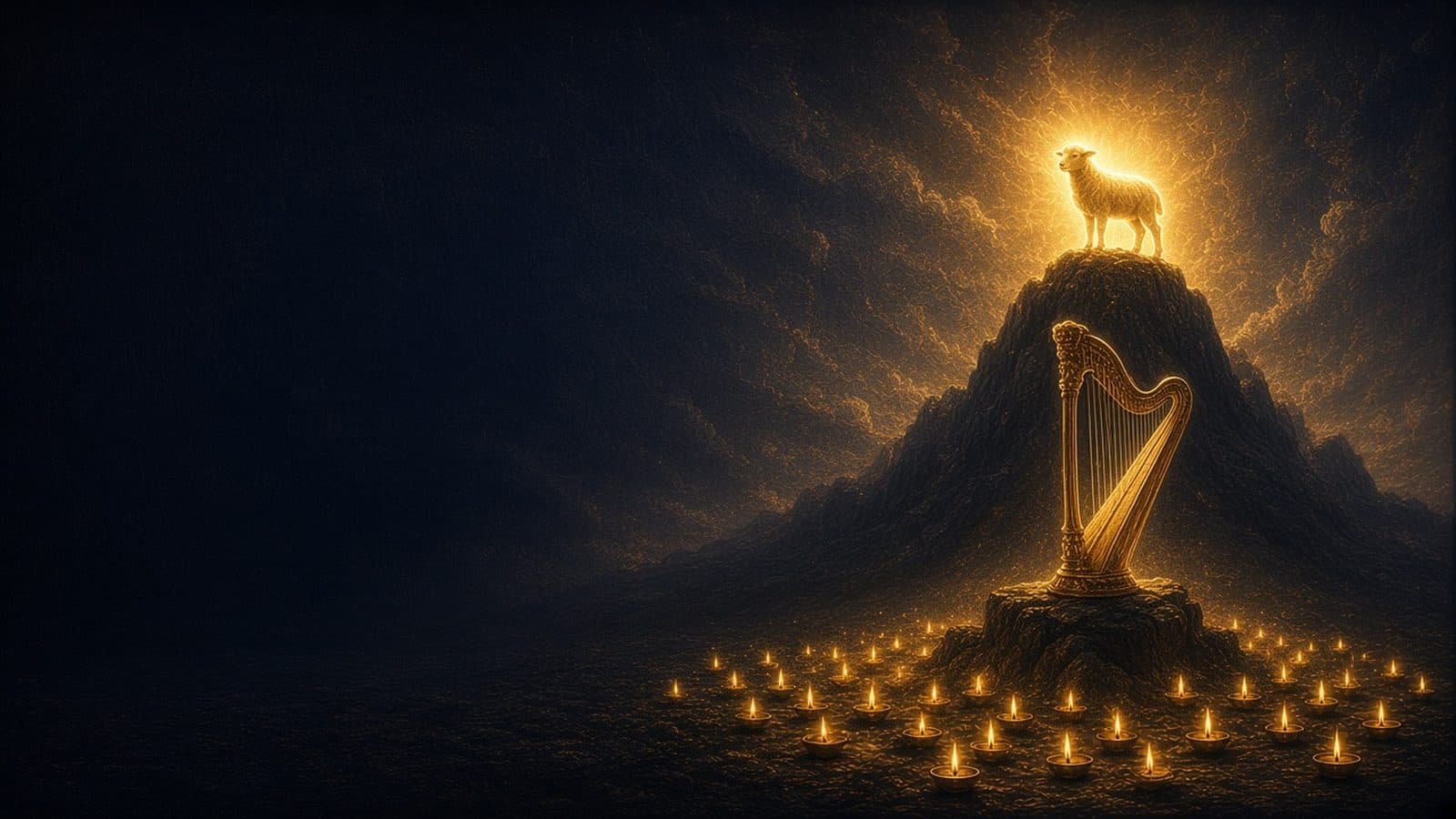
"I saw, and behold, the Lamb standing on Mount Zion, and with him a number, one hundred forty-four thousand, having his name, and the name of his Father, written on their foreheads" (WEB). Zion was where the Lord had said, "Yet I have set my King on my holy hill of Zion" (Psalm 2:6). It is the place of God's chosen King, and the Lamb is that King. Set it beside yesterday: a mark on the forehead from the beast, a name on the forehead from the Father and the Lamb. The promise is already in 3:12 and finishes in 22:4: "his name will be on their foreheads."
Who are the 144,000? This is the same number as the sealed in 7:4, and readers differ. Some take it literally as a particular redeemed company of Israel. Others see it as a symbolic number, twelve times twelve times a thousand, for the whole people of God made complete. A hint for the second view is the way John in chapter 7 first hears a number and then sees a multitude from every nation, much as in chapter 5 he hears of a Lion and sees a Lamb. Here, they are simply described as "redeemed out of the earth."
The sound of heaven is "like the sound of many waters, and like the sound of a great thunder," and yet also gentle, "like that of harpists playing on their harps." They sing "a new song," the song of Revelation 5:9, for "you were killed, and bought us for God with your blood." The reason only the redeemed can learn it is that it is a song of rescue. You can know the words of redemption without being able to sing it, but only the rescued can sing it from the heart.
14:4-5Virgins, firstfruits, and truth
"These are those who were not defiled with women, for they are virgins." This is one of the most puzzled-over lines in the book, and we should handle it carefully.
One reading takes it literally, as a description of unmarried and celibate men. But that would sit awkwardly with a Bible that says, "Let marriage be held in honor among all" (Hebrews 13:4), and that never calls married people second-class. Another reading notes that "virgins" in the prophets is the language of faithfulness. Idolatry was often called adultery, and the opposite of Babylon, who in later chapters is pictured as a prostitute, is a people who have kept themselves for the Lamb alone. A third notes the language of holy war. Soldiers in Israel were to keep themselves pure before battle (Deuteronomy 23:9-10; 1 Samuel 21:5), and these are the Lamb's army, consecrated for the fight. Many scholars favour the second or third. All agree on the point: these are people whose loyalty did not go to the beast.
Three more descriptions follow. They "follow the Lamb wherever he goes," and since the Lamb is the one who goes to the cross, that is not a comfortable trail. They were "redeemed by Jesus from among men," a plain gospel phrase with no mention of their merit. And they are "the first fruits to God and to the Lamb." Firstfruits were the first portion of a crop, given to God as a pledge that more was coming. The harvest is on its way, and that is where tomorrow's reading goes.
Finally, John says that in their mouth "was found no lie." Where the beast and his prophet deceive, these are truthful. Their blamelessness is not perfection from birth but the character of those the Lamb has made clean.
14:6-11Three angels
The first angel flies with "an eternal Good News to proclaim to those who dwell on the earth, and to every nation, tribe, language, and people." Notice the scope: the same worldwide reach the beast claims in 13:7, with a different message: "Fear the Lord, and give him glory; for the hour of his judgment has come. Worship him who made the heaven, the earth, the sea, and the springs of waters!" Even now it is Good News, an open invitation to turn from the beast and worship the Creator.
The second angel says, "Babylon the great has fallen," echoing Isaiah 21:9. Babylon will take centre stage in chapters 17 and 18. Many scholars think it stands first for Rome and then for every proud, seductive world system.
The third angel's warning is stark. Whoever worships the beast and receives his mark "will drink of the wine of the wrath of God," and, in the angel's words, "The smoke of their torment goes up forever and ever." This is a hard saying, and there are different readings. Many Christians through history have read it as describing everlasting conscious punishment. Others note that "smoke goes up forever" is borrowed from Isaiah 34:10, where Edom's destruction is described in the same terms, though Edom is not burning now, and they take the image to mean a final and irreversible end. We should hold our reading with humility.
What every serious reader can say is this: the stakes are real and final, the verdict comes in the presence of the holy angels and of the Lamb himself, and the warning is itself a mercy. You do not warn people about a danger you want them to walk into. The invitation runs right through the angels' flight, and the word is "if anyone."
14:12-13Perseverance and rest
"Here is the perseverance of the saints, those who keep the commandments of God, and the faith of Jesus." It is the same call we heard in 13:10, where the WEB renders the Greek word "endurance." After the terrible warning, the call is not to panic. It is to stay faithful.
Then comes a voice from heaven. "Write," it says, which John has been told before when something is too important to forget. "Blessed are the dead who die in the Lord from now on." This is the second of seven blessings in the book. The first, in 1:3, was for those who read, hear, and keep the words of this prophecy. The others come in 16:15, 19:9, 20:6, 22:7, and 22:14. Revelation wants to make people blessed, not frightened.
"Yes," says the Spirit, "that they may rest from their labors; for their works follow with them." Here the Spirit adds his own amen. Rest is for people whose faithful labour has been long and costly. And "their works follow with them" does not say the works earned their place, since they were "redeemed by Jesus." It says their faithful labour is not lost. It goes with them, remembered by the One who sees it.
For a church facing the sword, this is astonishing. The beast thinks death is his weapon. In the Lord, death is a doorway to rest.
Key words in Revelation 14:1-13
- Zion
- The hill of Jerusalem, the city of David and the place God chose for his King. Here it is the Lamb's place of victory, set against the beast's place by the sea.
- Firstfruits (aparche)
- The first part of a harvest, given to God as a pledge of more to come. The redeemed are God's pledge of the full harvest.
- Good News (euangelion)
- The announcement of a victory or a rescue. Even in a chapter of judgment, the first angel's message is called Good News.
- Perseverance (hypomone)
- Remaining under pressure without giving way. The same Greek word as in 13:10, where the WEB translates it 'endurance'.
Cross references
- Psalm 2:6God sets his King on Zion, the place where the Lamb now stands.
- Revelation 5:9The new song of those bought by the Lamb's blood from every tribe and language.
- Revelation 7:3-4God's servants sealed on their foreheads, the same 144,000.
- Isaiah 21:9'Fallen, fallen is Babylon,' the oracle that the second angel echoes.
- Isaiah 34:10Smoke going up forever, the image behind 14:11 in an earlier judgment.
- Revelation 22:4God's name on the foreheads of his people, fully realised in the new creation.
Part B Three lenses on the text
The Pattern
How the whole Bible speaks here
John arranges his scenes in contrasts. In chapter 13 the beast stands by the sea; in chapter 14 the Lamb stands on a mountain. The beast's people carry a mark; the Lamb's people carry a name. The beast's followers cry out, "Who is like the beast?" and the Lamb's followers sing a song that no one else can learn. The two chapters are meant to be read side by side, like the two panels of a diptych.
There is also a pattern in the order of the angels. Before any warning, there is Good News. The first thing heaven says to the earth is not "Fear the beast" or even "Beware," but "Fear the Lord, and give him glory." That says something about God's way of working. He leads with an invitation, and the warnings follow, because the warnings only make sense once the invitation is understood.
Notice, too, that the phrase "first fruits" sets up what comes next. A firstfruits is always a promise about a harvest, and the very next passage is a harvest scene. And one more detail: the chapter's blessing, "Blessed are the dead who die in the Lord," is the second of seven. The book is built around blessings, and it is worth reading the whole of it with an ear for them.
The Glory
What this shows us of God
Look at how many times the Lamb appears in these thirteen verses. He stands on Zion. His name is on the foreheads. The redeemed follow him wherever he goes. They were "redeemed by Jesus" and are firstfruits "to the Lamb." The third angel's judgment happens in his presence. Everything in the chapter revolves around him, which is what the beast always wanted for himself and never could have.
And what does the Lamb do for his people? He stands with them. In the middle of the beast's world, in the middle of a mark and a ban, there is no sign that they are alone. He has bought them with his blood, he has written his Father's name on them, and he goes ahead of them. To follow him "wherever he goes" does mean the cross, but it also means resurrection, for this is the Lamb who says, "I was dead, and behold, I am alive forever and ever. Amen. I have the keys of Death and of Hades" (Revelation 1:18).
That is why death in the Lord is blessed. The One who holds the keys has already walked through the door and come back. Believers do not die into the beast's hands. They die into rest, and into the care of the One who counts every faithful act. God's glory is not only seen in the thunder and the harps. It is seen in the way he tenderly tells John to write it down for the comfort of those who suffer.
The Challenge
What it asks of us
There is a verse in today's reading that many of us would quietly rather skip, and it is the third angel's warning.
But look at how the passage handles it. The warning is placed in the middle of a gospel proclamation that goes to every nation. The angel flies. The message is urgent because it matters, and it is urgent because there is still time. If you take the warning seriously and the gospel seriously, you will find that you cannot be casual about the people around you who do not know the Lamb.
So here are two honest questions. First, who in your life has no one telling them the Good News? A neighbour, a colleague, a family member? You do not need a formula, only a willingness to say something kind and true. Notice that the angel's message is not an insult. It begins with an invitation to worship the One who made the heaven, the earth, and the sea. Second, if you already follow the Lamb, are you persevering? Not in being impressive, but in the daily keeping of God's commandments and faith in Jesus.
Never use this passage as a weapon. Use it as a reason to pray with tears for people you love, and as a reason to be a truthful, faithful voice in a world that is busy with its own songs.
Part C Daily devotional
Reflection
A song is a strange thing. You can hear one through a wall, recognise it, and still not know the words. But once you have learned it, once it has been sung in your own life, it is yours in a different way.
The song in Revelation 14 can only be learned by the redeemed. That is a comfort and a question. The comfort is that you do not have to be impressive to sing it. You only have to have been bought, and Jesus has done the buying. The question is whether you are singing it, with your actual life, or only knowing the words.
Notice where this song comes from. It rises from a people who have been under pressure, who carried no mark, who followed the Lamb on a hard road. It is a song of people who found that he was worth it. The beast's world is noisy, but the sound John hears is like many waters, large and deep and steady.
Today, let that sound be louder to you than the other noise. Let the Lamb's name be what you carry. And if you are weary, hear the Spirit's word: rest is coming, and your works are not forgotten.
Questions for journaling
- The beast stands by the sea and the Lamb on Mount Zion. Which of these two scenes is more real to you on an ordinary day, and why?
- What does it mean for you that the Lamb's people carry his name and his Father's name on their foreheads?
- The first angel's message is called 'Good News' even though it comes with a call to fear God and a warning of judgment. How do you hold those things together?
- Who could you pray for, and perhaps speak to, who has never heard the Good News in a way they could understand?
- What does 'their works follow with them' say to you about the faithful things nobody sees?
Prayer
Lamb of God, you stand on Zion, and you stand with your people wherever they are. Thank you that you have redeemed me by your blood and written the Father's name on me. Teach me the new song, and let it be true in my life and not only on my lips. Give me tender courage to speak the Good News to people who need it, and give me perseverance to keep your commandments and trust you. When I am tired, remind me that those who die in you are blessed, and that my labour in you is never lost. Amen.
Write down the name of one person who needs to hear the Good News, and pray for them by name each day this week. Then look for one honest, kind thing you could say to them.
Blessed are the dead who die in the Lord from now on.Revelation 14:13 (WEB)
Common questions about Revelation 14:1-13
What is Revelation 14:1-13 about?
While the beasts demand worship from the shore, the Lamb stands on Mount Zion with a company who carry his name, and three angels announce the eternal Good News, the fall of Babylon, and a solemn warning, so that the saints can persevere and the dying in Christ can rest.
Where does Revelation 14:1-13 fit in the book of Revelation?
After two chapters of monsters, the next verse is a mountain.
What does “Zion” mean in Revelation 14:1-13?
The hill of Jerusalem, the city of David and the place God chose for his King. Here it is the Lamb's place of victory, set against the beast's place by the sea.
What does “Firstfruits (aparche)” mean in Revelation 14:1-13?
The first part of a harvest, given to God as a pledge of more to come. The redeemed are God's pledge of the full harvest.
What does “Good News (euangelion)” mean in Revelation 14:1-13?
The announcement of a victory or a rescue. Even in a chapter of judgment, the first angel's message is called Good News.
How can I apply Revelation 14:1-13 today?
Write down the name of one person who needs to hear the Good News, and pray for them by name each day this week. Then look for one honest, kind thing you could say to them.
What is a good memory verse for Revelation 14:1-13?
Revelation 14:13: “Blessed are the dead who die in the Lord from now on.” (WEB)
Free daily email
The daily study, in your inbox
One passage a day: a careful explanation, three lenses and a short devotional, sent to you by email. Free, and you can stop whenever you like.