Day 2
The One Among the Lampstands
Revelation 1:9-20 14 min read WEB
Passage at a glance
- Passage
- Revelation 1:9-20 (WEB)
- Series
- Revelation, day 2 of 37
- Section
- Prologue
- Reading time
- 14 minutes
- Key words
- Son of man (huios anthrōpou), First and last (ho prōtos kai ho eschatos), Keys of Death and Hades, Lamp stands (luchniai)
- Previous passage
- Revelation 1:1-8
- Next passage
- Revelation 2:1-7
Part A Context
Yesterday ended with God himself speaking: the Alpha and the Omega, the Almighty. Now the camera moves from the throne to a single man on a small, rocky island. Patmos lies in the Aegean Sea, off the coast of Roman Asia. John says he is there "because of God's Word and the testimony of Jesus Christ" (WEB). Many scholars think he had been exiled for his preaching, since Rome sometimes banished troublemakers to islands, though John does not spell out the details.
Notice how he introduces himself. He does not write as an apostle with rank. He is "your brother and partner" in suffering, in the kingdom, and in endurance. The seven churches he will address were real congregations, strung along a circuit of Roman roads, and many scholars think this was a natural route for a messenger to carry a scroll. They were small, watched, and weary. Before they hear a word of correction, they need to know who is walking among them. Chapter 1 answers that, and the answer is overwhelming.
Part A Explanation
1:9-11A brother on the island
John's first words are about solidarity. He is a "partner" in three things, and the order is worth noticing: the oppression, the Kingdom, and the perseverance. They share a single phrase, "in Christ Jesus." Suffering and kingdom are not opposites here. For John, the church is a kingdom that presently looks like a minority under pressure, and the way through is patient endurance.
Then comes the moment itself. "I was in the Spirit on the Lord's day." Many scholars understand this as Sunday, the day of the resurrection, which was already becoming the gathering day for Christians. Whether or not John had a congregation to join, he was worshipping, and that is when the heavens opened. Then he hears "a loud voice, like a trumpet." A trumpet blast announced God's arrival at Sinai in Exodus 19, so the sound itself tells us that God is about to speak.
Notice the order of the commission. John hears first, and only then turns to see. The voice tells him to write what he sees "in a book" and send it to seven named cities. So this vision was never meant to stay private. It was sent, in writing, to ordinary congregations, to be read aloud, exactly as Day 1 told us.
1:12-16A portrait painted from the Old Testament
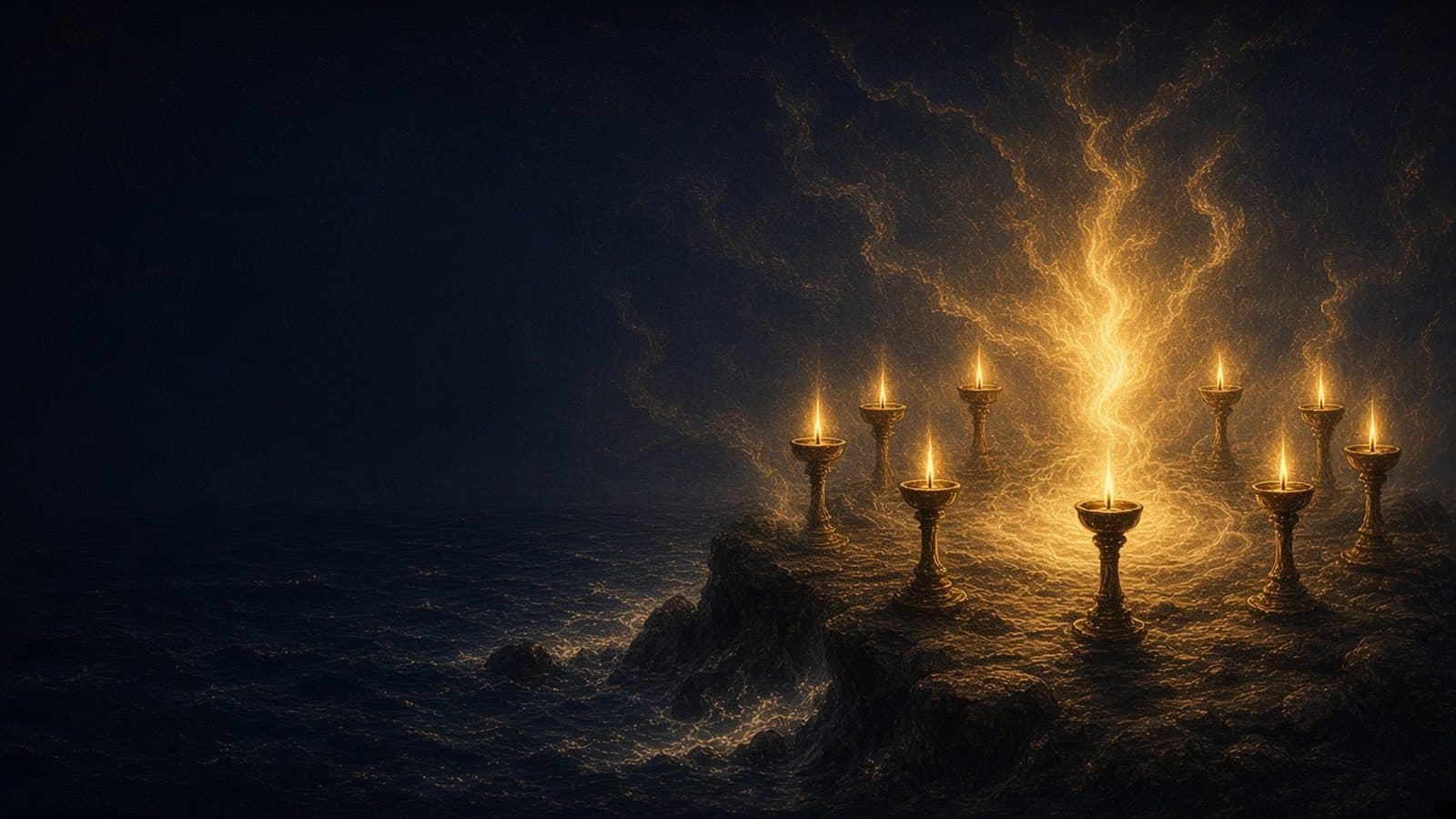
John turns and sees "seven golden lamp stands." Israel's tabernacle held one golden lampstand with seven branches, kept burning by the priests. John's image is different: seven separate stands. Verse 20 will tell us what they are, but the Old Testament background already suggests that God's light now burns in many places at once.
Among them stands "one like a son of man," the figure who came with the clouds in Daniel 7. The robe to his feet and the golden sash suggest dignity, and many scholars see royal and priestly tones. Then the details come quickly, and almost every one is borrowed. "His head and his hair were white as white wool" matches the Ancient of Days in Daniel 7:9, a description of God himself. His eyes are "like a flame of fire," his feet "like burnished brass," and his voice "like the voice of many waters," which echoes Daniel 10 and Ezekiel 1. From his mouth comes "a sharp two-edged sword," a picture of his word as a weapon, like the mouth of the servant in Isaiah 49:2. His face is "like the sun shining at its brightest."
John does not describe a photograph. He is assembling a mosaic of Old Testament glory, tile by tile, until the figure is unmistakable: the man who is God.
1:17On the floor, under a hand
John's response is not curiosity. "When I saw him, I fell at his feet like a dead man." He is an old and seasoned believer, and he still collapses. Holiness does that to us when we see even a little of it. Daniel fell on his face in the same way in Daniel 10, and Ezekiel did in Ezekiel 1. Prophets before him have lain on the ground at the sight of God, and now it is John's turn.
Then comes the tenderness. "He laid his right hand on me, saying, 'Don't be afraid.'" Look at which hand it is. The right hand held the seven stars a moment ago. The hand that holds the churches now rests on one trembling man. The Lord of the universe does not stay at a distance. He touches.
The reason for confidence follows at once: "I am the first and the last." In Isaiah 44:6 and 48:12, this is what the Lord says of himself. Jesus is taking the title that belongs to the God of Israel. The first and the last cannot be late to anything and cannot be outlasted by anyone. That is why John can stop being afraid, even on the ground.
1:18The keys in the hand that was pierced
The next sentence moves from glory to the cross: "I was dead, and behold, I am alive forever and ever." Who says this? The one with eyes of fire and a voice of waters says that he died. John does not hide the cross behind the brilliance. The glorified Christ is still the crucified one, and the death is part of the credentials.
Then: "I have the keys of Death and of Hades." In the ancient world, a key was authority. Hades was the realm of the dead, pictured in Scripture with gates. Jesus does not simply visit it and leave. He holds the keys, which means he decides who goes in and who comes out. For people who had watched friends die for the faith, this was news of the highest order. Death is not a wall at the end of the road. It is a door, and Jesus has the key.
It also answers a quiet fear in John's own situation. Rome could imprison him, and even kill him. But Rome did not hold the keys. The One who was dead and is alive does. Every emperor's power ends where Jesus's begins.
1:19-20A mystery unlocked
Jesus repeats the command to write, and now lists three things: "the things which you have seen, and the things which are, and the things which will happen hereafter." Christians have read this in different ways. Some take it as an outline of the book: the vision of chapter 1, the churches of chapters 2 and 3, and then the future from chapter 4. Others think the three phrases describe one whole prophecy that mixes present and future throughout. Either way, John is told to write down what is true of Christ now and what is coming.
Then Jesus explains the symbols, which is helpful, since John does not always explain. "The seven stars are the angels of the seven assemblies. The seven lamp stands are seven assemblies." The word "angel" simply means messenger, and it is debated whether these are heavenly guardians or human leaders. All agree on the main point. The churches are in Christ's right hand, held and protected, and they are among Christ's lampstands, the places where light is meant to shine. He is both the one who holds them and the one who walks beside them.
The word "mystery" does not mean something hidden for ever. It means something once hidden and now revealed. Jesus has just told us what the symbols mean.
Key words in Revelation 1:9-20
- Son of man (huios anthrōpou)
- A title from Daniel 7, where a human-looking figure comes with the clouds and receives everlasting rule. Jesus used it of himself often. In this vision he wears both human and divine features, as though the two pictures were one person.
- First and last (ho prōtos kai ho eschatos)
- A title the Lord uses of himself in Isaiah. When Jesus takes it, he claims the eternal nature of God, the one who stands before all things and outlasts all things.
- Keys of Death and Hades
- Keys stand for authority to open and shut. Hades is the realm of the dead. Jesus, who died and rose, has taken control of both, so death can no longer hold anyone he intends to release.
- Lamp stands (luchniai)
- Golden lamp holders recalling the lampstand in the tabernacle. They stand for the seven churches, as verse 20 says, and show that the church is meant to carry God's light, with Christ among them.
Cross references
- Daniel 7:9-14The Ancient of Days and the son of man, whose features John blends in one portrait of Jesus.
- Daniel 10:5-9A man in linen with eyes like fire; the prophet falls to the ground in terror, just as John does.
- Ezekiel 1:24-28A voice like many waters and a glory like fire, with the prophet falling on his face.
- Isaiah 44:6The Lord declares himself the first and the last, the title Jesus claims in verse 17.
- Exodus 25:31-40The golden lampstand of the tabernacle, the background to John's lamp stands.
- John 11:25-26Jesus's earlier claim to be the resurrection and the life, now seen in the one who holds the keys.
Part B Three lenses on the text
The Pattern
How the whole Bible speaks here
The Bible has a pattern for the moment God commissions a messenger. The prophet sees a glory, collapses, is lifted up by a word or a touch, and is then given a task. Isaiah sees the Lord in the temple and cries out that he is ruined. Ezekiel falls on his face by a river. Daniel is left with no strength in him. The sequence keeps returning: sight, trembling, raising, sending. John's experience here fits that pattern exactly, and that is the point. He is not an exception. He stands in the line of the prophets.
But look at what is different. In Isaiah, a seraph touches the prophet's lips with a coal. In Daniel, an angel touches him. Here, the touch comes from the figure on the throne itself. The glory that made them all fall is the one who puts out his hand. It is as if the Old Testament had been asking all along who would reach down to the prophets, and chapter 1 says it is the Son of Man himself.
Notice also the single, deliberate word that links Day 1 to today: "first." Jesus is the "firstborn of the dead" in 1:5 and the "first and the last" in 1:17. The frame holds.
The Glory
What this shows us of God
The fiery eyes, the sword, the voice like a waterfall are not decoration. They are the outline of holiness. A God whose eyes are fire sees what is hidden, and a God whose word is a sword is not mocked. The Bible never lets us make Jesus smaller than this.
So why can John stop trembling? Not because the glory dims. It does not. He stops trembling because the One who blazes also says, "I was dead." The fire of God's holiness met our sin on the cross, and Jesus bore it. The hand laid on John is the same hand that was pierced for sinners. A Judge that terrifying could only be approached safely if someone had already stepped in front of the sentence, and Christ did.
There is something else here that is easy to miss. Jesus holds the keys of Death and Hades. That means even death serves his purpose. Every grave on earth, every prison cell and island of exile, sits inside his sovereignty. God's glory is not threatened by suffering. It reigns over it.
And so the deepest joy available to us is not escaping this glory but seeing it from under his hand. Fear that is held by that hand turns to worship. The more clearly we see him, the less there is left to be afraid of.
The Challenge
What it asks of us
Can I be honest about something? Most of us carry around a Jesus that fits in our pocket. He is kind, understanding, and available when we need him, and none of that is wrong. But the Jesus John saw would make most of us go quiet and fall on the floor. We do not do that very often.
I think this matters because the church in the first century was tired, and the answer to their tiredness was not a softer Jesus. It was a bigger one. If he really walks among the lampstands, then he is in our building, in our gatherings, and in our half-listening on Sunday morning. What would change if we believed it? Would we pray differently? Would we show up differently?
And notice John. He calls himself a brother and partner in the oppression. He is not writing from a comfortable chair. Many of us are tempted to assume that suffering means something has gone wrong. John says it is part of the shared life of the kingdom.
Finally, look at the phrase "on the Lord's day." John made room. He seems to have been someone who made room for God, and the vision found him there. When did you last set aside a stretch of time with no screen and no agenda, simply to be in his presence? He is not asking for performance. He is asking for you.
Part C Daily devotional
Reflection
Think about the last time you were truly afraid. Maybe it was a phone call, a scan, a knock at the door. Fear has a way of making the world very small, until there is nothing in it but the thing you dread.
John knew fear. He was an old man on an island, cut off from the people he loved. And then he saw Jesus, and the fear he already had was swallowed up in something much bigger, and he fell like a dead man. This is the part I find astonishing: it was not the end of his story. A hand came down. A voice said, "Don't be afraid."
Hold onto how that sentence arrives. It is not a motivational slogan. It comes from the one who has the keys of Death and Hades, who says "I was dead, and behold, I am alive." He has already walked through the thing you are most afraid of, and he came out the other side with the keys in his hand.
Whatever you are carrying into today, it has not been missed by the One who walks among the lampstands. He knows your name and your church by name. His hand is on you, and it is a steady hand.
Tomorrow the one who walks among the lampstands starts speaking to the churches one by one, beginning with Ephesus. Those eyes of fire, we will find, are searching and tender at once.
Questions for journaling
- What did you picture when you first read the description of Jesus in verses 13 to 16, and which detail do you find hardest to hold together with the Jesus you usually imagine?
- John falls down, and Jesus lifts him. When have you felt the weight of God's holiness, and when have you felt his comfort? Which is more familiar to you right now?
- Verse 18 says Jesus holds the keys of Death and Hades. What fear in your life would look different if you really believed that?
- John made room for worship on the Lord's day. What is one regular, protected space you could give to meeting with Jesus this week?
Prayer
Lord Jesus, I bow before you, the first and the last, the Living One. You burn with a holiness I cannot approach, and yet you lay your right hand on me and say, "Don't be afraid." Thank you that you were dead and are alive for ever, and that you hold the keys of Death and Hades. Hold my fears, and my family, and my church in that same hand. Walk among us, and light our lamps again. Teach me to listen the way John listened, and to worship the way he fell. Amen.
Write down one fear on a slip of paper. Underneath it, copy Revelation 1:17-18 and read it aloud, then fold the paper and keep it in your Bible as a reminder that the keys are in his hand.
and the Living one. I was dead, and behold, I am alive forever and ever. Amen. I have the keys of Death and of Hades.Revelation 1:18 (WEB)
Common questions about Revelation 1:9-20
What is Revelation 1:9-20 about?
On a prison island, John sees the risen Jesus, blazing with the glory of God, holding his churches in his hand and walking among them, and the One who terrifies him is the One who says, "Don't be afraid."
Where does Revelation 1:9-20 fit in the book of Revelation?
Yesterday ended with God himself speaking: the Alpha and the Omega, the Almighty. Now the camera moves from the throne to a single man on a small, rocky island. Patmos lies in the Aegean Sea, off the coast of Roman Asia. John says he is there "because of God's Word and the testimony of Jesus Christ" (WEB). Many scholars think he had been exiled for his preaching, since Rome sometimes banished troublemakers to islands, though John does not spell out the details.
What does “Son of man (huios anthrōpou)” mean in Revelation 1:9-20?
A title from Daniel 7, where a human-looking figure comes with the clouds and receives everlasting rule. Jesus used it of himself often. In this vision he wears both human and divine features, as though the two pictures were one person.
What does “First and last (ho prōtos kai ho eschatos)” mean in Revelation 1:9-20?
A title the Lord uses of himself in Isaiah. When Jesus takes it, he claims the eternal nature of God, the one who stands before all things and outlasts all things.
What does “Keys of Death and Hades” mean in Revelation 1:9-20?
Keys stand for authority to open and shut. Hades is the realm of the dead. Jesus, who died and rose, has taken control of both, so death can no longer hold anyone he intends to release.
How can I apply Revelation 1:9-20 today?
Write down one fear on a slip of paper. Underneath it, copy Revelation 1:17-18 and read it aloud, then fold the paper and keep it in your Bible as a reminder that the keys are in his hand.
What is a good memory verse for Revelation 1:9-20?
Revelation 1:18: “and the Living one. I was dead, and behold, I am alive forever and ever. Amen. I have the keys of Death and of Hades.” (WEB)
Free daily email
The daily study, in your inbox
One passage a day: a careful explanation, three lenses and a short devotional, sent to you by email. Free, and you can stop whenever you like.