Day 28
The Woman on the Beast
Revelation 17:1-18 14 min read WEB
What is Revelation 17:1-18 about?
In short: Babylon is shown as a dazzling, intoxicating, blood-stained power that seduces the nations and devours itself, and the chapter's own answer to her is the Lamb, who overcomes with those who are called, chosen, and faithful.
Passage at a glance
- Passage
- Revelation 17:1-18 (WEB)
- Series
- Revelation, day 28 of 37
- Section
- The Fall of Babylon
- Reading time
- 14 minutes
- Topics
- Babylon, Idolatry, Temptation, Victory, Faithfulness
- Key words
- Babylon, Prostitute (porne), Mystery (mysterion), Seven mountains
- Previous passage
- Revelation 16:12-21
- Next passage
- Revelation 18:1-24
Part A Context
"Babylon the great was remembered in the sight of God." That line, at the end of the seventh bowl, was easy to miss. Today we are introduced to her.
One of the seven bowl-angels takes John into the wilderness and shows him a woman on a scarlet beast. It is one of the most disturbing pictures in the Bible, and it was meant to be. The image of a prostitute is not chosen to insult women. It comes straight out of the prophets, who used it for a city or people that sold its loyalty for money and power (Isaiah 1:21; Nahum 3:4). It is about unfaithfulness, not about sex.
It is also the dark twin of another woman. Chapter 12 gave us a woman clothed with the sun, and chapter 19 will give us a bride. Today's woman is what you become when you give your love to everything except the Lamb.
Part A Explanation
17:1-2The great prostitute
The angel promises to show John "the judgment of the great prostitute who sits on many waters." That is a legal word. Chapter 17 is a courtroom scene, and the verdict has already been given in 14:8 and 16:19.
Her crimes are two. "The kings of the earth committed sexual immorality" with her, and "those who dwell in the earth were made drunken with the wine of her sexual immorality." In the Old Testament, whoring is the standard picture of worshipping other gods and trusting other powers. She seduces kings through politics and ordinary people through wine. The first group give her their loyalty. The second drink in her way of life until they cannot think clearly.
Notice that she "sits on many waters." Jeremiah described the original Babylon in similar words, and that city really was built on rivers and canals. But the angel later gives the interpretation of the waters himself: "peoples, multitudes, nations, and languages" (17:15). Her reach is as wide as humanity.
Whatever Babylon is, then, she is not a small matter. She is a power that has the whole world drinking.
17:3-6Beautiful, rich, and drunk on blood
John is carried "in the Spirit into a wilderness," which is where the other woman, the church, was kept safe in 12:14. There he sees "a woman sitting on a scarlet-colored beast, full of blasphemous names, having seven heads and ten horns." The beast is the one from chapter 13, and she rides it. The empire holds the power, and she directs the desire.
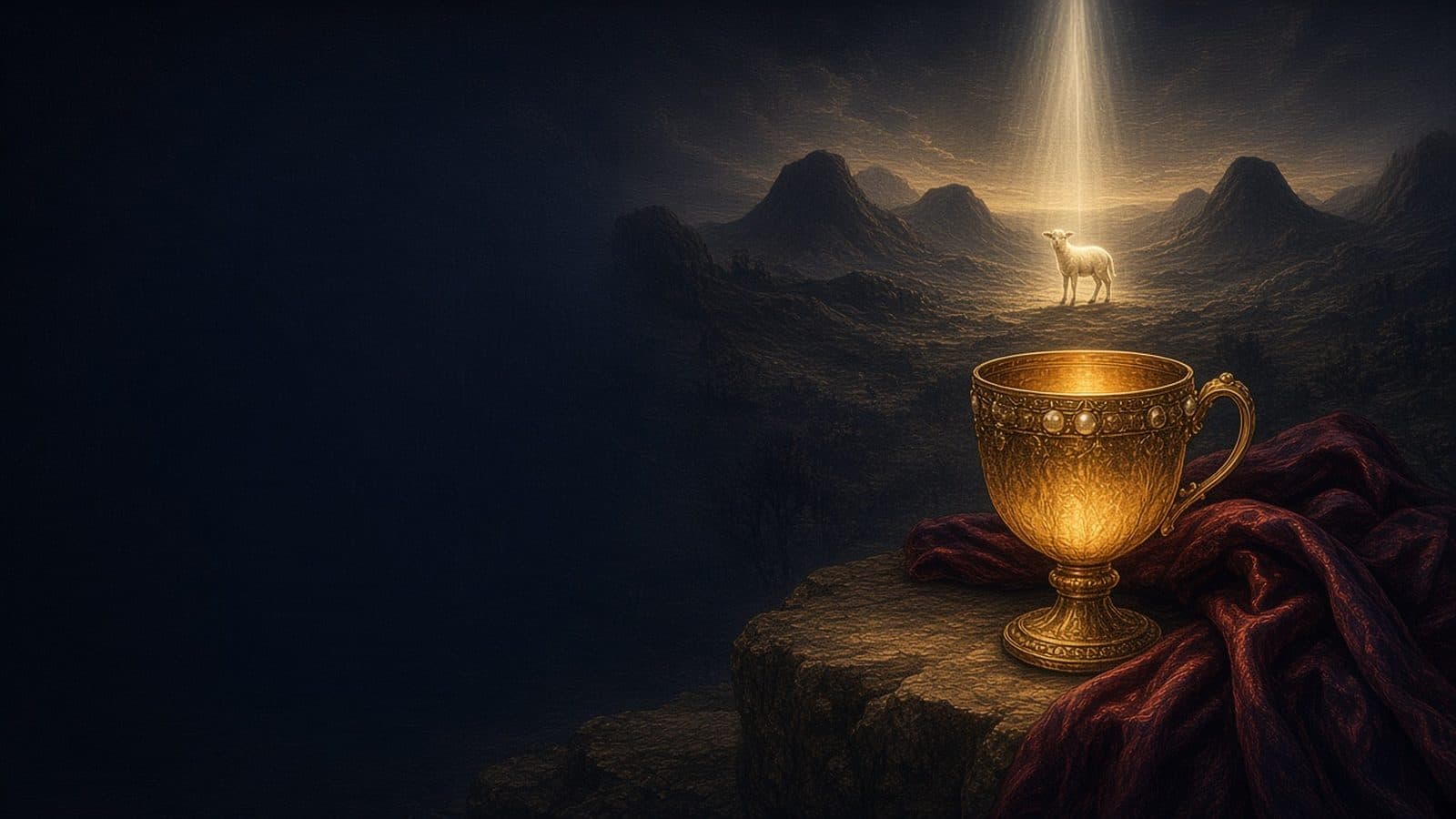
Look at how she is dressed: "purple and scarlet, and decked with gold and precious stones and pearls." She looks magnificent. She holds "a golden cup," and the cup is "full of abominations." That is the whole strategy of temptation in one picture: gold on the outside, filth on the inside. The beauty is real, and so is the poison.
On her forehead is a name: "MYSTERY, BABYLON THE GREAT." Babylon, remember, is where the tower of Babel was built, by people who said, "let's make a name for ourselves" (Genesis 11:4). "Mystery" suggests that this name has a deeper meaning, beyond a single city.
And then the terrible detail: she is "drunken with the blood of the saints, and with the blood of the martyrs of Jesus." The glittering city is built on the bodies of God's people. John says, "I wondered with great amazement." So would we.
17:7-8The beast that was, and is not
The angel asks, "Why do you wonder?" and promises to explain the mystery. First, the beast: "The beast that you saw was, and is not; and is about to come up out of the abyss and to go into destruction."
Hear the echo. Chapter 1 described God as the one "who is and who was and who is to come." The beast tries to copy that. He "was," he "is not," and he "shall be present" again. This is the counterfeit of the Lamb, who was slain and is alive. Rising from the abyss is a very different thing from rising from the grave.
Many scholars think this refers to the ancient story, current in the first century, that Nero would return after his death. Others see a more general pattern in which oppressive power seems to die and then returns in new form. Either way, the beast's resurrection gets the same reaction every time: the world marvels.
The ones who marvel are those "whose names have not been written in the book of life from the foundation of the world." The implication is quiet and wonderful: those whose names are written there are not carried away by the spectacle. John's readers, under pressure, might fear that the beast is unstoppable. The angel's answer is that the beast's power can dazzle the world, but it cannot touch what is written in heaven.
17:9-14Seven mountains, ten kings, one Lamb
"Here is the mind that has wisdom," the angel says, and then gives a puzzle. "The seven heads are seven mountains on which the woman sits. They are seven kings." Five have fallen, one is, one is yet to come, and the beast himself is an eighth who belongs to the seven.
For the first readers, the seven mountains would have sounded very much like Rome, which was widely known as the city on seven hills. That is why many scholars hold that Babylon here stands first of all for Rome and its empire. Others agree that Rome was in view but think the seven are symbolic of completeness, so that Babylon represents the world's rebellious powers in every age. A third group looks to a future form of the same thing. Careful readers have disagreed on how to count the kings, and I would be cautious about anyone who is too sure.
The ten horns are "ten kings who have received no kingdom as yet," who give their power to the beast "for one hour." And then comes the sentence that matters most in the chapter: "These will war against the Lamb, and the Lamb will overcome them, for he is Lord of lords, and King of kings, and those who are with him are called chosen and faithful."
Whatever the numbers mean, the outcome is not in doubt. The Lamb who was slain wins by the cross. And he does not fight alone. His people are with him.
17:15-18The city that devours itself
The last scene is a shock. The beast and the ten horns, her former partners, "will hate the prostitute, will make her desolate, will strip her naked, will eat her flesh, and will burn her utterly with fire."
That is how corrupt power ends. It consumes its own. The ones who were seduced eventually turn on the seducer, because a system built on greed and fear has no loyalty left when it runs dry.
Then comes a line that is easy to read past: "For God has put in their hearts to do what he has in mind." Even the destruction of Babylon is not an accident of politics. The writer of Proverbs said, "The king's heart is in Yahweh's hand like the watercourses. He turns it wherever he desires" (Proverbs 21:1). The wicked do their own will, and the Lord uses it to bring about his.
Finally the angel names her: "The woman whom you saw is the great city, which reigns over the kings of the earth." In John's day, only one city did that. Yet the language is wider than one century, and that is why the chapter has spoken to Christians under many empires.
Notice what the passage does not do. It does not give us a list of present governments to point at. It gives us a pattern to recognise, a seduction to refuse, and a Lamb to follow.
Key words in Revelation 17:1-18
- Babylon
- In the Old Testament, the empire that destroyed Jerusalem and the city of Babel's proud tower. In Revelation it is a name for the seductive, persecuting world power that rivals God, and many scholars see Rome as its first-century form.
- Prostitute (porne)
- A prophetic image for spiritual unfaithfulness, trusting wealth, power, or other gods instead of the Lord. It describes a city's allegiance, not a group of people.
- Mystery (mysterion)
- A hidden meaning now being explained. The name on her forehead signals that Babylon is more than a single city or a single century.
- Seven mountains
- Probably the seven hills of Rome for the first readers, and for many also a symbol of complete worldly power. Scholars debate the sevenfold kings that go with it.
Cross references
- Nahum 3:4Nineveh is called a prostitute who sells nations, the prophetic background to the image of a city that seduces.
- Genesis 11:4Babel's builders want to make a name for themselves, the beginning of the Babylon story.
- Jeremiah 51:7Babylon as a golden cup in the Lord's hand that made the nations drunk.
- Proverbs 21:1The king's heart is in the Lord's hand, behind the line about God putting his purpose in the kings' hearts.
- Revelation 19:7-9The other woman: the Lamb's bride, clothed in pure linen, invited to the supper.
- Revelation 5:9The Lamb's blood buys people for God from every nation, the opposite of the blood the woman drinks.
Part B Three lenses on the text
The Pattern
How the whole Bible speaks here
This chapter is half of a pair. John is carried away "in the Spirit" twice in the last part of the book, and both times an angel from the seven bowls shows him a woman. In 17:1-3 he is taken to a wilderness to see the prostitute. In 21:9-10 the same kind of angel carries him "in the Spirit" to a great, high mountain to see the bride, the holy city, Jerusalem. Same guide, same method, opposite women.
Put them side by side. One city sits on many waters and the other has the river of life flowing through it. One is dressed in purple, scarlet, and jewels she has gathered, and the other in fine linen given to her. One carries a cup of abominations and the other receives the water of life. One has a name on her forehead that says "Mystery, Babylon," and the other belongs to the Lamb. We are being asked a question: which city are you building your life toward?
There is also an important contrast in place. The woman sits on the beast and is carried by it, and the bride walks beside the Lamb. The one is borne along by power. The other is led by love. It is the pattern of the whole book: two kingdoms, two loves, two destinies, and no neutral ground between them.
The Glory
What this shows us of God
Look at where God puts the Lamb in a chapter of such horror. In the middle of all this dread, a single sentence stands up: "the Lamb will overcome them, for he is Lord of lords, and King of kings."
The reason it can be said so calmly is that the Lamb has already overcome. He did not win by out-fighting the beast. He won by being killed. Heaven sings to the Lamb that he "bought us for God with your blood, out of every tribe, language, people, and nation" (5:9). The woman drinks the blood of God's people, and the Lamb gave his own blood to rescue them. That difference is the difference between the two cities. One lives by taking life, and the other by giving it.
And God is not only the judge of Babylon. He is the one who gathered a people out of her. Chapter 18 will say, "Come out of her, my people" (18:4). That is a mercy. The one who judges the seducing city first calls his people out of it. There is a door, and it is open now.
Everything glittering about Babylon is borrowed. Everything about the Lamb is his own. It is hard to find a better reason to worship him.
The Challenge
What it asks of us
Here is the uncomfortable truth about this chapter. Nobody reading it thinks the woman looks like a monster. That is the point. She is dressed in gold and pearls. The cup is golden. Nothing about her looks dangerous.
So where might she be in your life? I mean the pull toward comfort, status, and approval that does not feel like idolatry because it looks respectable. Not necessarily scandalous sin, but the steady, polite invitation to love the world's cup because everyone else seems to be drinking from it.
Do not use this chapter to point at other people, or to decide who counts as Babylon. Ask the sharper question: what in me is drinking her wine? What do I fear to lose, what do I long to be admired for, what would I quietly compromise to keep?
Then take one concrete step. Choose one habit, one purchase, one relationship, or one silence that has been shaped more by the world's approval than by loyalty to Jesus, and change it this week. You do not need to retreat from everyday life. You need to be loyal to the Lamb in the middle of it. Those who are with him are called, chosen, and faithful, and faithful is something you can be today.
Part C Daily devotional
Reflection
Remember a time when something beautiful tugged at you. I do not mean something obviously wrong. I mean something shiny. A better job, a bigger house, a place in the right crowd, a version of your life that would impress people.
The golden cup in this chapter is exactly that. What makes it dangerous is that it is lovely. If the contents were visible, nobody would drink. The poison is hidden under the gold.
And the passage is gentle with us in one way. It does not tell us the cup is ugly. It tells us the truth about what is inside, and then it gives us a better thing to love. The Lamb is not less beautiful than Babylon. He is far more. He is Lord of lords and King of kings, and he gives what the woman only promises: joy that does not rot, belonging that does not use you, a table where you are wanted for who you are.
So the way to resist Babylon is not mostly to scowl at her. It is to look at Jesus until she loses her glitter. When you feel the pull today, name it quietly, thank God that you have been bought with something better than gold, and turn your eyes towards the one who loves you.
Tomorrow the city falls. And we will hear the voice calling his people out of it.
Questions for journaling
- The woman is beautiful and the cup is golden. Where do you find yourself drawn to things that look good but pull you away from loyalty to Jesus?
- The beast and the ten kings end up destroying the woman. What does that say about the promises made by anything that seduces us?
- Many Christians have seen Rome, a world system, or something yet to come in this chapter. Why do you think the Spirit left the image broad enough to speak to many generations?
- What does it mean for you that those with the Lamb are 'called, chosen, and faithful'? Which of those three words do you most need to hear today?
Prayer
Lord Jesus, Lamb who was slain and who is Lord of lords, thank you that you bought me with your blood. Show me what is really in the cups I find attractive. Forgive me for the loyalties I have given away to comfort, to status, and to the approval of people. Keep me from judging others while I ignore my own heart. Teach me to love you more than anything the world can offer, and make me faithful where I am. I trust that you will overcome. Amen.
Write down one thing you tend to chase because it looks impressive or comfortable. Pray over it for a few minutes, asking what Jesus thinks of it, and then take one small step this week to loosen its hold.
These will war against the Lamb, and the Lamb will overcome them, for he is Lord of lords, and King of kings, and those who are with him are called chosen and faithful.Revelation 17:14 (WEB)
Common questions about Revelation 17:1-18
What is Revelation 17:1-18 about?
Babylon is shown as a dazzling, intoxicating, blood-stained power that seduces the nations and devours itself, and the chapter's own answer to her is the Lamb, who overcomes with those who are called, chosen, and faithful.
Where does Revelation 17:1-18 fit in the book of Revelation?
"Babylon the great was remembered in the sight of God." That line, at the end of the seventh bowl, was easy to miss. Today we are introduced to her.
What does “Babylon” mean in Revelation 17:1-18?
In the Old Testament, the empire that destroyed Jerusalem and the city of Babel's proud tower. In Revelation it is a name for the seductive, persecuting world power that rivals God, and many scholars see Rome as its first-century form.
What does “Prostitute (porne)” mean in Revelation 17:1-18?
A prophetic image for spiritual unfaithfulness, trusting wealth, power, or other gods instead of the Lord. It describes a city's allegiance, not a group of people.
What does “Mystery (mysterion)” mean in Revelation 17:1-18?
A hidden meaning now being explained. The name on her forehead signals that Babylon is more than a single city or a single century.
How can I apply Revelation 17:1-18 today?
Write down one thing you tend to chase because it looks impressive or comfortable. Pray over it for a few minutes, asking what Jesus thinks of it, and then take one small step this week to loosen its hold.
What is a good memory verse for Revelation 17:1-18?
Revelation 17:14: “These will war against the Lamb, and the Lamb will overcome them, for he is Lord of lords, and King of kings, and those who are with him are called chosen and faithful.” (WEB)
Free daily email
The daily study, in your inbox
One passage a day: a careful explanation, three lenses and a short devotional, sent to you by email. Free, and you can stop whenever you like.